
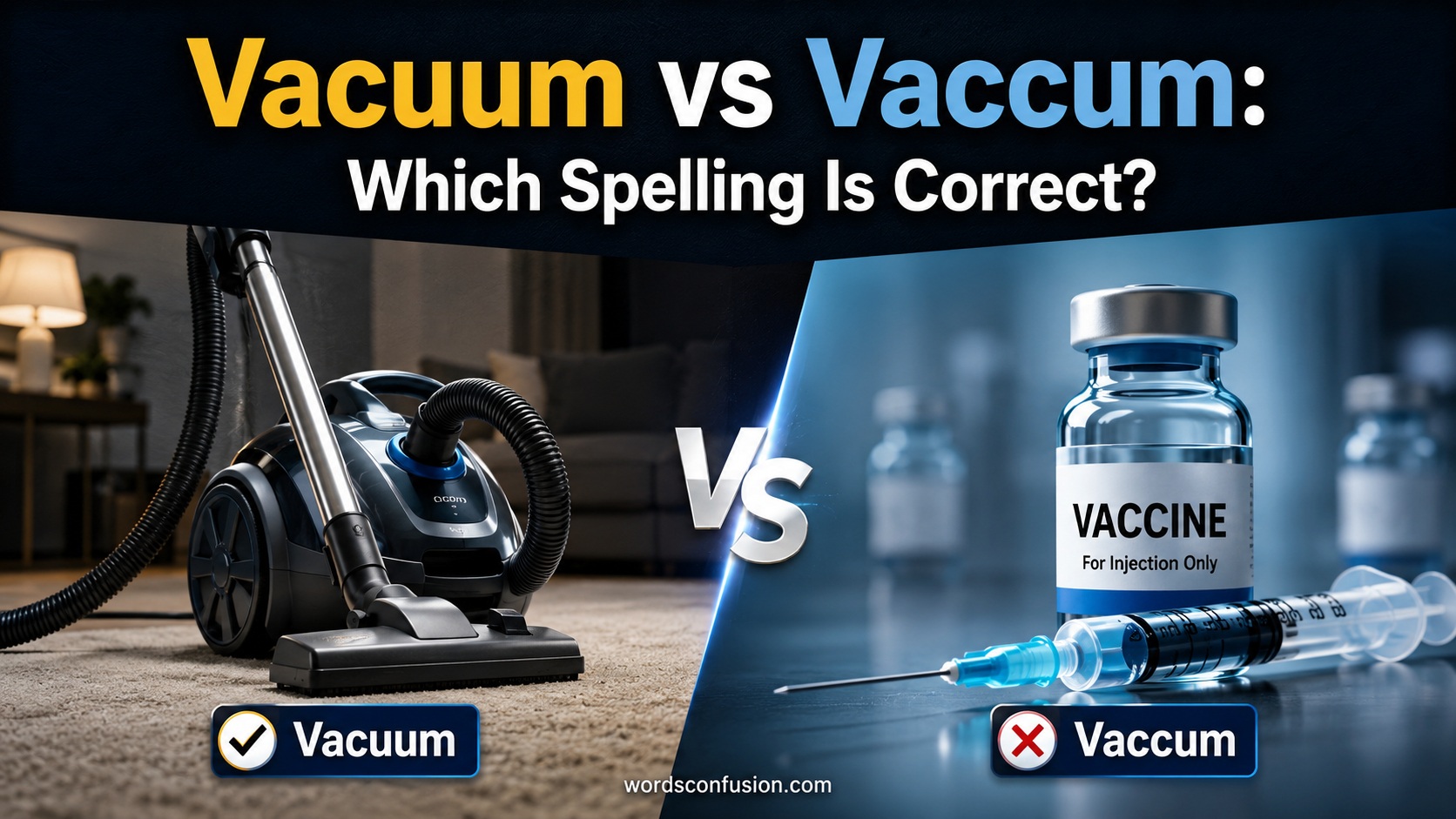
Have you ever typed vaccum and wondered whether something looked slightly off? You’re not alone. Vacuum vs vaccum is a common spelling confusion because both versions look almost identical at first glance. The difference comes down to just two letters, yet only one spelling works in standard English.
The correct spelling is vacuum. The spelling vaccum is incorrect.
This word often causes trouble because vacuum contains an unusual sequence of two consecutive u’s. Many people expect the word to follow a more familiar pattern and accidentally replace the second u with another c. That small change creates the common misspelling vaccum.
In this guide, you’ll learn the difference between vacuum and vaccum, discover why the correct word contains two u’s, explore its meanings and grammar, and see plenty of examples that make the spelling easy to remember.
Quick Answer: Vacuum vs Vaccum
Vacuum is the correct spelling. Vaccum is a misspelling.
The correct spelling is:
V-A-C-U-U-M
The incorrect spelling is:
V-A-C-C-U-M
The easiest way to remember it is:
Vacuum = one C + two U’s
Examples:
- Correct: I need to vacuum the carpet.
- Incorrect: I need to vaccum the carpet.
The word vacuum can refer to an empty space, a cleaning machine, or the act of cleaning with a vacuum cleaner. Vaccum has no standard meaning in English because it is simply a spelling error.
Vacuum vs Vaccum: Comparison Table
| Spelling | Correct? | Meaning | Example |
| Vacuum | Yes | An empty space, a cleaning machine, or the act of cleaning | I need to vacuum the living room. |
| Vaccum | No | No standard English meaning | “Vaccum” is a common misspelling of “vacuum.” |
The difference looks tiny, but spelling accuracy matters. A single letter can turn a standard English word into an error that spell-check software immediately flags.
Why Is Vacuum the Correct Spelling?
The correct spelling is vacuum, with one c followed by two u’s. The word follows a spelling pattern that may look unusual to modern English readers.
The word comes from Latin vacuus, meaning “empty” or “vacant.” English adopted the word through scientific and scholarly usage. Its connection to the idea of emptiness remains clear in meanings such as:
- An empty space
- A space containing very little matter
- A lack of something
- A machine that removes dirt by suction
The unusual uu sequence often catches people off guard. English contains many familiar letter patterns, but vacuum stands out because the two vowels appear together in the middle of the word.
Here’s the correct structure:
VAC + UUM = VACUUM
Not:
VAC + CUM = VACCUM
That second version may look visually familiar, but it doesn’t follow the standard spelling of the word.
Why Do People Spell Vacuum as Vaccum?
The vacuum vs vaccum confusion usually comes from the word’s unusual appearance. Several factors make the error especially common.
The Double-C Confusion
Many English words contain cc, including:
- accident
- accommodate
- success
- occasion
- necessary
Because cc appears frequently in English spelling, some writers instinctively insert a second c into vacuum.
The problem is that vacuum doesn’t follow that pattern. It contains only one c.
A writer may hear the strong k sound in the word and mentally connect it with spellings that use cc. However, English spelling doesn’t always allow pronunciation to dictate the letters.
The Unusual “UU” Combination
The biggest reason people write vaccum is probably the strange-looking uu combination.
When you see vacuum, the middle of the word looks unusual:
v a c u u m
Some people unconsciously simplify the spelling or replace the second u with a letter that feels more familiar. As a result, they write:
v a c c u m
That spelling may seem more comfortable visually, but it is incorrect.
Pronunciation Doesn’t Reveal the Spelling
In American English, vacuum is commonly pronounced approximately like VAK-yoom.
The pronunciation doesn’t clearly tell you that the word contains two u’s. That’s where the spelling problem begins.
Consider the difference:
- Pronunciation: VAK-yoom
- Spelling: V-A-C-U-U-M
The sound gives you no obvious reason to expect two consecutive u’s. Therefore, memorizing the spelling remains the safest approach.
What Does Vacuum Mean?
The word vacuum has several meanings. Its meaning depends on how you use it in a sentence.
Vacuum as a Space With Little or No Matter
In science, a vacuum refers to a space containing very little matter.
A perfect vacuum would contain no matter at all. In reality, creating a completely perfect vacuum is extremely difficult. Most practical vacuums contain tiny amounts of particles.
For example:
Scientists use a vacuum chamber to create controlled conditions for experiments.
The word also appears frequently in physics, engineering, astronomy, and space science.
Outer space is often described as a near-vacuum because it contains far fewer particles than Earth’s atmosphere.
Vacuum as a Cleaning Machine
In everyday conversation, vacuum commonly refers to a vacuum cleaner.
For example:
The vacuum is in the closet.
In this sentence, vacuum acts as a noun referring to the machine used to remove dirt, dust, hair, and other debris from surfaces.
Common types of vacuum cleaners include:
- Upright vacuums
- Canister vacuums
- Handheld vacuums
- Stick vacuums
- Cordless vacuums
- Robot vacuums
- Wet-and-dry vacuums
Although vacuum cleaner is the complete term, people commonly shorten it to simply vacuum.
Vacuum as a Verb
Vacuum can also function as a verb.
When you vacuum something, you clean it using a vacuum cleaner.
Examples:
- I vacuum the living room every Saturday.
- She vacuumed the stairs before the guests arrived.
- They are vacuuming the office.
This usage makes vacuum an interesting word because it can describe both the machine and the action performed with the machine.
Vacuum as a Figurative Concept
The word vacuum also appears in figurative expressions.
The phrase “in a vacuum” means considering something without considering its surrounding circumstances or outside influences.
For example:
You can’t evaluate the decision in a vacuum.
This means you shouldn’t judge the decision without considering the facts, circumstances, or consequences surrounding it.
The word also appears in phrases such as:
- Power vacuum
- Political vacuum
- Leadership vacuum
- Information vacuum
In each case, the word suggests an absence or gap.
Vacuum Used in Different Parts of Speech
The word vacuum can function in several grammatical roles.
| Part of Speech | Meaning | Example |
| Noun | A space containing little or no matter | The experiment took place in a vacuum. |
| Noun | A cleaning machine | The vacuum is in the garage. |
| Verb | To clean using a vacuum cleaner | I vacuum the carpet every week. |
| Adjective in compounds | Related to vacuum technology or conditions | The vacuum chamber remained sealed. |
This flexibility explains why vacuum appears in both everyday conversations and technical writing.
Correct Spelling: Vacuum
The correct spelling contains six letters:
V-A-C-U-U-M
The most important part is the middle:
CUU
That means:
- One C
- Two consecutive U’s
A useful visual breakdown looks like this:
VA + C + UU + M
Or:
VAC + UUM
The spelling vaccum changes this pattern by adding an extra c and removing one u.
Correct:
VACUUM
Incorrect:
VACCUM
The difference is easy to overlook when you’re typing quickly. That’s why the spelling deserves special attention.
Incorrect Spelling: Vaccum
Vaccum is not the standard spelling of the word.
It commonly appears when someone accidentally:
- Adds a second c
- Removes one of the two u’s
- Relies on pronunciation instead of spelling
- Types quickly without checking the word
Examples:
- Incorrect: I need to vaccum the bedroom.
- Correct: I need to vacuum the bedroom.
- Incorrect: The vaccum cleaner is broken.
- Correct: The vacuum cleaner is broken.
- Incorrect: The sample was placed in a vaccum chamber.
- Correct: The sample was placed in a vacuum chamber.
If you see vaccum in a document, email, essay, or article, replace it with vacuum.
Vacuum vs Vaccum in Sentences
Seeing the word in context makes the spelling difference easier to remember.
Correct Examples With Vacuum
- I need to vacuum the living room before dinner.
- The vacuum cleaner stopped working this morning.
- The spacecraft traveled through the vacuum of space.
- The researchers placed the material inside a vacuum chamber.
- You shouldn’t make an important decision in a vacuum.
- She vacuumed the entire house before the family arrived.
- The new vacuum removes dust from carpets efficiently.
- The laboratory uses a high-quality vacuum pump.
- A power vacuum developed after the leader resigned.
- The company sealed the food in a vacuum package.
Each example uses vacuum, never vaccum.
Incorrect Examples With Vaccum
The following examples contain the common spelling mistake:
- Incorrect: I need to vaccum the carpet.
- Correct: I need to vacuum the carpet.
- Incorrect: The vaccum cleaner is in the hallway.
- Correct: The vacuum cleaner is in the hallway.
- Incorrect: The scientist created a vaccum inside the chamber.
- Correct: The scientist created a vacuum inside the chamber.
- Incorrect: She vaccumed the entire apartment.
- Correct: She vacuumed the entire apartment.
Notice that the mistake can also appear in related forms. The correct base spelling always begins with vacuum.
Common Word Combinations With Vacuum
Learning common phrases can help you recognize the correct spelling naturally.
Everyday Vacuum Combinations
You may encounter these expressions in daily life:
- vacuum cleaner
- vacuum bag
- vacuum hose
- vacuum filter
- vacuum motor
- vacuum power
- vacuum attachment
- vacuum brush
- vacuum cord
- vacuum seal
For example:
The vacuum filter needs to be cleaned regularly.
Scientific and Technical Combinations
The word also appears in technical contexts:
- vacuum chamber
- vacuum pump
- vacuum pressure
- vacuum tube
- vacuum system
- vacuum technology
- vacuum gauge
- vacuum environment
- vacuum furnace
- vacuum deposition
These terms appear in fields such as engineering, manufacturing, physics, chemistry, and electronics.
Figurative Combinations
In figurative language, common expressions include:
- in a vacuum
- power vacuum
- political vacuum
- leadership vacuum
- information vacuum
For example:
A leadership vacuum can create confusion within an organization.
Here, vacuum doesn’t refer to a cleaning machine. Instead, it describes an absence of leadership.
Read More: Threshold vs Threshhold: Which Spelling Is Correct?
Common Words Related to Vacuum
The word vacuum belongs to a broader group of words connected to emptiness, absence, or lack.
Vacuous
Vacuous means lacking meaningful thought, intelligence, or content.
Example:
The speech sounded impressive but ultimately felt vacuous.
Vacancy
A vacancy refers to an empty space or an unoccupied position.
Examples:
- There is a vacancy in the apartment building.
- The company advertised a job vacancy.
Vacant
Vacant means empty or unoccupied.
Example:
The building has remained vacant for several years.
Vacate
Vacate means to leave a place.
Example:
The tenants must vacate the property by the end of the month.
Evacuate
Evacuate means to remove people from a dangerous area or to leave such an area.
Example:
Officials ordered residents to evacuate the region.
These words share historical connections with the idea of emptiness. However, their spellings differ. Knowing related words can help you understand the meaning of vacuum, but you still need to memorize its unusual uu spelling.
How to Remember the Spelling of Vacuum
The best spelling tricks are simple enough to use instantly.
Remember: Vacuum Has Room for Two U’s
A vacuum represents an empty space.
You can use that idea as a memory trick:
A vacuum has room for two U’s.
The phrase connects the meaning with the spelling.
VACUUM = one C + two U’s
This is probably the easiest reminder.
Use the “One C, Two U’s” Rule
When you hesitate between vacuum and vaccum, ask yourself:
Does the word have one C and two U’s?
If yes, you have the correct spelling:
VACUUM
If you see two c’s, you’ve written the common mistake:
VACCUM
Break the Word Into Parts
Instead of trying to memorize all six letters at once, divide the word:
VAC + UUM
Then combine the parts:
VAC + UUM = VACUUM
This technique works especially well for words that contain unusual letter patterns.
Write It in a Short Sentence
Memorizing a word in context often works better than repeating it alone.
Try:
I vacuum the floor.
The sentence gives the spelling a purpose. With repeated exposure, vacuum begins to look natural.
Vacuum Pronunciation
In American English, vacuum is commonly pronounced approximately:
VAK-yoom
The exact pronunciation may vary slightly depending on regional accent and speaking style.
The pronunciation creates part of the spelling problem because the word’s sound doesn’t clearly reveal the two u’s.
You hear something like:
VAK-yoom
But you write:
VACUUM
That mismatch explains why people sometimes rely on an incorrect spelling such as vaccum.
A useful rule applies here:
When pronunciation doesn’t clearly reveal the spelling, memorize the written form.
FAQs:
Is “vaccum” a correct spelling?
No. Vaccum is an incorrect spelling. The correct spelling is vacuum.
Why is vacuum spelled with two U’s?
The spelling reflects the word’s historical development and connection to Latin vacuus, meaning “empty.” The two u’s make the spelling unusual compared with many common English words.
How do you spell vacuum correctly?
Spell it:
V-A-C-U-U-M
The simplest memory trick is one C and two U’s.
What is the difference between vacuum and vaccum?
Vacuum is the correct English spelling. Vaccum is a misspelling.
For example:
- Correct: I need to vacuum the floor.
- Incorrect: I need to vaccum the floor.
Is vacuum both a noun and a verb?
Yes.
As a noun:
The vacuum is in the closet.
As a verb:
I vacuum the floor every morning.
What is the past tense of vacuum?
The past tense is vacuumed.
Example:
I vacuumed the entire house yesterday.
Is “vacuuming” spelled with two U’s?
Yes.
The correct spelling is:
vacuuming
Example:
She is vacuuming the living room.
Is “vacuum cleaner” the only correct phrase?
No. Both vacuum cleaner and vacuum are correct.
In everyday conversation, people often say:
I need a new vacuum.
The longer term vacuum cleaner provides more detail.
How can I remember vacuum vs vaccum?
Use this simple rule:
Vacuum has one C and two U’s.
You can also remember:
VAC + UUM = VACUUM
Conclusion:
When choosing between vacuum vs vaccum, the answer is clear: vacuum is the correct spelling.
Remember the key pattern:
V-A-C-U-U-M
The word contains one C and two U’s. The spelling vaccum is a common mistake caused by the unusual uu combination and the strong k sound in pronunciation.
Whether you’re talking about a cleaning machine, an empty space, a scientific chamber, or a figurative absence of something, the correct word remains vacuum.
So the next time you hesitate, don’t let the unusual spelling throw you off. Think one C, two U’s.
Correct: Vacuum
Incorrect: Vaccum

Andrew Wilson is an experienced language researcher and content writer specializing in WordsConfusion topics. He helps readers understand commonly confused English words, spelling differences, grammar rules, word meanings, and proper usage through clear explanations, practical examples, and easy-to-follow language guides. His goal is to make English learning simple, accurate, and accessible for students, writers, professionals, and everyday learners.