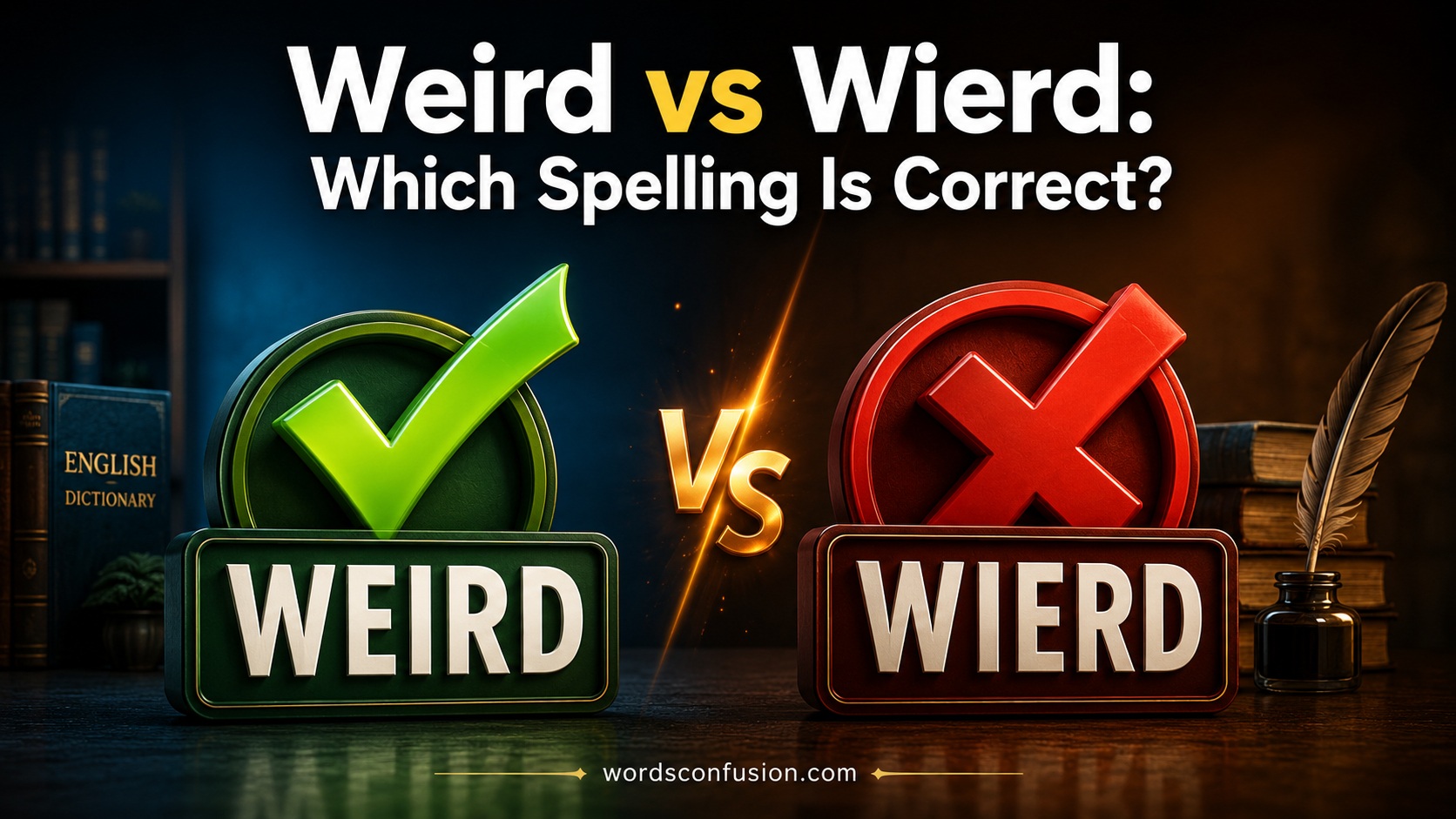
Have you ever typed wierd and then paused because it somehow looked right? You’re not alone. Weird vs Wierd is one of the most common spelling confusions in English because the correct spelling doesn’t follow the pattern many people expect.
The answer is simple: weird is correct, while wierd is a misspelling.
The confusion usually comes from the unusual letter order ei in weird. Many people remember the familiar spelling rule “i before e” and instinctively write wierd. Unfortunately, English spelling has plenty of exceptions, and weird is one of them.
In this guide, you’ll learn the difference between weird and wierd, what weird means, how to pronounce it, why people misspell it, and several easy ways to remember the correct spelling permanently.
Quick Answer: Is It Weird or Wierd?
Weird is the correct spelling.
Wierd is an incorrect spelling when you mean something strange, unusual, or bizarre.
| Spelling | Correct? | Meaning |
| Weird | Yes | Strange, unusual, or unexpected |
| Wierd | No | Common misspelling of weird |
Correct Example
That was a weird experience.
Incorrect Example
That was a wierd experience.
A quick rule makes the difference easy:
If you mean strange or unusual, spell it WEIRD.
What Does Weird Mean?
Weird is an adjective that describes something strange, unusual, unexpected, or difficult to explain.
You can use it for almost anything that feels outside the ordinary. A strange sound can be weird. An unusual coincidence can be weird. A person’s behavior can seem weird. Even a dream can feel weird.
For example:
- I had a weird dream last night.
- That was a weird question.
- The computer made a weird noise.
- She has a weird sense of humor.
- It was weird seeing my old school again.
The word doesn’t always carry a negative meaning. Context matters.
If someone says, “That movie was weird,” they might mean it was confusing, creative, disturbing, funny, or simply unusual. The surrounding situation tells you what kind of “weird” they mean.
Weird as an Adjective
The most common use of weird is as an adjective.
An adjective describes a noun. Therefore, weird can describe a person, place, thing, event, feeling, or experience.
Examples include:
- a weird idea
- a weird sound
- a weird coincidence
- a weird dream
- a weird situation
- a weird feeling
Consider this sentence:
I heard a weird noise in the kitchen.
Here, weird describes the noun noise. It tells you that the sound seemed unusual or unfamiliar.
Weird as a Noun
Weird can also function as a noun in certain contexts. However, this use is much less common in everyday American English.
The noun weird can refer to something supernatural, mysterious, or uncanny. Literary and fantasy writing sometimes uses the word in this way.
For example:
The story was filled with the weird and supernatural.
In ordinary conversation, however, most people use weird as an adjective.
Weird as a Verb
In informal English, you may also encounter the phrase weird out.
To weird someone out means to make that person feel uncomfortable, nervous, or unsettled.
Examples:
- That horror movie weirded me out.
- The strange sound weirded everyone out.
- Don’t weird yourself out before the presentation.
The past-tense form is usually weirded out.
What Does Wierd Mean?
In standard modern English, wierd is not the correct spelling of the word meaning strange or unusual.
When someone writes wierd, they usually intend to write weird but place the vowels in the wrong order.
For example:
❌ That is very wierd.
✅ That is very weird.
The misspelling appears frequently because wierd looks visually plausible. English contains many words with the letters ie, so the incorrect version can seem natural at first glance.
However, when you mean “strange,” weird is the spelling you should use.
Weird vs Wierd: What Is the Main Difference?
The main difference between weird and wierd is simple: weird is the correct English spelling, while wierd is a spelling mistake.
| Feature | Weird | Wierd |
| Standard English spelling | Yes | No |
| Meaning “strange” | Yes | No |
| Appropriate for formal writing | Yes | No |
| Common spelling error | No | Yes |
| Correct dictionary form | Yes | No |
The two spellings don’t represent two different meanings. In most cases, wierd is simply an incorrect attempt to spell weird.
That distinction matters in school assignments, professional writing, blog posts, emails, and applications. A single typo may go unnoticed. Repeated spelling errors, however, can make your writing look careless.
Why Do People Spell Weird as Wierd?
The spelling wierd feels natural to many English speakers for several reasons.
The “I Before E” Rule Creates Confusion
Many people learn this spelling rule:
I before E except after C.
This rule helps with words such as:
- believe
- field
- piece
After learning that pattern, people may instinctively write wierd.
But weird does not follow that pattern. It contains ei, not ie.
The problem is that the rule itself has many exceptions. English spelling is full of them.
Consider these words:
- weird
- their
- foreign
- leisure
- either
- height
They don’t all follow the simple pattern people remember from childhood.
So, when you write weird, don’t rely on the “i before e” rule. Remember the word itself.
The Pronunciation Doesn’t Make the Spelling Obvious
The pronunciation of weird sounds roughly like “weerd.”
That pronunciation doesn’t clearly tell you whether the middle letters should be ie or ei. When pronunciation fails to reveal the spelling, people often rely on visual memory.
That’s why a person might know exactly what the word means yet still hesitate between:
- weird
- wierd
English has many words where pronunciation and spelling don’t line up neatly. Weird is a classic example.
Wierd Looks Familiar
The incorrect spelling wierd can look right simply because the letter combination ie appears in many common English words.
For example:
- friend
- piece
- field
- believe
- chief
That familiarity can trick your eyes. The word looks reasonable even though the letters appear in the wrong order.
A useful strategy involves focusing on the correct visual pattern:
w + ei + rd = weird
Once you see the correct form often enough, wierd begins to look unusual.
How to Remember the Correct Spelling of Weird
Spelling becomes much easier when you connect the word to a simple memory trick.
Use the “WE” Memory Trick
Break the word into two parts:
WE + IRD = WEIRD
The word begins with WE, not WIE.
So remember:
WEIRD starts with WE.
This small trick works because the first three letters immediately remind you which vowel comes first.
Remember: “Weird Is Weird”
The spelling itself is unusual.
That gives you a simple memory association:
The spelling of weird is weird.
The word contains the unexpected sequence ei. In other words, the unusual word has an unusual spelling pattern.
Focus on the EI Combination
The middle of the word is:
w-E-I-r-d
The letters E and I appear in that order.
Not:
w-I-E-r-d
but:
w-E-I-r-d
This visual method works especially well if you often make the same spelling mistake.
Use a Simple Mental Sentence
Try remembering:
Weird people write “weird” correctly.
It sounds silly. That’s precisely why it can stick.
A memorable phrase often works better than memorizing an abstract spelling rule.
Weird Pronunciation: How Do You Say It?
In American English, weird is commonly pronounced approximately like “weerd.”
Its pronunciation is represented in the International Phonetic Alphabet as /wɪrd/.
It sounds similar to words such as:
- bird
- word
- heard
The exact sound can vary slightly depending on a speaker’s accent. Still, the pronunciation remains recognizable across standard varieties of English.
The incorrect spelling wierd doesn’t represent a separate standard pronunciation. If someone writes wierd, they usually still intend to say weird.
Weird vs Wierd in a Sentence
Seeing the correct spelling in real sentences makes the difference easier to remember.
Correct Examples With Weird
- That was a weird coincidence.
- I had a weird dream last night.
- The weather has been weird this week.
- He has a weird sense of humor.
- I heard a weird noise outside.
- This situation is getting weird.
- She had a weird feeling about the deal.
- That was one of the weirdest conversations I’ve ever had.
Incorrect Examples With Wierd
The following sentences contain the common spelling mistake:
- That was a wierd coincidence.
- I had a wierd dream.
- This situation is getting wierd.
- He has a wierd sense of humor.
The corrected versions use weird:
- That was a weird coincidence.
- I had a weird dream.
- This situation is getting weird.
- He has a weird sense of humor.
Quick Correction Table
| Incorrect | Correct |
| That is wierd. | That is weird. |
| I had a wierd dream. | I had a weird dream. |
| What a wierd situation! | What a weird situation! |
| This feels wierd. | This feels weird. |
| He acts wierd sometimes. | He acts weird sometimes. |
Read More: Vacuum vs Vaccum: Which Spelling Is Correct?
Common Phrases With Weird
The word weird appears in many everyday expressions.
Weird Feeling
I had a weird feeling that something was wrong.
This usually means an unexplained sense of discomfort or suspicion.
Weird Dream
I had a weird dream about flying through a city.
Dreams often feel strange because they combine unusual images and situations.
Weird Coincidence
It was a weird coincidence that we both wore the same shirt.
A coincidence becomes “weird” when it seems unusually unexpected.
Weird Sense of Humor
She has a weird sense of humor, but everyone loves her jokes.
This phrase often describes humor that feels unusual, unconventional, or unexpected.
Weird Experience
Traveling alone through the empty town was a weird experience.
The phrase can describe something memorable because it felt unfamiliar or unusual.
Weirded Out
That abandoned house really weirded me out.
This informal phrase means that something made you feel uncomfortable or unsettled.
Weird vs Strange vs Unusual
Although weird, strange, and unusual can share similar meanings, they don’t always create the same impression.
| Word | Meaning | Typical Tone |
| Weird | Strange or unexpected | Informal |
| Strange | Unfamiliar or unusual | Neutral |
| Unusual | Different from what is normal | More formal |
Compare these sentences:
That’s weird.
This sounds casual and conversational.
That’s strange.
This sounds neutral and can suggest confusion.
That’s unusual.
This sounds more measured and formal.
For example, if a company’s sales suddenly double overnight, a business report might say:
The company experienced an unusual increase in sales.
A friend might say:
That’s weird.
Both sentences communicate something unexpected. The tone changes.
Is Weird a Positive or Negative Word?
Weird can be positive, negative, or neutral.
The meaning depends heavily on context.
Positive Meaning
Her weird sense of humor makes everyone laugh.
Here, weird suggests something unusual but entertaining.
Neutral Meaning
It was a weird coincidence.
The speaker simply describes something unexpected.
Negative Meaning
His behavior was really weird.
Here, the word may suggest discomfort or suspicion.
The tone of voice also matters. A person can say “That’s weird” with curiosity, amusement, concern, or criticism.
So, weird isn’t automatically a negative word. Context decides the emotional meaning.
Is Weird Formal or Informal?
Weird works comfortably in everyday conversation and general writing.
You can use it in:
- Casual conversations
- Blog posts
- Social media
- Personal writing
- General news writing
- Informal emails
However, a more formal context may call for a more precise alternative.
Possible alternatives include:
- unusual
- unconventional
- atypical
- peculiar
- abnormal
- extraordinary
For example:
Casual:
The results were weird.
More formal:
The results were unusual.
The best word depends on your audience and purpose. You don’t need to eliminate weird from formal writing completely. Just make sure it matches the tone.
FAQs:
Is “wierd” a real word?
No. Wierd is generally considered a misspelling of weird when you mean something strange or unusual. The correct spelling is weird.
Why do people often spell weird as wierd?
The mistake usually happens because people remember the common “i before e” spelling pattern. However, weird is one of the many English words that doesn’t follow that simple rule. The correct order is ei: w-e-i-r-d.
How do you remember the spelling of weird?
A simple trick is to remember:
WE + IRD = WEIRD
You can also remember that “weird is weird” because its spelling doesn’t follow the pattern many people expect.
Is weird an adjective or a noun?
Weird most commonly functions as an adjective. It describes something strange or unusual.
That was a weird experience.
In some literary contexts, weird can also function as a noun. However, that usage is far less common in everyday English.
What is the difference between weird and strange?
Both words can mean unusual or unfamiliar. However, weird usually sounds more casual and conversational, while strange often sounds more neutral.
That’s weird.
That’s strange.
The best choice depends on the tone and context of your sentence.
Conclusion:
When comparing weird vs wierd, the answer is clear: weird is the correct spelling.
The word describes something strange, unusual, unexpected, or bizarre. Wierd is a common spelling mistake caused mainly by the unusual ei letter combination and confusion surrounding the “i before e” rule.
Remember the correct spelling:
W-E-I-R-D
A simple memory trick can help:
WE + IRD = WEIRD
So, whenever you mean something strange or unusual, write weird.
Weird is correct. Wierd is not.

Andrew Wilson is an experienced language researcher and content writer specializing in WordsConfusion topics. He helps readers understand commonly confused English words, spelling differences, grammar rules, word meanings, and proper usage through clear explanations, practical examples, and easy-to-follow language guides. His goal is to make English learning simple, accurate, and accessible for students, writers, professionals, and everyday learners.