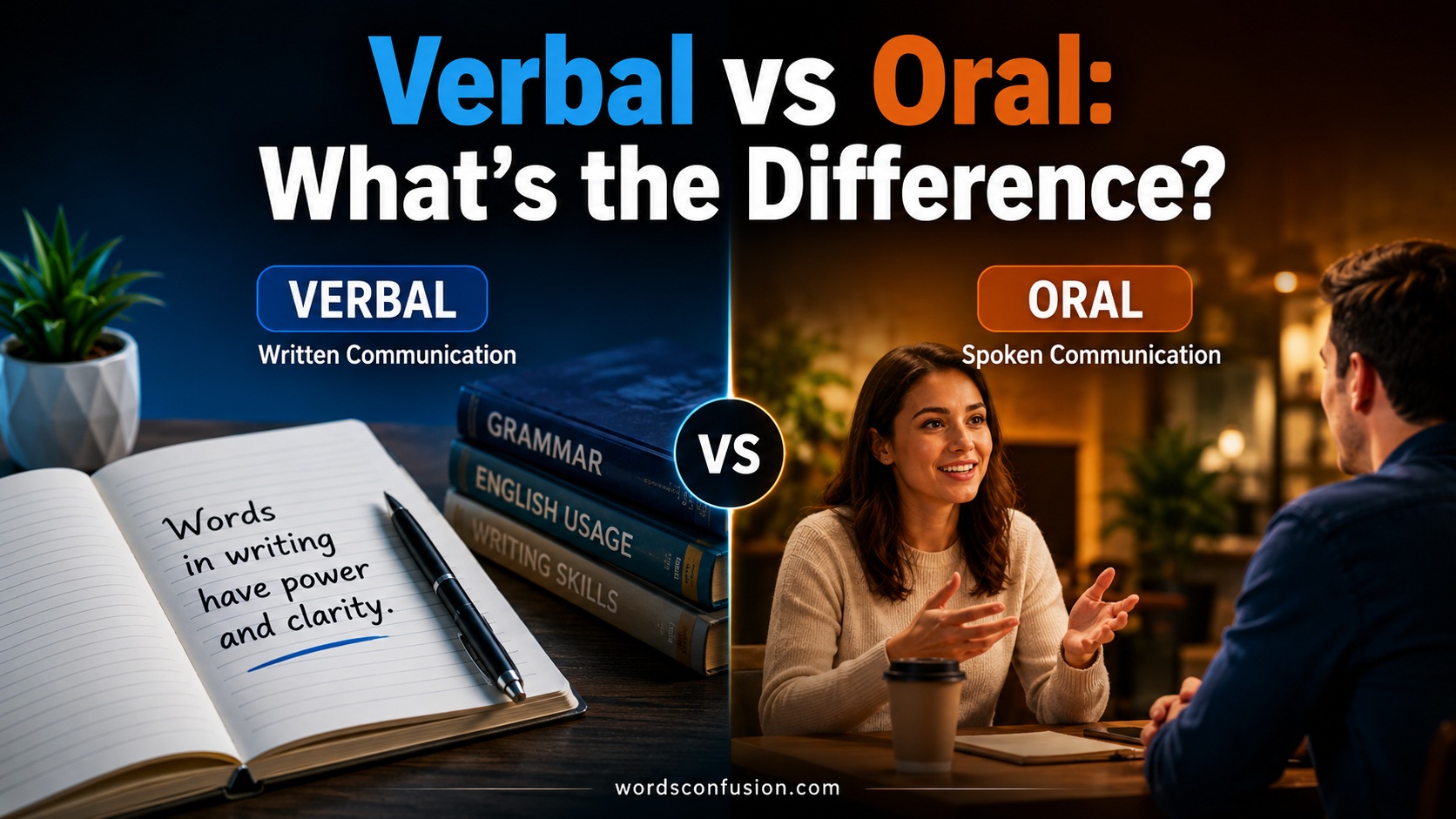
Have you ever heard someone say, “We have a verbal agreement,” when they really meant a spoken agreement? Or maybe you’ve wondered whether an oral presentation and a verbal presentation are the same thing. You’re not alone. These two words confuse students, professionals, writers, and even native English speakers because people often use them interchangeably.
Although verbal and oral both relate to communication, they aren’t identical. Their meanings overlap in everyday conversation. However, they differ in formal writing, linguistics, education, law, and healthcare. Choosing the right word can make your message clearer and more accurate.
The confusion usually comes from modern usage. Many people assume verbal simply means “spoken.” Traditionally, though, verbal refers to communication using words, whether those words are spoken or written. Oral, on the other hand, refers specifically to communication through the mouth or by speaking.
Understanding this distinction will help you write more precisely, speak with confidence, and avoid common grammar mistakes. Whether you’re preparing for an exam, drafting a legal document, giving a presentation, or simply improving your English, knowing when to use verbal instead of oral makes a noticeable difference.
In this guide, you’ll learn the exact meanings of both words, how they differ, where they overlap, real-life examples, common mistakes, and simple tricks to remember the difference forever.
Verbal vs Oral: Quick Answer
The simplest way to remember the difference is this:
- Verbal means related to words. Those words may be spoken or written, depending on the context.
- Oral means spoken through the mouth. It never refers to written communication.
Here’s a quick comparison.
| Term | Meaning | Includes Writing? | Includes Speaking? |
| Verbal | Related to words or language | Yes, in the traditional sense | Yes |
| Oral | Spoken by mouth | No | Yes |
Quick examples
Correct:
- The company made a verbal agreement before signing the contract.
- Students must complete an oral exam next week.
- She gave an oral presentation in front of the class.
- His verbal reasoning skills are excellent.
Easy rule to remember:
Verbal = Words
Oral = Mouth
Whenever you are talking only about speech, oral is usually the more precise choice. Whenever you’re referring to words or language more generally, verbal is often the better term.
Comparison Table: Verbal vs Oral
Understanding the difference becomes much easier when you compare the two side by side. The table below highlights their meanings, usage, and common contexts.
| Feature | Verbal | Oral |
| Basic meaning | Related to words or language | Related to spoken communication by mouth |
| Includes speaking | Yes | Yes |
| Includes writing | Traditionally, yes | No |
| Primary focus | Words | Speech |
| Common contexts | Communication, language, reasoning, agreements | Presentations, exams, instructions, traditions |
| Opposite | Nonverbal | Written |
| Common mistake | Assuming it always means spoken | Using it for written communication |
| Best used when | Talking about language in general | Talking specifically about speaking |
At a Glance
| If you’re talking about… | Use |
| Spoken communication only | Oral |
| Words, language, or communication in general | Verbal |
| A speech or presentation | Oral |
| Language skills | Verbal |
| Reading and writing abilities | Verbal |
| An interview conducted by speaking | Oral |
This distinction may seem small, yet it becomes important in professional writing, education, law, and medicine.
What Does Verbal Mean?
The word verbal comes from the Latin word verbum, which means word. At its core, verbal refers to anything connected with words or language.
Many people think verbal means “spoken,” but that is only part of the picture. In traditional English, verbal includes both spoken and written words because both forms rely on language.
Definition
Verbal means:
- Relating to words.
- Expressed through language.
- Connected with speaking, writing, or both.
The exact meaning depends on the context.
When Should You Use “Verbal”?
Use verbal when discussing:
- Language skills
- Communication using words
- Vocabulary
- Grammar
- Reading and writing
- Spoken language
- Written language
- Linguistics
Examples of Verbal
Consider these examples.
- She has excellent verbal communication skills.
- The assessment measures verbal reasoning.
- His verbal ability helped him succeed during the interview.
- Children develop verbal skills before they master writing.
- Their verbal exchange quickly resolved the misunderstanding.
Notice that these examples focus on language itself, not just speech.
Common Expressions Using “Verbal”
You’ll encounter verbal in many everyday expressions.
Verbal Communication
This refers to communication that uses words. Depending on the field, it may include spoken and written language, although many workplaces use it to mean spoken communication.
Example:
Good verbal communication helps teams avoid misunderstandings.
Verbal Reasoning
Many standardized tests measure verbal reasoning, which evaluates how well someone understands words, relationships, and written passages.
Example:
Her verbal reasoning score ranked in the top five percent.
Verbal Ability
This phrase describes a person’s skill with language, including vocabulary, comprehension, and expression.
Example:
Strong verbal ability is valuable in teaching, law, journalism, and management.
Verbal Abuse
Verbal abuse involves using harmful or insulting words to hurt another person.
Examples include:
- Constant criticism
- Threats
- Name-calling
- Humiliation
- Manipulation through language
The harm comes from the words, whether they are spoken face-to-face or communicated in another verbal form.
Verbal Agreement
A verbal agreement is an agreement made using words instead of a written contract.
However, this phrase creates confusion because some people interpret verbal as including written words. For that reason, many lawyers prefer the phrase oral agreement when they specifically mean an agreement made by speaking.
We’ll explore this distinction later in the article.
Verbal in Different Fields
The meaning of verbal shifts slightly depending on the profession.
| Field | Meaning of Verbal |
| Linguistics | Related to words or language |
| Education | Language and literacy skills |
| Psychology | Language-based intelligence |
| Business | Communication using words |
| Human Resources | Speaking and communication skills |
| Law | Agreements expressed in words |
Understanding the context helps you choose the correct word every time.
Examples in Everyday Life
Here are realistic examples showing how people naturally use verbal.
At work
The manager praised Sarah’s verbal communication during the client meeting.
In school
Students with strong verbal reasoning often perform well in reading comprehension.
During a job interview
The recruiter evaluated both the candidate’s verbal and written communication skills.
At home
Parents encourage verbal expression so children can explain their feelings clearly.
Common Misunderstanding
Here’s where confusion begins.
Many people say:
“I’ll give you verbal instructions.”
Technically, this usually means instructions communicated with words. Since the instructions are spoken, oral instructions is more precise.
In everyday conversation, though, most people understand verbal instructions to mean spoken directions. That’s why you’ll hear the phrase frequently, even though language experts often recommend oral instructions for greater accuracy.
A Simple Way to Think About It
Imagine communication as a large umbrella.
Under that umbrella are:
- Spoken words
- Written words
Both belong to verbal communication because both use words.
Now imagine a smaller umbrella underneath.
That smaller umbrella contains only:
- Speaking
- Listening
That’s oral communication.
Every oral message is verbal because it uses words.
Not every verbal message is oral because written communication also uses words. This simple relationship explains why the two words overlap yet aren’t perfect synonyms.
What Does Oral Mean?
Unlike verbal, which relates to words in general, oral has a much narrower meaning. It refers specifically to spoken communication or anything involving the mouth.
The word oral comes from the Latin os, meaning mouth. That’s why you’ll also see it in medical terms such as oral medication, oral hygiene, and oral surgery. In communication, however, oral simply means spoken rather than written.
Definition
Oral means:
- Spoken aloud.
- Communicated through speech.
- Related to the mouth.
Whenever you’re talking about someone speaking instead of writing, oral is usually the most accurate word.
When Should You Use “Oral”?
Use oral when referring to:
- Speeches
- Presentations
- Conversations
- Interviews
- Exams
- Instructions given aloud
- Stories passed down by speaking
- Court arguments delivered before judges
Examples of Oral
Here are a few examples.
- Students must complete an oral exam before graduation.
- The doctor gave oral instructions after the procedure.
- She delivered an excellent oral presentation.
- Witnesses provided oral testimony during the trial.
- The professor conducted an oral interview instead of a written test.
In each example, the communication happens by speaking rather than writing.
Read More: Valuable vs Invaluable: What’s the Difference? Meaning, Usage, and Examples
Common Expressions Using “Oral”
Some phrases almost always use oral because they describe spoken communication.
Oral Presentation
An oral presentation is a speech delivered to an audience.
Example
The students prepared a ten-minute oral presentation about climate change.
Oral Exam
Many schools and universities use oral exams to test speaking ability and subject knowledge.
Examples include:
- Language proficiency tests
- Graduate thesis defenses
- Medical examinations
- Law school assessments
Oral Tradition
Before books became common, many cultures preserved history through oral tradition. People memorized stories and passed them from one generation to the next by speaking.
Examples include:
- Folk tales
- Legends
- Epic poems
- Cultural history
- Indigenous storytelling
Oral Argument
In courts, lawyers often present oral arguments before judges. These arguments supplement written legal briefs and allow attorneys to answer questions directly.
Oral Instructions
Hospitals, workplaces, and schools frequently provide oral instructions before giving written materials.
Example
The nurse explained the medication schedule through oral instructions and later handed the patient a printed guide.
Oral History
Historians collect oral histories by interviewing people about events they personally experienced.
Examples include:
- Military veterans
- Civil rights activists
- Community elders
- Disaster survivors
These spoken accounts preserve valuable firsthand experiences.
Oral in Different Fields
The meaning of oral remains remarkably consistent across professions.
| Field | Meaning of Oral |
| Education | Spoken assessments and presentations |
| Medicine | Related to the mouth or medications taken by mouth |
| Law | Spoken testimony and courtroom arguments |
| Linguistics | Spoken language |
| History | Spoken accounts passed through generations |
Unlike verbal, oral rarely changes meaning based on context.
Examples in Everyday Life
Here are some natural examples.
At school
Students practiced their oral presentations before standing in front of the class.
At work
The manager gave oral feedback during the performance review.
At the doctor’s office
Patients received oral instructions before leaving the clinic.
In court
The attorney presented an oral argument before the Supreme Court.
During language learning
Speaking practice improves oral fluency much faster than memorizing vocabulary alone.
Common Misunderstanding
Some people mistakenly use oral when discussing all forms of communication.
For example:
The company improved its oral communication by redesigning employee emails.
This sentence isn’t accurate because emails are written, not spoken.
A better version would be:
The company improved its verbal communication by redesigning employee emails.
Or even more precisely:
The company improved its written communication by redesigning employee emails.
Choosing the right word makes your writing clearer and more professional.
FAQs:
Is verbal the same as oral?
No. Although people often use the terms interchangeably, they don’t mean exactly the same thing. Verbal relates to words or language, while oral refers specifically to spoken communication. Every oral message is verbal because it uses words. However, written communication is also verbal, which means not every verbal message is oral.
Does verbal include written communication?
Traditionally, yes. Verbal refers to communication through words, whether those words are spoken or written. In everyday English, many people use verbal to mean “spoken,” but in formal writing and linguistics, it has a broader meaning that includes written language.
When should I use oral instead of verbal?
Use oral whenever you’re referring only to spoken communication. For example, write oral presentation, oral exam, oral instructions, or oral argument. These phrases clearly indicate that the communication takes place by speaking rather than writing.
Is a verbal agreement legally binding?
A verbal agreement can be legally binding in many situations, provided it meets the legal requirements for a valid contract, such as mutual agreement and consideration. However, proving the terms of a spoken agreement can be difficult. That’s why many legal professionals recommend putting important agreements in writing, even when the law recognizes oral contracts.
What is the easiest way to remember the difference between verbal and oral?
A simple memory trick is:
- Verbal = Words
- Oral = Mouth
If you’re talking about language or words in general, choose verbal. If you’re talking only about speaking, choose oral.
Conclusion:
The difference between verbal vs oral is subtle, yet it’s important if you want your English to be clear and precise. While both words involve communication, they focus on different aspects of it. Verbal relates to words and language, whether spoken or written. Oral refers specifically to communication that happens through speech.
In everyday conversations, you’ll often hear people use verbal to mean “spoken.” Most listeners understand this usage, and many modern dictionaries recognize it. Still, choosing oral when you mean spoken communication removes ambiguity and makes your writing more accurate, especially in academic, legal, medical, and professional settings.

Andrew Wilson is an experienced language researcher and content writer specializing in WordsConfusion topics. He helps readers understand commonly confused English words, spelling differences, grammar rules, word meanings, and proper usage through clear explanations, practical examples, and easy-to-follow language guides. His goal is to make English learning simple, accurate, and accessible for students, writers, professionals, and everyday learners.