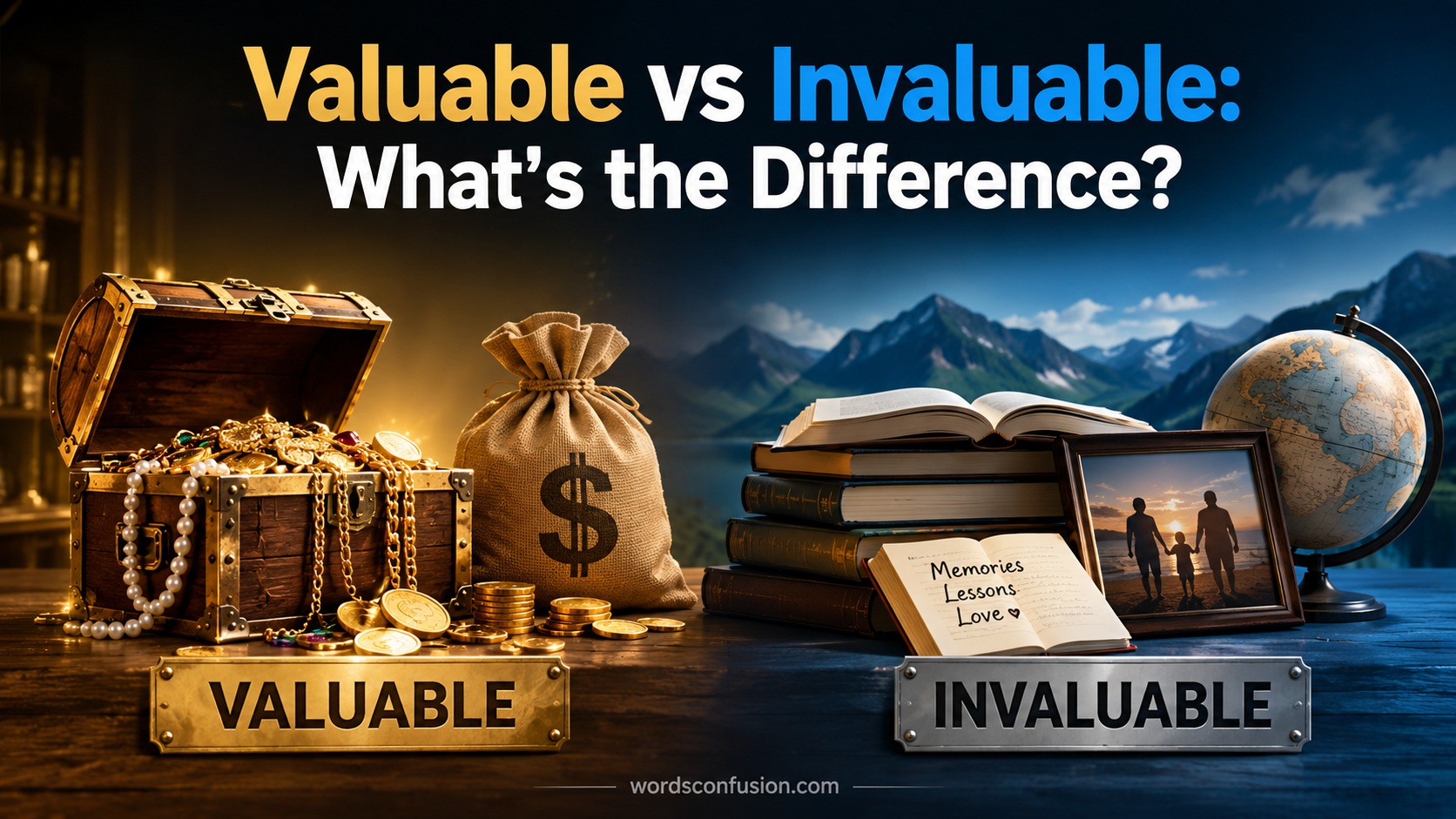
Have you ever stopped while writing and wondered whether you should use valuable or invaluable? At first glance, these two words look like opposites. After all, the prefix in- often means “not,” so it seems logical to think invaluable means not valuable. Surprisingly, that’s not what the word means.
In modern English, valuable describes something that has significant worth or usefulness. Invaluable, on the other hand, describes something so important, useful, or precious that its value cannot be measured. Although the words appear to contradict each other, they often express similar ideas, with invaluable carrying a much stronger sense of appreciation.
This unusual pair causes confusion for students, writers, professionals, and even native English speakers. You might see a museum describe an ancient manuscript as invaluable, while a jeweler calls a diamond valuable. Both words are correct, yet they highlight different levels of worth.
In this guide, you’ll learn exactly what valuable and invaluable mean, how they differ, when to use each one, why invaluable has its surprising meaning, and how to avoid common mistakes. You’ll also find comparison tables, practical examples, grammar tips, and an easy memory trick that will help you choose the right word every time.
Valuable vs Invaluable – Quick Answer
The difference is simple once you know what each word really means.
| Word | Meaning | Best Used For |
| Valuable | Having great worth, usefulness, or importance | Money, objects, skills, information, resources |
| Invaluable | So valuable that its worth cannot be measured | Advice, expertise, support, experience, historical items |
Here’s a quick comparison:
- Valuable = worth a lot.
- Invaluable = worth so much that assigning a value is almost impossible.
- Invaluable is usually stronger than valuable.
- Neither word means “worthless.”
Quick Examples
- This painting is valuable because it is worth millions of dollars.
- Your advice was invaluable during the interview process.
- She carries several valuable documents in her briefcase.
- The doctor’s quick decision proved invaluable during the emergency.
- The team’s experienced engineer became an invaluable member of the project.
Think of it this way:
A valuable item has high value.
An invaluable person or resource has value beyond measurement.
That’s the key difference.
What Does “Valuable” Mean?
Definition
The adjective valuable means having considerable monetary, practical, or personal worth. It can describe physical objects, knowledge, skills, relationships, opportunities, or anything that provides meaningful benefit.
Unlike invaluable, the word valuable doesn’t imply that something is beyond price. It simply tells the reader that the thing has significant value.
Pronunciation
Valuable
Pronunciation: VAL-yoo-uh-bul
Part of Speech
Valuable is primarily used as an adjective.
Examples:
- valuable information
- valuable employee
- valuable experience
- valuable artwork
- valuable resource
It can also function as a noun in expressions like:
- Leave your valuables in the hotel safe.
In that sentence, valuables refers to possessions such as jewelry, electronics, cash, or important documents.
Origin and Etymology
The word valuable comes from the noun value, which traces back through Old French to the Latin verb valere, meaning to be strong, to be worth, or to have power.
English adopted valuable in the early 17th century to describe things that possessed measurable worth. Over time, its meaning expanded beyond money to include usefulness, importance, and personal significance.
Today, the word applies to almost every area of life.
Common Contexts Where “Valuable” Is Used
One reason valuable appears so often is its flexibility. It works in financial, academic, professional, and everyday situations.
Valuable Objects
Physical items with high monetary value often receive this description.
Examples include:
- Gold
- Diamonds
- Antique furniture
- Rare books
- Luxury watches
- Fine art
Example:
The museum keeps its most valuable artifacts in a climate-controlled vault.
Valuable Information
Knowledge can be just as valuable as money.
Examples:
- Market research
- Customer feedback
- Medical records
- Scientific findings
- Security data
Example:
Customer surveys provide valuable insights into buying habits.
Valuable Skills
Employers often describe abilities as valuable because they improve productivity and solve problems.
Examples include:
- Leadership
- Programming
- Communication
- Critical thinking
- Project management
Example:
Fluency in multiple languages is a valuable skill in international business.
Valuable Time
Time cannot be replaced, which makes it valuable in both personal and professional settings.
Example:
The new software saves employees valuable time every week.
Valuable Relationships
Strong personal and professional relationships often create lasting benefits.
Example:
Building trust with clients creates valuable long-term partnerships.
Example Sentences Using “Valuable”
- The company owns several valuable patents.
- She shared valuable feedback after reviewing my presentation.
- Good communication is a valuable leadership skill.
- The firefighter rescued several valuable historical documents.
- His experience became a valuable asset to the organization.
- Exercise is valuable for both physical and mental health.
- The teacher gave students valuable advice before the exam.
- This rare coin became more valuable over time.
- Your honesty is one of your most valuable qualities.
- Regular backups protect valuable business data.
What Does “Invaluable” Mean?
Definition
The adjective invaluable means extremely valuable, indispensable, or so important that its value cannot be measured. It describes people, knowledge, experiences, or resources that provide exceptional benefit.
Although the word begins with the prefix in-, it does not mean “not valuable.” Instead, it emphasizes that something is worth more than anyone could reasonably put a price on.
For example:
- A mentor’s guidance can be invaluable to a young professional.
- Accurate medical records are invaluable during an emergency.
- Years of practical experience become invaluable when solving complex problems.
In most situations, invaluable expresses stronger appreciation than valuable.
Why the Prefix “In-” Doesn’t Mean “Not”
This is where many learners become confused.
In English, the prefix in- often creates the opposite of a word.
For example:
- visible → invisible
- complete → incomplete
- correct → incorrect
Because of this pattern, it’s easy to assume that invaluable means “not valuable.”
It doesn’t.
Historically, invaluable developed with the sense of “too valuable to calculate.” Instead of reversing the meaning, the prefix became part of a word that emphasized immeasurable worth.
You can think of it this way:
- Valuable = has great value.
- Invaluable = has so much value that no realistic price could represent it.
Pronunciation
Invaluable
Pronunciation: in-VAL-yoo-uh-bul
Part of Speech
Invaluable functions as an adjective.
Unlike valuable, it is not commonly used as a noun.
Examples include:
- invaluable advice
- invaluable support
- invaluable experience
- invaluable contribution
- invaluable assistance
Origin and Etymology
The word invaluable first appeared in English during the 17th century.
It combines:
- in-
- valuable
However, its historical meaning evolved to express the idea of being beyond valuation rather than lacking value.
The word came to describe something whose importance exceeded any practical attempt to assign a price.
Today, dictionaries consistently define invaluable as extremely valuable, indispensable, or beyond price.
Read More: Systematic vs Systemic: What’s the Difference? Meaning, Usage, and Examples
Common Contexts Where “Invaluable” Is Used
Unlike valuable, invaluable usually describes things whose importance goes beyond money.
Expertise
Professional knowledge often saves time, money, and effort.
Example:
The consultant’s experience proved invaluable during the merger.
Advice
Good advice can prevent expensive mistakes.
Example:
Her financial guidance was invaluable when we bought our first home.
Support
People often describe emotional or professional support as invaluable.
Example:
Your encouragement has been invaluable throughout this project.
Experience
Years of real-world practice often become more valuable than theoretical knowledge.
Example:
His military experience became invaluable during disaster relief operations.
Historical Records
Some documents are impossible to replace.
Example:
These original manuscripts are considered invaluable cultural treasures.
Medical Care
Healthcare professionals frequently use the word when discussing life-saving information or teamwork.
Example:
The nurse’s quick observations were invaluable during the emergency.
Education
Teachers, mentors, and research materials often provide invaluable help.
Example:
Constructive feedback is invaluable for improving your writing.
Example Sentences Using “Invaluable”
- Your patience has been invaluable during this difficult transition.
- The scientist made an invaluable contribution to cancer research.
- Reliable data is invaluable when making business decisions.
- Her mentor offered invaluable career advice.
- Volunteers provide invaluable support after natural disasters.
- The translator’s local knowledge proved invaluable during negotiations.
- Family encouragement became invaluable throughout his recovery.
- Accurate weather forecasts are invaluable for airline safety.
- Years of customer feedback became an invaluable resource for product development.
- His calm leadership was invaluable during the crisis.
Valuable vs Invaluable: Side-by-Side Comparison
Although both words describe something important, they are not interchangeable in every situation.
The table below highlights the differences.
| Feature | Valuable | Invaluable |
| Meaning | Having great worth or usefulness | Having such great worth that it cannot be measured |
| Strength | Strong | Stronger |
| Monetary Value | Often refers to money or market value | Rarely focuses on money |
| Emotional Value | Sometimes | Very often |
| Practical Value | Yes | Yes, with greater emphasis |
| Typical Subjects | Jewelry, property, skills, information | Advice, expertise, experience, support |
| Tone | Neutral | More appreciative and emphatic |
| Common Workplace Usage | Valuable employee | Invaluable team member |
| Replacement | Usually replaceable | Often difficult or impossible to replace |
At a Glance
Choose valuable when something has clear worth.
Choose invaluable when something is exceptionally important or beyond measurement.
For example:
- The laptop contains valuable business records.
- The IT manager’s experience became invaluable after the cyberattack.
Both sentences describe importance. The second places much greater emphasis on the person’s contribution.
The Biggest Difference Between Valuable and Invaluable
The biggest difference lies in the degree of value, not the direction of meaning.
Many people expect invaluable to mean the opposite of valuable because the prefix in- usually creates negative words.
English doesn’t always follow predictable patterns.
Consider these two sentences:
This necklace is valuable because it contains rare diamonds.
Here, the necklace has a high financial value.
Now compare it with this example:
My grandmother’s advice has been invaluable throughout my life.
Her advice probably doesn’t have a price tag. Its worth comes from the lasting guidance and impact it provides.
That’s why invaluable often describes things you simply cannot replace.
A Simple Analogy
Imagine two books.
The first is a rare first edition worth $25,000.
It is valuable.
The second is your late grandfather’s handwritten journal filled with family stories and life lessons.
Its emotional worth cannot be measured.
It is invaluable.
One has a high market price.
The other has immeasurable personal value.
Another Everyday Example
Suppose your company purchases an expensive computer server.
The server is valuable because replacing it would cost thousands of dollars.
Now imagine the senior engineer who designed the entire network suddenly leaves.
Their knowledge, experience, and years of problem-solving may be invaluable because replacing that expertise could take years.
Money measures the server.
Experience measures the engineer.
One is valuable.
The other is invaluable.
FAQs:
Is invaluable the opposite of valuable?
No. Although the prefix in- often creates the opposite of a word, invaluable is an exception. It means extremely valuable or beyond measure, not “without value.” That’s why something can be both valuable and invaluable, depending on the level of importance you want to express.
Which is stronger: valuable or invaluable?
Invaluable is generally the stronger word. Valuable means something has significant worth or usefulness, while invaluable suggests that its importance is so great that it cannot be measured or replaced.
For example:
- The company owns valuable equipment.
- The leadership was invaluable during the crisis.
Can a person be described as valuable or invaluable?
Yes. Both words can describe people, but they convey different levels of appreciation.
- A valuable employee contributes significantly to the organization.
- An invaluable employee is considered exceptionally important and very difficult to replace.
Using invaluable emphasizes extraordinary contributions rather than ordinary usefulness.
Is priceless the same as invaluable?
The two words are very similar but not always identical.
Priceless often highlights emotional, cultural, or artistic value that cannot be assigned a monetary price.
Invaluable emphasizes exceptional usefulness, importance, or contribution.
For example:
- The family photograph is priceless because of its sentimental value.
- The doctor’s quick decision was invaluable during the emergency.
When should I use valuable instead of invaluable?
Use valuable when something has clear financial, practical, or measurable worth.
Use invaluable when you want to stress that something is extraordinarily important or beyond ordinary measurement.
As a simple rule:
- Valuable = worth a lot.
- Invaluable = worth more than words or numbers can express.
Conclusion:
Understanding the difference between valuable and invaluable becomes much easier once you focus on the degree of worth rather than the prefix in-. A valuable object, skill, or resource has significant value and usefulness. An invaluable person, piece of advice, or experience goes a step further because its importance is so great that it cannot realistically be measured.
Whenever you’re writing or speaking, think about what you’re describing. If it has high but measurable worth, valuable is usually the right choice. If it plays an exceptional role and would be nearly impossible to replace, invaluable communicates that idea more effectively.

Andrew Wilson is an experienced language researcher and content writer specializing in WordsConfusion topics. He helps readers understand commonly confused English words, spelling differences, grammar rules, word meanings, and proper usage through clear explanations, practical examples, and easy-to-follow language guides. His goal is to make English learning simple, accurate, and accessible for students, writers, professionals, and everyday learners.