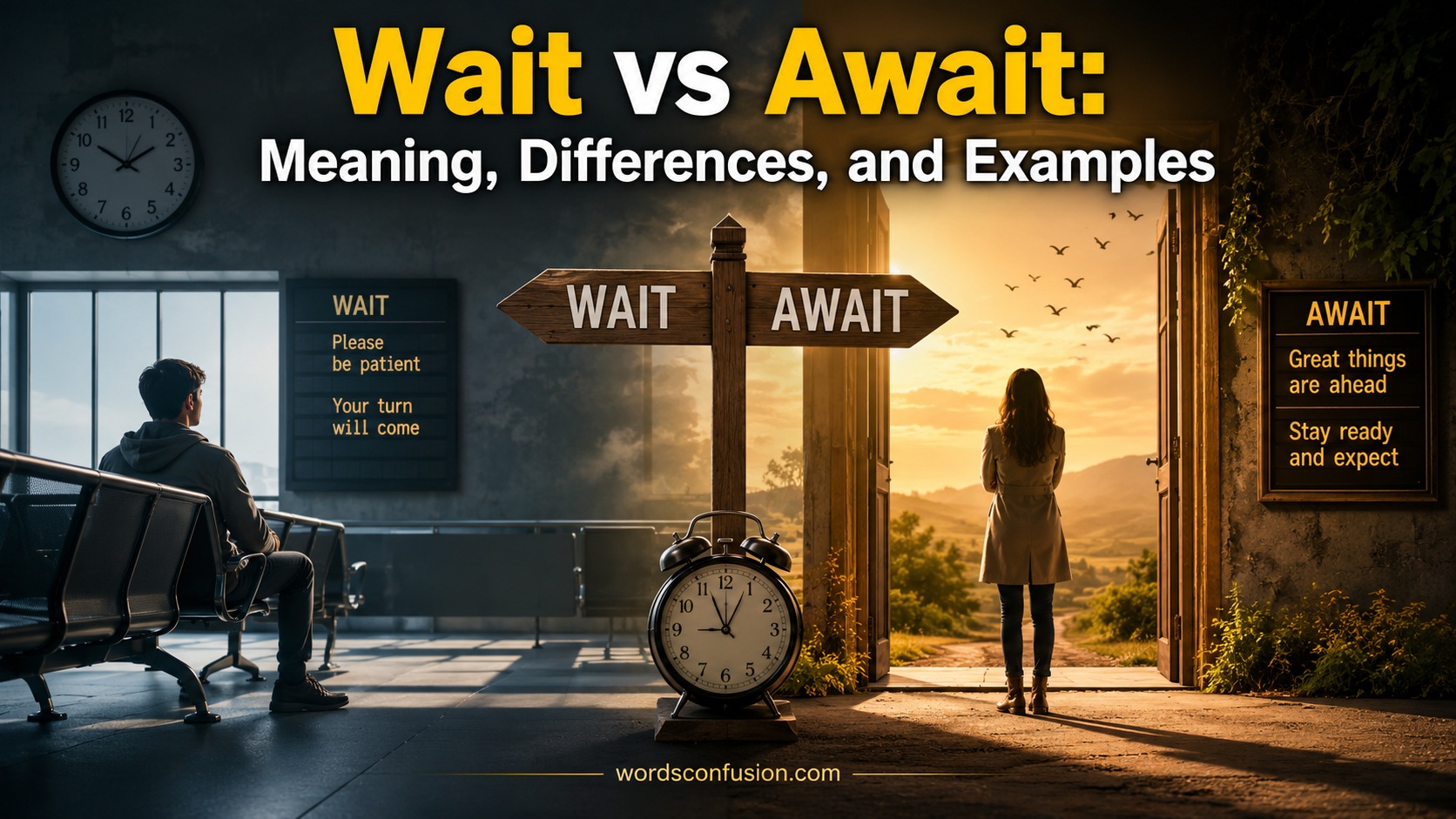
Choosing between wait and await can be surprisingly tricky. Both words relate to the idea of expecting something to happen, yet they don’t work the same way in a sentence. Many English learners—and even native speakers—mistakenly write phrases like “await for your reply” or replace wait with await because they believe it sounds more professional.
The truth is much simpler. Wait and await have similar meanings, but they follow different grammar rules and fit different situations. Knowing when to use each word helps you write naturally, avoid common mistakes, and communicate more confidently.
This guide explains every important difference between wait vs await, including grammar rules, sentence structures, examples, common errors, memory tricks, and practice exercises.
Quick Answer
The main difference between wait and await is their sentence structure.
- Wait usually needs for before the object.
- Await takes the object directly without for.
Correct:
- I am waiting for the bus.
- We await your response.
Incorrect:
- I am waiting the bus.
- We await for your response.
Simple rule to remember:
Wait = wait for something
Await = await something
Wait vs Await: At a Glance
| Feature | Wait | Await |
| Meaning | Stay until something happens | Expect something to happen |
| Part of Speech | Verb | Verb |
| Needs “for”? | Usually yes | Never |
| Object Required | Often follows “for” | Direct object required |
| Formality | Everyday and informal | Formal and professional |
| Common Usage | Conversations | Business, academic, legal writing |
| Example | Wait for the train. | Await the decision. |
What Does “Wait” Mean?
The verb wait means to stay where you are or delay action until someone or something arrives or happens.
People use wait every day because it sounds natural in conversation.
How “Wait” Works in a Sentence
Most of the time, wait is followed by for before the object.
Examples:
- Please wait for me.
- We’re waiting for the results.
- She waited for two hours.
- They waited patiently.
You can also use wait before another verb.
Examples:
- Wait to leave.
- Wait until tomorrow.
- Wait before making a decision.
Common Sentence Patterns
| Pattern | Example |
| Wait for + noun | Wait for the bus. |
| Wait for + person | Wait for Sarah. |
| Wait to + verb | Wait to speak. |
| Wait until + clause | Wait until it stops raining. |
| Wait before + verb-ing | Wait before signing. |
Examples of “Wait”
- I’ll wait for you outside.
- We waited until midnight.
- Please wait before answering.
- They waited for the meeting to begin.
- Everyone waited quietly.
What Does “Await” Mean?
The verb await means to expect or wait for something to happen.
Unlike wait, await directly takes its object.
It sounds more formal and appears frequently in professional writing.
How “Await” Works in a Sentence
The structure is straightforward.
Await + object
Examples:
- We await your reply.
- She awaits approval.
- The company awaits payment.
- Students await their results.
Notice there is no “for.”
Common Sentence Patterns
| Pattern | Example |
| Await + noun | Await approval. |
| Await + pronoun | Await him. |
| Await + decision | Await the verdict. |
| Await + response | Await your response. |
| Await + instructions | Await further instructions. |
Examples of “Await”
- We await confirmation.
- Thousands await the final results.
- The team awaits the manager’s decision.
- Investors await today’s announcement.
- Patients await treatment.
The Main Difference Between Wait and Await
Although both verbs describe expectation, they differ in grammar and style.
| Feature | Wait | Await |
| Requires “for” | Usually | Never |
| Formality | Casual | Formal |
| Common in speech | Yes | Less common |
| Common in business writing | Sometimes | Frequently |
| Sounds conversational | Yes | No |
Consider these examples.
Casual conversation
I’ll wait for you.
Business email
We await your approval.
Both sentences express expectation, yet the tone changes significantly.
Wait vs Await: Grammar Rules Explained
Grammar is where most mistakes happen.
Understanding these rules will prevent almost every error.
Why “Await” Does Not Need “For”
The word await already includes the idea of “waiting for.”
Adding for creates an incorrect sentence.
Correct:
- We await your decision.
- I await the results.
- They await instructions.
Incorrect:
- We await for your decision.
- I await for the results.
- They await for instructions.
Think of it this way.
The object comes immediately after await.
Await + object
Why “Wait” Usually Needs “For”
Unlike await, the verb wait normally requires for before its object.
Correct:
- Wait for me.
- Wait for your turn.
- Wait for the bus.
Incorrect:
- Wait me.
- Wait your turn.
- Wait the bus.
Can “Wait” Be Used Without “For”?
Yes.
Certain sentence structures don’t need for.
Examples:
- Wait here.
- Wait outside.
- Wait until Monday.
- Wait to speak.
- Wait patiently.
The rule is simple.
Use for when a noun follows directly.
Side-by-Side Sentence Comparison
| Wait | Await |
| Wait for the train. | Await the train’s arrival. |
| Wait for my reply. | Await my reply. |
| Wait for approval. | Await approval. |
| Wait until tomorrow. | Await tomorrow’s announcement. |
| Wait for the decision. | Await the decision. |
Notice how await sounds noticeably more formal.
When to Use “Wait”
Use wait in everyday communication.
It fits naturally in spoken English and informal writing.
Common situations include:
- Daily conversations
- Text messages
- Family discussions
- Friendly emails
- Customer interactions
- Instructions
- Travel situations
Examples:
- Wait for me.
- Wait outside.
- Wait your turn? No. Say Wait for your turn.
- Wait until I’m ready.
- We can wait.
When to Use “Await”
Use await when writing formally.
It appears frequently in:
- Business emails
- Academic papers
- Government documents
- Legal writing
- Company announcements
- Professional correspondence
- Official notices
Examples:
- We await your confirmation.
- Applicants await the interview results.
- The committee awaits further information.
- Customers await shipment.
Read More: Use vs Utilize: What’s the Difference? Meaning, and Examples
Common Mistakes People Make
Many learners repeat the same errors.
Learning them now saves future embarrassment.
Using “Await For”
This is the biggest mistake.
Incorrect:
- We await for your response.
Correct:
- We await your response.
Replacing Every “Wait” With “Await”
Some writers believe await always sounds better.
It doesn’t.
This sentence sounds unnatural.
I await for my friend outside.
Natural English:
I wait for my friend outside.
Forgetting the Object After “Await”
Because await is transitive, it normally requires an object.
Correct:
- We await instructions.
Less natural:
- We await.
Using the Wrong Verb Pattern
Incorrect:
- Await for approval.
- Wait approval.
Correct:
- Await approval.
- Wait for approval.
Wait vs Await in Professional Writing
Professional writing values clarity and precision.
That’s why await appears often in business communication.
Examples from workplace emails:
We await your signed agreement.
We await confirmation before processing your request.
We await your feedback.
However, don’t overuse it.
Modern business writing often sounds friendlier with wait.
Compare these:
Formal:
We await your response.
Friendly:
We’re waiting for your response.
Both are correct.
Choose the tone that matches your audience.
Wait vs Await in Everyday Conversation
Native speakers overwhelmingly prefer wait during conversation.
Imagine ordering coffee.
Natural:
I’ll wait here.
Unnatural:
I’ll await here.
Talking with friends:
Wait for me.
Not:
Await me.
This difference helps your English sound much more natural.
Common Expressions with “Wait”
Many English expressions use wait, not await.
| Expression | Meaning |
| Wait a minute | Pause briefly |
| Wait and see | Delay judgment |
| Wait your turn | Take turns patiently |
| Can’t wait | Very excited |
| Wait in line | Stand in a queue |
| Wait up | Slow down |
| Wait around | Stay without doing much |
Examples:
- I can’t wait for the weekend.
- Let’s wait and see.
- Wait a minute.
FAQs:
Is “await” more formal than “wait”?
Yes. Await sounds more formal and commonly appears in business, legal, academic, and official writing. Wait is the preferred choice for everyday conversation.
Why is “await for” incorrect?
Because await already takes a direct object. Adding for creates a grammatical error.
Correct:
- We await your response.
Incorrect:
- We await for your response.
Can I say “I await your reply”?
Yes. This is a grammatically correct and common phrase in formal emails and business correspondence.
Can “wait” and “await” always replace each other?
No. While they share similar meanings, they follow different grammatical structures and suit different levels of formality. Replacing one with the other often changes the tone or creates an incorrect sentence.
Which word do native English speakers use more often?
Native speakers use wait far more often in everyday speech. Await appears mainly in formal writing, official notices, business communication, and legal documents.
Conclusion:
Understanding the difference between wait vs await is easier than it first appears. Both verbs express the idea of expecting something, yet they follow different grammar rules and suit different contexts.
Use wait when speaking casually or writing in a natural, conversational tone. It usually requires for before the object, as in “wait for the bus” or “wait for your friend.”

Andrew Wilson is an experienced language researcher and content writer specializing in WordsConfusion topics. He helps readers understand commonly confused English words, spelling differences, grammar rules, word meanings, and proper usage through clear explanations, practical examples, and easy-to-follow language guides. His goal is to make English learning simple, accurate, and accessible for students, writers, professionals, and everyday learners.