Many people treat use and utilize as interchangeable. At first glance, they appear to mean the same thing. However, they don’t always fit the same situations. Choosing the right word can make your writing clearer, stronger, and more natural.
One of the most common writing mistakes is replacing use with utilize simply because it sounds more formal. In reality, professional editors, style guides, and plain-language experts often recommend the opposite. They encourage writers to choose use unless utilize adds a specific meaning that use cannot express.
Whether you’re writing an email, preparing an academic paper, creating website content, or drafting a business report, understanding the difference between use vs utilize will help you communicate more effectively.
In this guide, you’ll learn what each word means, how they differ, when to choose one over the other, and how to avoid common mistakes. You’ll also find comparison tables, real-life examples, memory tips, and practice exercises to help you master these commonly confused words.
Quick Answer
The simplest way to remember use vs utilize is this:
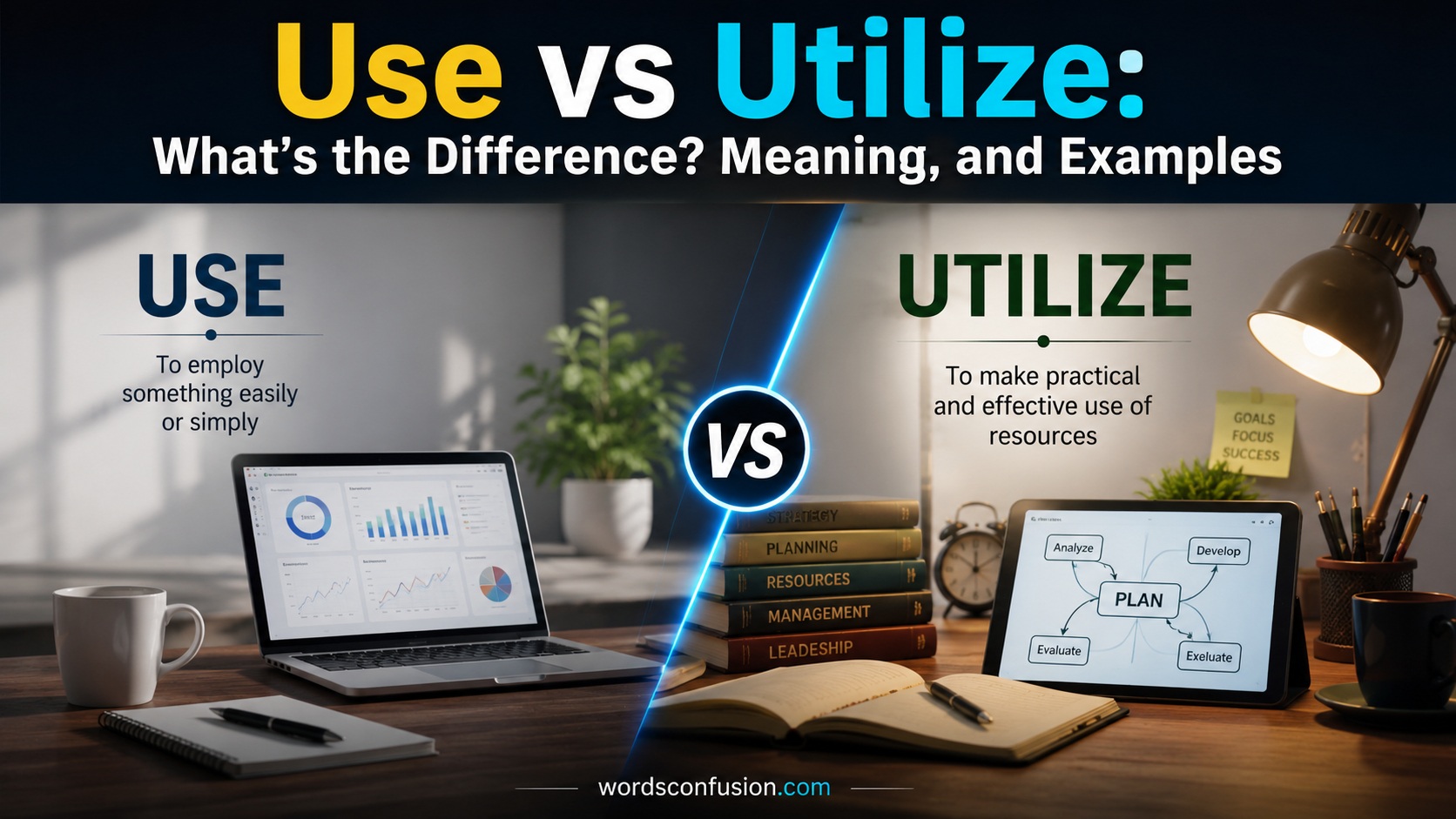
- Use means to employ something for its intended purpose.
- Utilize means to make practical or effective use of something, especially in a way that is not its original or obvious purpose.
Examples:
- I used a flashlight to see in the dark.
- The campers utilized empty bottles to collect rainwater.
Quick Rule:
If use sounds natural, choose it. Use utilize only when you want to emphasise making the best or an unusual use of something.
Use vs Utilize: Side-by-Side Comparison
| Feature | Use | Utilize |
| Meaning | Employ something for its normal purpose | Make practical or efficient use of something |
| Tone | Simple and natural | More formal and technical |
| Everyday English | Very common | Rare |
| Business Writing | Preferred in most cases | Suitable in specific contexts |
| Academic Writing | Common | Appropriate when precision matters |
| Technical Documents | Frequently used | Often used when discussing efficiency |
| Best Choice | Most situations | Limited situations requiring emphasis |
| Example | Use a computer to write | Utilize unused office space |
What Does “Use” Mean?
Definition
The verb use means to employ, operate, apply, or take advantage of something for its intended purpose. It is one of the most common words in the English language because it works naturally in almost every situation.
Whether you use a phone, a pen, a recipe, or a software program, the meaning stays clear and direct.
When to Use “Use”
Choose use whenever you are talking about ordinary actions or everyday communication.
You should use use when you:
- Write emails
- Speak in conversations
- Create blog posts
- Write reports
- Explain instructions
- Describe daily activities
- Write marketing content
- Produce academic assignments unless greater precision is required
In other words, use should be your default choice.
Everyday Examples
Here are several natural examples.
- Please use your password to sign in.
- She uses a planner to organise her schedule.
- We used public transportation during our trip.
- Can I use your charger for a few minutes?
- The chef used fresh herbs in the recipe.
- Students use dictionaries to check meanings.
- Many designers use vector graphics for logos.
- Doctors use medical imaging to diagnose patients.
Notice how replacing use with utilize in these sentences would make most of them sound unnecessarily formal.
Common Expressions with “Use”
English contains many phrases built around the word use.
Some common examples include:
- Use wisely
- Use carefully
- Use regularly
- Easy to use
- Put to good use
- Make good use of
- In use
- Out of use
- For personal use
- For public use
These expressions appear in everyday speech, advertising, technical manuals, and professional writing.
What Does “Utilize” Mean?
Definition
The word utilize means to make practical, effective, or profitable use of something, especially when it is not being used in its usual way or when you want to highlight efficiency.
Unlike use, utilize often suggests creativity, resourcefulness, or optimisation.
When to Use “Utilize”
Although many writers overuse utilize, it does have legitimate uses.
Choose utilize when you want to emphasise:
- Efficient use of resources
- Alternative or unexpected purposes
- Maximising value
- Technical processes
- Scientific procedures
- Engineering solutions
- Resource management
Professional Examples
Consider these examples.
- Engineers utilized recycled steel to reduce construction costs.
- Researchers utilized satellite data to monitor climate patterns.
- Hospitals utilize artificial intelligence to improve diagnostic accuracy.
- The company utilized unused warehouse space for temporary storage.
- Farmers utilized rainwater harvesting systems during drought conditions.
In each sentence, utilize highlights efficiency or making the best possible use of available resources.
Why “Utilize” Sounds More Formal
The word utilize entered English through Latin and French influences. Because of its history and frequent appearance in legal, scientific, and technical writing, it naturally carries a more formal tone.
However, formal does not always mean better.
Many experienced editors recommend removing utilize whenever use communicates exactly the same idea.
Compare these examples.
Less natural
- Please utilize the login button.
More natural
- Please use the login button.
The second sentence is shorter, clearer, and easier to read.
The Main Difference Between Use and Utilize
At their core, both words involve employing something for a purpose. The real difference lies in how and why that purpose is achieved.
Difference in Meaning
Use simply means to employ something.
Utilize means to make effective or resourceful use of something.
Think of it this way.
If you drink from a coffee mug, you use it.
If you turn that same coffee mug into a pencil holder, you utilize it.
The second action involves giving the object a practical purpose beyond its original design.
Difference in Tone
| Aspect | Use | Utilize |
| Readability | Very high | Moderate |
| Simplicity | Excellent | More formal |
| Everyday Speech | Common | Rare |
| Technical Writing | Appropriate | Sometimes preferred |
| Plain English | Strongly recommended | Limited use |
Most readers process use more quickly because it is shorter and more familiar.
Difference in Context
The context often determines which word sounds best.
| Situation | Better Choice | Reason |
| Casual conversation | Use | Natural wording |
| Business email | Use | Clear and direct |
| Technical report | Utilize | Emphasises efficient application |
| Scientific research | Utilize | Highlights methodology |
| Website copy | Use | Better readability |
| User instructions | Use | Easier for readers |
A Simple Analogy
Imagine you own a ladder.
- When you climb the ladder to paint your house, you use it.
- When you lay the ladder across a muddy ditch to create a temporary bridge, you utilize it.
The ladder serves an unexpected but practical purpose in the second example.
That subtle distinction captures the heart of use vs utilize.
Writing Tip: If replacing utilize with use does not change the meaning, use is almost always the better choice.
Is “Utilize” Just a Fancy Word for “Use”?
Not exactly. While many people use utilize as a more formal version of use, professional editors often point out that the two words are not perfect synonyms.
In most situations, use communicates the idea just as well. Replacing it with utilize doesn’t make your writing more professional. Instead, it can make your sentences longer and less natural.
For example:
Less natural
- Employees should utilize the company portal to submit leave requests.
More natural
- Employees should use the company portal to submit leave requests.
The meaning stays exactly the same, yet the second sentence is easier to read.
However, there are situations where utilize adds an important shade of meaning.
Compare these examples:
- She used a knife to cut vegetables.
- She utilized an old credit card to scrape ice off the windshield.
The first example describes the knife’s intended purpose. The second highlights a creative way to solve a problem using an object differently than intended.
That subtle distinction is why utilize still has a place in English.
When to Use “Use”
For most writing, use should be your first choice. It works naturally in nearly every situation and makes your message easier to understand.
Daily Conversation
People almost always say use in everyday speech.
Examples:
- I use my phone for work.
- Can you use my laptop?
- We use this road every day.
- She uses public transportation.
Using utilize in these conversations would sound overly formal.
Emails
Clear communication matters more than impressive vocabulary.
Good examples include:
- Please use the attached template.
- You can use this link to register.
- Use your employee ID to log in.
- Customers can use the online support portal.
These sentences are direct and easy to understand.
Website Content
Website visitors scan pages quickly. Short, familiar words improve readability.
Instead of writing:
Utilize our online calculator.
Write:
Use our online calculator.
Readers understand the message instantly.
Marketing Copy
Strong marketing copy relies on clarity.
Examples:
- Use our app to save time.
- Use these tips to grow your business.
- Use our free checklist before you travel.
Simple language often converts better because readers don’t have to pause and interpret unfamiliar wording.
General Business Communication
Modern business writing values plain English.
Choose use when writing:
- Company announcements
- Internal reports
- Customer emails
- Training materials
- Product documentation
Clear writing builds trust.
Read More: Tortuous vs Torturous: Meaning, Differences, and Examples
When to Use “Utilize”
Although use is the better choice most of the time, utilize remains appropriate in specific contexts.
Technical Writing
Technical documents often describe efficient systems or innovative methods.
Examples:
- The software utilizes machine learning algorithms.
- The system utilizes cloud-based storage.
- The device utilizes infrared sensors.
Here, utilizes emphasises the technology being employed as part of a designed process.
Scientific Research
Researchers frequently discuss methods and available resources.
Examples:
- Scientists utilized satellite imagery.
- The experiment utilized advanced microscopy.
- Researchers utilized historical climate data.
In these cases, utilized suggests deliberate and effective application.
Engineering
Engineering often focuses on making the best possible use of materials and resources.
Examples:
- Engineers utilized recycled concrete.
- The bridge design utilizes lightweight alloys.
- The project utilizes renewable energy sources.
Healthcare
Healthcare professionals frequently describe medical procedures and equipment.
Examples:
- Surgeons utilized robotic assistance.
- The hospital utilizes electronic health records.
- Doctors utilize imaging technology for diagnosis.
Resource Management
This is one of the strongest situations for utilize.
Examples:
- The company utilized unused office space.
- Farmers utilized collected rainwater.
- The factory utilizes waste heat to generate electricity.
The emphasis isn’t simply on using something. It is on making productive use of resources that might otherwise go unused.
Use vs Utilize in Plain English
Plain English aims to communicate ideas as clearly as possible.
Most plain-language experts recommend choosing use unless utilize provides additional meaning.
Why?
Because shorter words improve readability.
Benefits include:
- Faster reading
- Better comprehension
- More natural tone
- Fewer misunderstandings
- Stronger communication
Before-and-After Examples
| Wordy Version | Clear Version |
| Utilize this form to apply. | Use this form to apply. |
| Utilize the search feature. | Use the search feature. |
| Employees should utilize the handbook. | Employees should use the handbook. |
| Customers may utilize online support. | Customers may use online support. |
| Utilize your account dashboard. | Use your account dashboard. |
Notice that the simpler versions don’t lose any meaning.
They simply become easier to read.
Good writing isn’t about sounding smarter. It’s about helping your reader understand your message quickly.
FAQs:
Is use or utilize more correct?
Both words are grammatically correct, but use is the better choice in most situations. It is shorter, clearer, and sounds more natural in everyday English. Choose utilize only when you want to emphasize making efficient, practical, or creative use of something.
Is utilize more formal than use?
Yes. Utilize has a more formal and technical tone, which is why it appears more often in academic papers, engineering documents, scientific writing, and professional reports. However, formal writing doesn’t always require utilize. If use expresses the same meaning, it is usually the stronger choice.
Can I replace use with utilize in every sentence?
No. Although the words are similar, they are not always interchangeable. Replacing use with utilize can make your writing sound awkward or overly formal. In most cases, use is the more natural option.
Why do many editors recommend using use instead of utilize?
Editors prefer use because it improves readability and follows plain-language principles. Readers understand shorter, familiar words more quickly. Unless utilize adds a specific meaning about efficiency or resourcefulness, use keeps your writing simple and effective.
How can I easily remember the difference between use and utilize?
Think of this simple rule:
- Use = employ something for its normal or intended purpose.
- Utilize = make effective or creative use of something, especially in an unexpected way.
For example:
- Use a pen to write.
- Utilize an empty glass jar to organize office supplies.
Conclusion:
Understanding use vs utilize is easier than many people think. While both words involve employing something for a purpose, they are not perfect synonyms.
In everyday writing, use is almost always the better choice. It is concise, familiar, and easy for readers to understand. Whether you’re writing emails, blog posts, website content, or business documents, use helps your message stay clear and natural.

Andrew Wilson is an experienced language researcher and content writer specializing in WordsConfusion topics. He helps readers understand commonly confused English words, spelling differences, grammar rules, word meanings, and proper usage through clear explanations, practical examples, and easy-to-follow language guides. His goal is to make English learning simple, accurate, and accessible for students, writers, professionals, and everyday learners.