
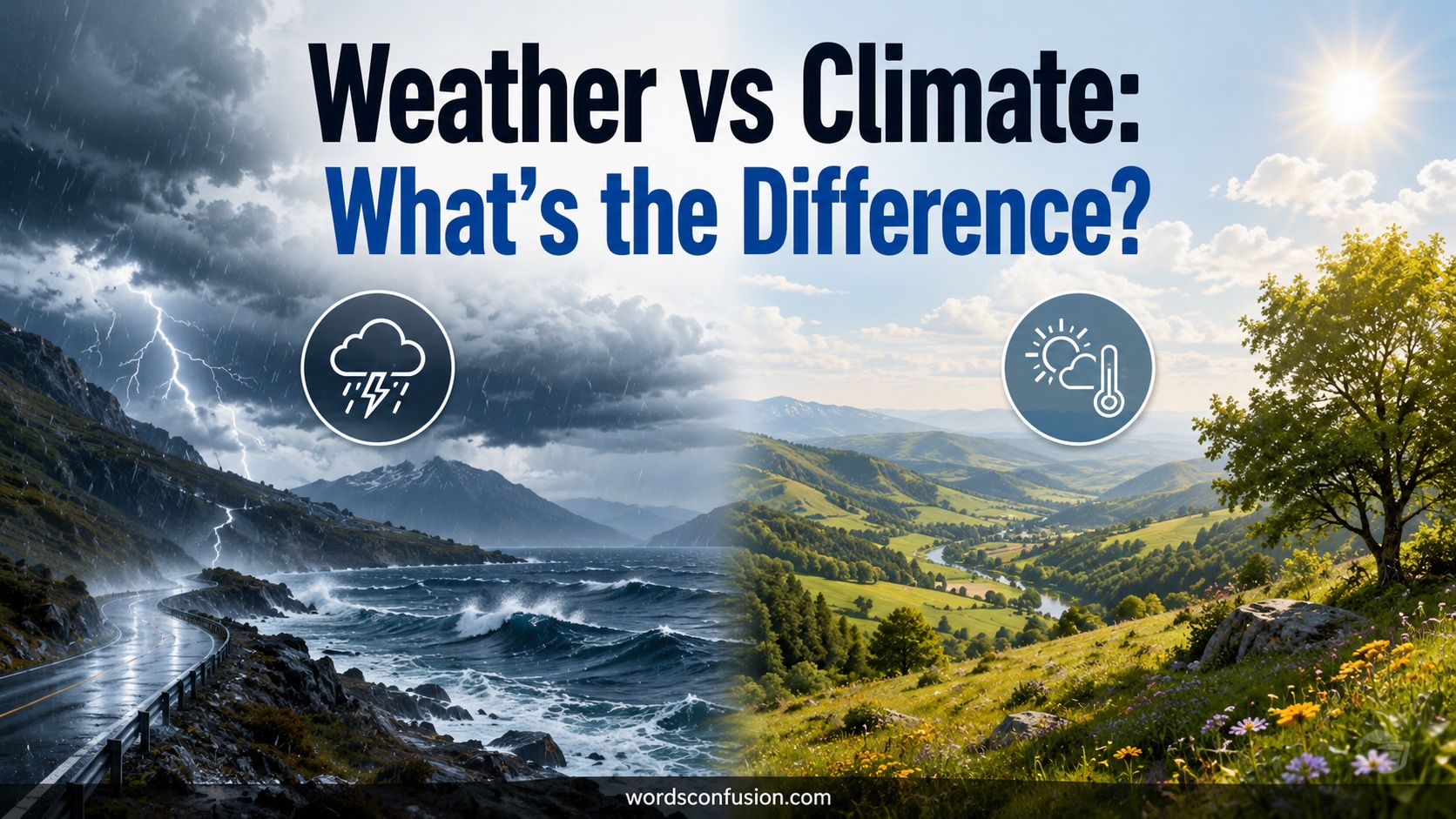
Have you ever heard someone say, “Today’s climate is terrible,” after a rainy afternoon? It happens all the time. People often use weather and climate as if they mean the same thing. They don’t. While both describe atmospheric conditions, they refer to different time scales and help us understand our environment in different ways.
Knowing the difference between weather vs climate isn’t just useful for science class. It helps you interpret weather forecasts, understand news about climate change, plan vacations, prepare for natural disasters, and even make better farming or business decisions.
Think of it this way: weather tells you what to wear today, while climate tells you what clothes belong in your closet all year. That simple idea captures the biggest distinction between these two terms.
In this guide, you’ll learn what weather and climate mean, how scientists measure them, what factors influence each one, why they matter, and how they work together. You’ll also find practical examples, comparison tables, common misconceptions, and an easy trick to remember the difference forever.
Weather vs Climate – Quick Answer
| Weather | Climate |
| Weather describes the short-term condition of the atmosphere at a specific place and time. | Climate describes the average weather patterns of a region over a long period, usually 30 years or more. |
| Changes hourly, daily, or weekly. | Changes over decades or centuries. |
| Forecast using current observations and computer models. | Determined by analyzing long-term weather records. |
| Example: It is raining today. | Example: Seattle has a generally wet climate. |
Simple example:
If it rains this afternoon, that’s weather.
If a city usually experiences rainy winters every year, that’s climate.
Easy way to remember:
Weather is what you get today. Climate is what you expect over many years.
What Is Weather?
Weather refers to the current state of the atmosphere at a particular location and time. It includes everything happening outside right now, whether it’s sunny, cloudy, windy, foggy, snowy, or stormy.
Unlike climate, weather changes constantly. A bright morning can turn into a rainy afternoon. Calm winds can become powerful gusts within hours. That’s why weather forecasts update several times each day.
Weather affects almost every part of daily life. It influences transportation, agriculture, sports, construction, tourism, and even your morning commute.
Elements of Weather
Meteorologists observe several atmospheric conditions to describe weather accurately.
- Temperature measures how hot or cold the air is.
- Humidity indicates the amount of water vapor in the air.
- Air pressure measures the weight of the atmosphere.
- Wind speed and direction show how air moves.
- Cloud cover reveals the amount of clouds in the sky.
- Precipitation includes rain, snow, sleet, and hail.
- Visibility measures how clearly you can see through the atmosphere.
These elements constantly interact. A drop in air pressure may signal an approaching storm. Warm ocean water can fuel hurricanes. Cold temperatures combined with moisture can produce snowfall.
Examples of Weather
Weather changes quickly because atmospheric conditions constantly shift.
Examples include:
- A thunderstorm during the evening
- Heavy snowfall overnight
- Dense morning fog
- A windy afternoon
- A sunny weekend
- A heatwave lasting several days
- Freezing temperatures overnight
Each event represents weather, not climate, because it occurs over a relatively short period.
Why Does Weather Change So Quickly?
Several natural processes keep the atmosphere moving.
These include:
- Uneven heating from the sun
- Earth’s rotation
- Ocean currents
- Changing air pressure systems
- Jet streams
- Moisture moving through the atmosphere
Because these factors constantly change, predicting weather becomes more difficult the further into the future you look. A forecast for tomorrow is usually much more accurate than one made two weeks in advance.
Why Weather Forecasts Improve Every Year
Modern forecasting combines millions of observations from around the world.
Meteorologists collect data from:
- Weather stations
- Doppler radar
- Weather balloons
- Satellites
- Aircraft
- Ocean buoys
- Computer forecast models
Advanced supercomputers analyze this information to predict how atmospheric conditions will evolve over the coming hours and days.
Even with sophisticated technology, the atmosphere remains a chaotic system. Small changes today can produce very different weather several days later.
This sensitivity explains why weather forecasts gradually lose accuracy over time.
What Is Climate?
Climate describes the long-term pattern of weather in a particular region. Instead of focusing on today’s conditions, climate looks at what the weather is usually like over many years. According to the World Meteorological Organization (WMO), scientists typically use 30 years of weather data to define a region’s climate. This long record helps smooth out unusual events and reveals consistent patterns.
For example, one snowy winter doesn’t change a region’s climate. Likewise, one hot summer doesn’t mean the climate has permanently shifted. Scientists examine decades of observations before drawing conclusions about climate trends.
Climate helps answer questions such as:
- Is this area generally warm or cold?
- Does it receive heavy rainfall each year?
- Are winters usually mild or severe?
- How long does the dry season last?
- How often do hurricanes or droughts occur?
Unlike weather, climate changes gradually. Natural processes and human activities can influence it over many decades or even centuries.
Major Climate Types
Scientists classify climates based on long-term averages of temperature and precipitation.
Tropical Climate
A tropical climate stays warm throughout the year and receives abundant rainfall.
Characteristics include:
- High temperatures year-round
- Frequent rainfall
- High humidity
- Dense rainforests in many regions
Examples include parts of the Amazon Basin, Indonesia, and central Africa.
Desert Climate
Desert climates receive very little rainfall and often experience extreme temperatures.
Characteristics include:
- Less than 10 inches (250 mm) of rain annually
- Hot days
- Cool or cold nights
- Sparse vegetation
The Sahara Desert and the Arabian Desert are classic examples.
Temperate Climate
Temperate climates experience four distinct seasons.
Characteristics include:
- Warm summers
- Cool or cold winters
- Moderate rainfall
- Seasonal temperature changes
Much of Europe and parts of the United States fall into this category.
Polar Climate
Polar climates remain extremely cold throughout the year.
Characteristics include:
- Long, harsh winters
- Very short summers
- Limited precipitation
- Ice sheets and tundra landscapes
Antarctica and Greenland are well-known examples.
Why Do Scientists Use 30 Years?
Thirty years provides enough information to identify stable weather patterns while filtering out short-term variations.
For instance:
- One unusually wet year doesn’t define a climate.
- One severe drought doesn’t permanently change a climate.
- One powerful hurricane doesn’t represent average conditions.
By studying three decades of observations, scientists can determine what is normal for a particular region.
Climate Is More Than Temperature
Many people associate climate only with heat or cold. In reality, climate includes several long-term atmospheric patterns.
Climate considers:
- Average temperatures
- Annual rainfall
- Humidity levels
- Wind patterns
- Seasonal changes
- Snowfall frequency
- Storm occurrence
Together, these factors create the unique climate of every region on Earth.
Weather vs Climate: Side-by-Side Comparison
Understanding the difference becomes much easier when you compare the two directly.
| Feature | Weather | Climate |
| Definition | Short-term atmospheric conditions | Long-term average weather patterns |
| Time Scale | Minutes to weeks | 30 years or more |
| Changes | Frequently | Gradually |
| Predictability | Days to about two weeks | Long-term trends over decades |
| Data Used | Current observations | Historical weather records |
| Geographic Scope | Local areas | Regions, countries, or the globe |
| Examples | Rain today, snow tomorrow | Tropical climate, desert climate |
| Measured By | Weather stations, radar, satellites | Long-term weather records and climate models |
| Purpose | Daily forecasts | Understanding long-term environmental patterns |
Weather vs Climate at a Glance
| Weather | Climate |
| What is happening now | What usually happens over many years |
| Changes quickly | Changes slowly |
| Forecast for days | Studied over decades |
| Helps plan daily activities | Helps understand long-term environmental trends |
The Biggest Difference Between Weather and Climate
The simplest way to understand weather vs climate is to focus on time.
Weather tells you what’s happening right now.
Climate tells you what’s normally expected over many years.
Imagine visiting a city for one weekend. If it rains during your trip, you’ve experienced its weather. However, you can’t conclude that the city has a rainy climate based on just two days. You need decades of weather records to understand its climate.
An Easy Analogy
Think about a person’s behavior.
- Weather is like someone’s mood.
- Climate is like their personality.
A person may feel happy one day and frustrated the next. Their mood changes frequently. However, their overall personality stays much more consistent over time.
The atmosphere behaves in a similar way.
Another Simple Example
Consider the city of Phoenix, Arizona.
One winter day might be cloudy with light rain.
That’s weather.
However, Phoenix remains known for its hot, dry desert climate because decades of observations show consistently low rainfall and high temperatures.
One unusual day doesn’t redefine the region’s climate.
Why One Storm Doesn’t Define Climate
People sometimes point to a cold day or a snowstorm and claim climate change isn’t happening.
That’s a misunderstanding.
Individual weather events occur naturally. Climate examines long-term averages, not isolated events.
Scientists analyze:
- Decades of temperatures
- Long-term rainfall trends
- Seasonal changes
- Ocean temperatures
- Ice cover
- Atmospheric patterns
Only after examining large datasets can they identify genuine climate trends.
How Climate Influences Weather
Climate doesn’t determine tomorrow’s weather. Instead, it creates the conditions under which weather occurs.
For example:
- Tropical climates experience frequent heavy rainfall.
- Desert climates usually have dry weather.
- Polar climates remain cold for most of the year.
- Mediterranean climates often have dry summers and wetter winters.
In other words, weather happens within the boundaries set by climate.
How Scientists Measure Weather
Scientists monitor weather continuously using advanced instruments and technology. These observations help meteorologists understand current atmospheric conditions and create short-term forecasts.
Weather Stations
Weather stations collect data from the Earth’s surface. They measure:
- Air temperature
- Humidity
- Wind speed
- Wind direction
- Atmospheric pressure
- Rainfall
Thousands of automated weather stations operate worldwide and send updates every few minutes.
Weather Satellites
Satellites orbit Earth and capture images of clouds, storms, and atmospheric conditions. They help meteorologists track:
- Hurricanes
- Thunderstorms
- Cloud movement
- Wildfire smoke
- Snow cover
Satellites also monitor regions where ground-based weather stations are scarce, such as oceans and remote deserts.
Doppler Radar
Radar systems detect precipitation and measure its movement.
Meteorologists use radar to identify:
- Rain
- Snow
- Hail
- Thunderstorms
- Tornado-producing storms
This technology plays a vital role in issuing severe weather warnings.
Weather Balloons
Weather balloons carry instruments called radiosondes high into the atmosphere.
They measure:
- Temperature
- Humidity
- Air pressure
- Wind speed
- Wind direction
These measurements improve the accuracy of weather prediction models.
Ocean Buoys
Because oceans cover more than 70% of Earth’s surface, ocean buoys provide valuable weather data.
They monitor:
- Sea surface temperature
- Wave height
- Wind conditions
- Atmospheric pressure
This information helps forecast hurricanes and other marine weather events.
Computer Forecast Models
Modern forecasting relies heavily on powerful computers.
Scientists combine observations from around the world with mathematical equations to simulate how the atmosphere will behave over the coming hours and days.
Although forecasts have improved significantly over the last few decades, the atmosphere remains highly dynamic. As a result, long-range weather forecasts become less accurate over time.
How Scientists Measure Climate
Climate scientists focus on long-term patterns rather than daily conditions. They gather information from many different sources to understand how Earth’s climate has changed over decades, centuries, and even millions of years.
Long-Term Weather Records
The foundation of climate science is historical weather data.
Scientists analyze decades of records that include:
- Daily temperatures
- Rainfall totals
- Snowfall
- Wind patterns
- Humidity
- Air pressure
These records reveal long-term trends rather than isolated events.
Ice Cores
Scientists drill deep into glaciers and ice sheets to extract ice cores.
Each layer contains tiny air bubbles trapped thousands of years ago.
These samples reveal:
- Ancient atmospheric composition
- Past temperatures
- Volcanic activity
- Greenhouse gas concentrations
Some Antarctic ice cores preserve climate information dating back more than 800,000 years.
Tree Rings
Trees add one growth ring each year.
The width of each ring reflects growing conditions during that season.
Scientists use tree rings to estimate:
- Rainfall
- Temperature
- Drought periods
- Regional climate changes
Ocean Sediments
Layers of sediment accumulate slowly on the ocean floor.
These layers contain fossils, minerals, and chemical signatures that provide clues about ancient climates.
Researchers use them to reconstruct Earth’s climate history over millions of years.
Satellite Observations
Satellites also support climate research by monitoring long-term changes in:
- Global temperatures
- Sea ice
- Ocean temperatures
- Vegetation
- Cloud cover
- Sea level
Because satellites observe the entire planet, they provide a consistent global perspective.
Climate Models
Climate models differ from weather models.
Instead of predicting next week’s weather, they simulate long-term climate trends under different scenarios.
Scientists use these models to study:
- Rising global temperatures
- Changing rainfall patterns
- Sea-level rise
- Future climate conditions
Read More: Vision vs Mission: What’s the Difference? Meaning, and Examples
Factors That Affect Weather
Several natural factors influence daily weather conditions.
Temperature
The Sun heats Earth’s surface unevenly. Warm air rises while cooler air sinks, creating atmospheric circulation that drives weather systems.
Air Pressure
Differences in air pressure create wind.
Low-pressure systems often bring clouds and precipitation, while high-pressure systems usually produce clearer skies.
Humidity
Humidity measures the amount of water vapor in the air.
Higher humidity increases the likelihood of cloud formation and rainfall.
Wind
Wind moves heat and moisture around the planet.
Strong winds can quickly change local weather conditions.
Jet Streams
Jet streams are fast-moving rivers of air high in the atmosphere.
They guide storms and influence weather patterns across large regions.
Ocean Currents
Warm and cold ocean currents transfer heat around the globe.
They affect coastal temperatures and influence storm development.
Mountains
Mountains force air upward.
As air rises, it cools and often produces precipitation on one side while creating dry conditions on the other.
Factors That Affect Climate
Climate develops over long periods because several geographic and environmental factors remain relatively stable.
These include:
- Latitude: Areas near the equator receive more direct sunlight than the poles.
- Elevation: Higher elevations are generally cooler than low-lying regions.
- Distance from oceans: Coastal regions often have milder climates than inland areas.
- Ocean currents: Warm and cold currents influence regional temperatures.
- Prevailing winds: Long-term wind patterns transport heat and moisture.
- Mountain ranges: Mountains can block moisture and create rain shadows.
- Vegetation: Forests, grasslands, and deserts influence local temperatures and humidity.
- Human activities: Urbanization and greenhouse gas emissions can affect regional and global climate.
Examples of Weather vs Climate
The easiest way to understand the difference is through everyday examples.
| Situation | Weather or Climate? | Why? |
| It rained this afternoon. | Weather | A short-term event. |
| Chicago usually has cold winters. | Climate | A long-term seasonal pattern. |
| A thunderstorm is expected tonight. | Weather | A daily forecast. |
| The Sahara receives very little rainfall each year. | Climate | A long-term average. |
| Tomorrow’s high will reach 90°F (32°C). | Weather | A one-day forecast. |
| Antarctica remains extremely cold year-round. | Climate | A persistent climate pattern. |
Can Climate Change Affect Weather?
Yes. Climate change can influence weather patterns, but it does not cause every individual weather event.
As Earth’s average temperature rises, the atmosphere can hold more moisture and store more energy. These changes may increase the likelihood or intensity of certain types of extreme weather.
Research shows that climate change can contribute to:
- More frequent heatwaves
- Heavier rainfall in some regions
- Longer droughts in others
- Increased wildfire risk
- Rising sea levels that worsen coastal flooding
- Stronger tropical cyclones under favorable conditions
However, it’s important to understand that weather is naturally variable. A single storm, cold spell, or heatwave cannot prove or disprove long-term climate change. Scientists study decades of observations before identifying climate trends.
FAQs:
What is the main difference between weather and climate?
Weather describes short-term atmospheric conditions, such as today’s temperature or tomorrow’s rain forecast. Climate refers to the average weather patterns in a region over at least 30 years.
Why do scientists use 30 years to define climate?
A 30-year period provides enough data to smooth out unusual weather events and identify reliable long-term patterns. This standard helps scientists compare climates consistently across different regions.
Can weather affect climate?
Individual weather events do not change climate. However, the combined weather patterns observed over many decades form a region’s climate. Climate is essentially the long-term average of weather.
Why is weather easier to observe than climate?
You can observe weather directly by looking outside or checking a forecast. Climate requires decades of weather observations and data analysis to identify long-term trends and averages.
Can two places have similar weather but different climates?
Yes. Two cities may experience the same weather on a particular day, such as rain or sunshine, yet have very different climates based on their long-term temperature, rainfall, and seasonal patterns.
Conclusion:
Understanding weather vs climate is easier once you focus on one key idea: weather is temporary, while climate is long-term. Weather describes the atmosphere at a specific place and time, changing from hour to hour or day to day. Climate, on the other hand, reflects the average of those weather conditions over decades.
Although the two concepts are closely connected, they serve different purposes. Weather helps you decide whether to carry an umbrella today. Climate helps communities design buildings, farmers choose crops, scientists study environmental changes, and governments prepare for future challenges.

Andrew Wilson is an experienced language researcher and content writer specializing in WordsConfusion topics. He helps readers understand commonly confused English words, spelling differences, grammar rules, word meanings, and proper usage through clear explanations, practical examples, and easy-to-follow language guides. His goal is to make English learning simple, accurate, and accessible for students, writers, professionals, and everyday learners.