Setting a clear direction is one of the biggest factors behind success. Whether you’re planning a business strategy, preparing for an exam, launching a marketing campaign, or working toward a personal milestone, you’ve probably heard the terms goal and objective. Many people use them interchangeably. However, they don’t mean the same thing.
Understanding the difference between a goal vs objective helps you create better plans, measure progress accurately, and stay focused on what truly matters. A goal gives you a destination. An objective maps out the steps you need to reach it. When you know how they work together, planning becomes simpler and results become easier to achieve.
For example, imagine you want to run a marathon. Saying, “I want to finish a marathon,” is your goal. Training four days a week, increasing your running distance by one mile every week, and completing a 20-mile practice run before race day are your objectives. The goal tells you where you’re going. The objectives explain how you’ll get there.
This guide explains the meaning of goals and objectives, highlights their key differences, shows practical examples across different industries, and teaches you how to write both effectively. By the end, you’ll know exactly when to use each term and how they fit into a successful plan.
Goal vs Objective – Quick Answer
A goal is a broad, long-term outcome that you want to achieve. It describes the overall destination.
An objective is a specific, measurable action that helps you achieve that goal. It defines the steps needed to reach the destination.
In simple terms:
- Goal = What you want to achieve
- Objective = How you will achieve it
Example
Goal: Increase customer satisfaction.
Objectives:
- Reduce average response time from six hours to two hours within three months.
- Achieve a customer satisfaction score of 90% by the end of the year.
- Train every customer support representative on the new help desk system before the next quarter.
The goal provides direction. The objectives create a practical roadmap.
Goal vs Objective Comparison Table
| Feature | Goal | Objective |
| Definition | A broad desired outcome | A specific action or result that supports a goal |
| Purpose | Provides direction | Creates a measurable plan |
| Scope | Wide | Narrow and focused |
| Timeframe | Long-term | Short-term or milestone-based |
| Measurement | Often qualitative | Usually quantitative and measurable |
| Level of Detail | General | Detailed |
| Flexibility | Can change as priorities evolve | Usually follows a defined plan |
| Focus | End result | Process and progress |
| Example | Become an industry leader | Increase market share by 10% within 12 months |
What Is a Goal?
Definition of a Goal
A goal is the overall result you want to accomplish. It represents a vision or destination rather than a detailed action plan.
Goals answer questions such as:
- What do you want to achieve?
- Where do you want to be?
- What outcome are you working toward?
Unlike objectives, goals don’t always include numbers, deadlines, or precise measurements. Instead, they provide motivation and establish a clear direction.
Think of a goal as the destination on a GPS. You know where you want to arrive even though you haven’t chosen every road you’ll take.
Key Characteristics of a Goal
A strong goal usually has several important qualities.
Broad in scope
Goals focus on the big picture instead of individual tasks.
Long-term
Many goals take months or even years to accomplish.
Direction-focused
Goals guide decisions and priorities.
Motivating
A meaningful goal inspires action and keeps people committed.
Outcome-oriented
Goals describe the final achievement rather than the activities required to reach it.
Examples of Goals
Business
- Become the leading software provider for small businesses.
- Improve customer loyalty across all product lines.
Career
- Become a senior project manager.
- Build expertise in data analytics.
Education
- Graduate with honors.
- Earn a master’s degree.
Fitness
- Complete a full marathon.
- Improve overall health and endurance.
Personal Life
- Achieve financial independence.
- Learn to speak Spanish fluently.
- Build a healthier work-life balance.
Notice that each goal describes an end result. None explains exactly how to accomplish it.
Why Goals Matter
Without goals, it’s easy to stay busy without making meaningful progress.
Goals help you:
- Focus your efforts.
- Prioritize important work.
- Stay motivated during challenges.
- Make better decisions.
- Measure long-term success.
Imagine building a house without a blueprint. Every worker might stay busy, yet the finished structure wouldn’t match the owner’s vision. Goals serve as that blueprint for your plans.
“A goal without a plan is just a wish.” — Antoine de Saint-Exupéry
Although the quote is widely shared in leadership and business circles, its message remains relevant. Goals become achievable only when you support them with clear objectives.
What Is an Objective?
Definition of an Objective
An objective is a specific, measurable result or action that moves you closer to achieving a goal.
Objectives answer questions such as:
- What exactly needs to happen?
- How will success be measured?
- When should it be completed?
Unlike goals, objectives leave little room for ambiguity. They define clear expectations and measurable outcomes.
Think of objectives as the checkpoints along a road trip. Every checkpoint confirms you’re moving in the right direction toward your destination.
Key Characteristics of an Objective
Effective objectives share several common traits.
Specific
Everyone understands exactly what needs to happen.
Measurable
Progress can be tracked using numbers, percentages, or milestones.
Action-oriented
Objectives focus on activities or results rather than broad ideas.
Time-bound
Most objectives include a deadline.
Aligned with a Goal
Every objective should contribute directly to achieving a larger goal.
Examples of Objectives
Workplace
- Reduce employee turnover by 15% within one year.
- Complete leadership training for all supervisors by September.
Marketing
- Increase website traffic by 30% over the next six months.
- Generate 500 qualified leads each month.
Education
- Study two hours every weekday.
- Maintain a GPA of 3.8 or higher this semester.
Health
- Walk 10,000 steps five days each week.
- Lose 15 pounds over four months through regular exercise and balanced nutrition.
Project Management
- Finish software testing before July 30.
- Complete user training before product launch.
Each objective clearly defines what success looks like and when it should happen.
Why Objectives Matter
Objectives turn ideas into action.
They help you:
- Break large goals into manageable steps.
- Track progress consistently.
- Identify problems early.
- Keep teams aligned.
- Measure success with confidence.
Suppose your goal is to publish a book. Writing one chapter every two weeks, completing editing by October, and submitting the manuscript before December are objectives that steadily move you toward your goal.
The Main Differences Between Goals and Objectives
People often confuse goals and objectives because they both describe desired outcomes. However, each serves a distinct purpose. Understanding their differences makes planning far more effective.
Scope
A goal covers the overall destination.
An objective focuses on one specific part of the journey.
Example
Goal: Improve employee engagement.
Objective: Increase employee survey participation from 65% to 90% by the end of the quarter.
The goal is broad. The objective addresses one measurable improvement.
Specificity
Goals are intentionally general. They provide direction without describing every detail.
Objectives remove uncertainty. They explain exactly what should happen.
| Goal | Objective |
| Improve customer service. | Reduce average customer wait time to under three minutes by December. |
Measurability
Goals often describe success in broad terms.
Objectives use measurable indicators such as percentages, revenue, completion rates, or deadlines.
For example:
Goal
Increase brand awareness.
Objective
Grow social media followers by 20% within six months.
The objective gives you a clear way to evaluate progress.
Timeframe
Goals usually span a longer period.
Objectives often focus on shorter milestones that contribute to long-term success.
| Goal | Typical Timeline |
| Become a market leader | Three to five years |
| Launch a new website | Three months |
| Increase monthly sales | Six months |
Objectives create momentum by breaking large ambitions into achievable stages.
Purpose
Goals define the destination.
Objectives define the path.
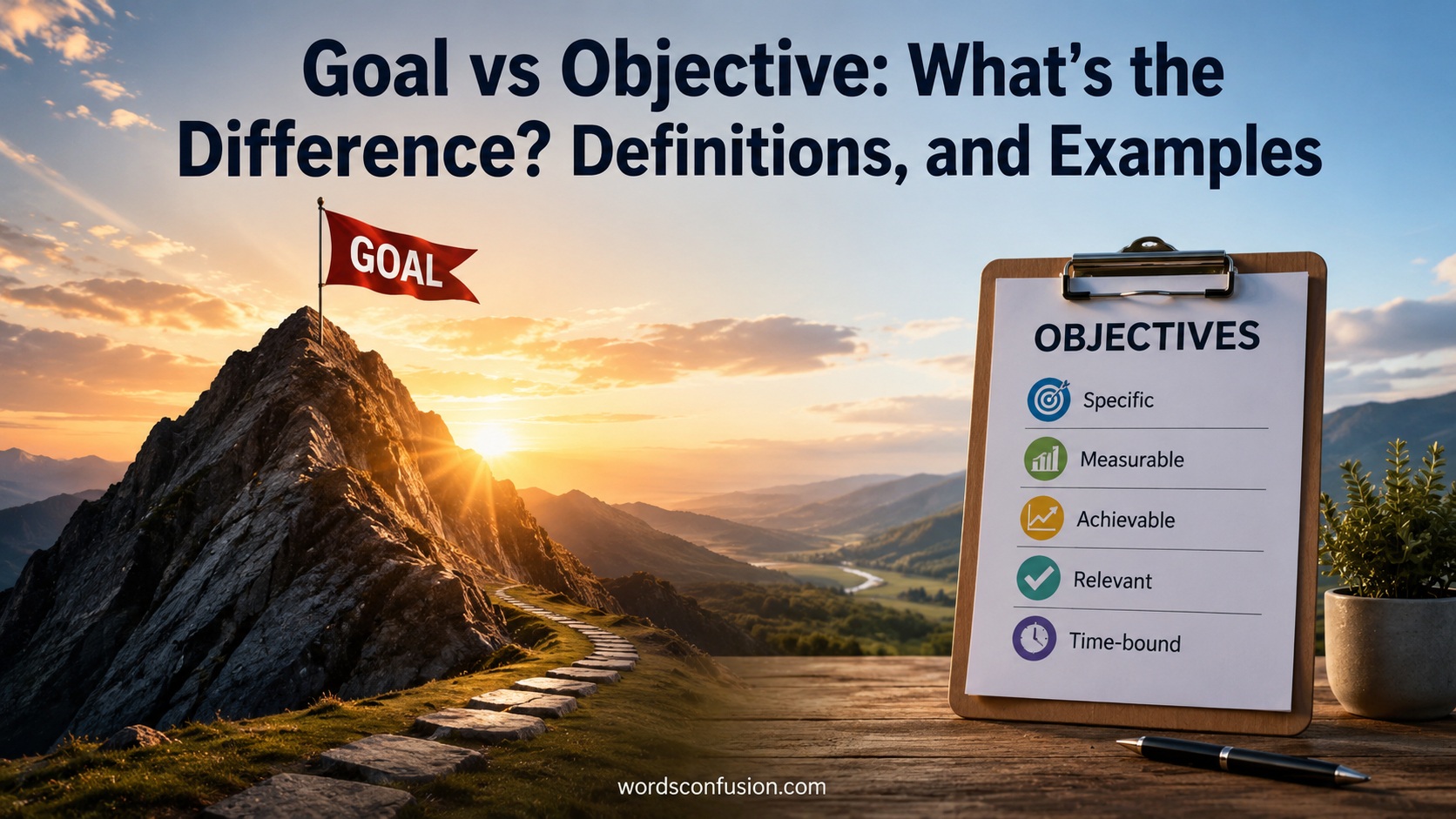
Think of climbing a mountain.
The summit is your goal.
The trail markers, rest stops, equipment checks, and daily climbing schedule are your objectives.
Without objectives, reaching the summit becomes much more difficult.
Flexibility
Goals can evolve as circumstances change.
For example, a company might shift its long-term vision after entering a new market.
Objectives are usually less flexible because they involve deadlines, budgets, and measurable commitments. Teams often adjust them only when priorities change significantly.
Success Criteria
Goals answer one question:
Did we reach the desired outcome?
Objectives answer another:
Did we complete the measurable steps needed to get there?
Successful organizations evaluate both.
They celebrate achieving goals while also reviewing whether each objective contributed effectively to the final result.
Read More: Weather vs Climate: What’s the Difference? Definitions, and Examples
Goal vs Objective Examples in Different Situations
The easiest way to understand the difference between a goal and an objective is to see how they work in real life. No matter the field, the relationship stays the same. The goal defines the destination. The objectives describe the measurable steps that lead there.
Business Example
Goal
Increase annual company revenue.
Objectives
- Increase online sales by 20% within 12 months.
- Launch two new products before the fourth quarter.
- Improve customer retention from 75% to 85%.
- Expand into three new regional markets by year-end.
In this example, the company has one broad goal. Each objective contributes directly to achieving that goal.
Marketing Example
Goal
Build stronger brand awareness.
Objectives
- Increase organic website traffic by 35% in six months.
- Publish four high-quality blog posts every month.
- Reach 100,000 social media followers before December.
- Earn 50 backlinks from reputable websites.
Marketing teams often measure objectives using analytics, making it easier to evaluate success.
Education Example
Goal
Graduate with honors.
Objectives
- Maintain a GPA of at least 3.8.
- Complete every assignment before its deadline.
- Study three hours each weekday.
- Attend every scheduled review session.
Career Example
Goal
Become a senior software engineer.
Objectives
- Earn an advanced cloud certification within six months.
- Lead two major development projects this year.
- Mentor one junior developer each quarter.
- Improve coding efficiency by reducing bugs by 25%.
Fitness Example
Goal
Complete a marathon.
Objectives
- Run four times each week.
- Increase weekly mileage by 10%.
- Complete a 20-mile training run before race day.
- Follow a balanced nutrition plan throughout training.
Personal Finance Example
Goal
Achieve financial independence.
Objectives
- Save 20% of monthly income.
- Eliminate all high-interest debt within two years.
- Invest consistently every month.
- Build an emergency fund covering six months of expenses.
How Goals and Objectives Work Together
Goals and objectives are partners, not competitors. One without the other creates an incomplete plan.
A goal provides purpose. Objectives create progress.
Consider this simple hierarchy:
Vision
↓
Goal
↓
Objectives
↓
Tasks
↓
Daily Actions
Here’s a practical example.
Vision
Build a successful online business.
Goal
Become a trusted authority in digital marketing.
Objectives
- Publish three in-depth articles each week.
- Grow email subscribers to 25,000 within one year.
- Increase monthly organic traffic by 40%.
- Launch one premium course before year-end.
Tasks
- Research keywords.
- Write articles.
- Design landing pages.
- Send weekly newsletters.
Every task supports an objective. Every objective supports the goal. Together, they move you closer to your vision.
SMART Objectives Explained
Objectives work best when they follow the SMART framework.
| SMART Element | Meaning |
| Specific | Clearly defines what will be achieved. |
| Measurable | Progress can be tracked. |
| Achievable | Realistic based on available resources. |
| Relevant | Supports the larger goal. |
| Time-bound | Includes a deadline. |
Weak Objective
Increase website visitors.
SMART Objective
Increase organic website traffic by 30% within six months by publishing two optimized articles every week.
The second version leaves little room for confusion. Everyone knows what success looks like.
FAQs:
Is a goal the same as an objective?
No. A goal is the overall outcome you want to achieve while an objective is a specific, measurable step that helps you reach that outcome.
Which comes first, a goal or an objective?
The goal comes first. Once you know where you want to go, you can create objectives that guide you toward that destination.
Can one goal have multiple objectives?
Yes. Most meaningful goals require several objectives. Each objective addresses a different part of the plan and contributes to the same overall result.
Are objectives always measurable?
In most professional settings, yes. Effective objectives include measurable outcomes such as percentages, deadlines, revenue, customer satisfaction scores, or completion rates. Measurable objectives make it easier to track progress and evaluate success.
What is the difference between a goal, an objective, and a target?
A goal describes the broad result you want to achieve. An objective explains the measurable action needed to reach that goal. A target is a specific numerical benchmark used to measure progress, such as increasing sales by 15% or gaining 1,000 new customers.
Conclusion:
Understanding the difference between goal vs objective can transform the way you plan, work, and measure success. Although people often use the terms interchangeably, they serve distinct purposes. A goal gives you a clear destination and a sense of purpose. An objective breaks that vision into practical, measurable steps you can follow.
Whether you’re leading a business, managing a project, pursuing a career milestone, or working toward a personal ambition, combining well-defined goals with carefully planned objectives creates a roadmap for success. Goals keep you focused on the bigger picture. Objectives help you make steady progress one milestone at a time.

Andrew Wilson is an experienced language researcher and content writer specializing in WordsConfusion topics. He helps readers understand commonly confused English words, spelling differences, grammar rules, word meanings, and proper usage through clear explanations, practical examples, and easy-to-follow language guides. His goal is to make English learning simple, accurate, and accessible for students, writers, professionals, and everyday learners.