
When people compare accuracy vs precision, they often assume both words mean the same thing. They don’t. Although the terms frequently appear together, they describe two different qualities of a measurement. Understanding that distinction helps you interpret data correctly, make better decisions, and communicate more clearly in science, engineering, healthcare, business, and even everyday life.
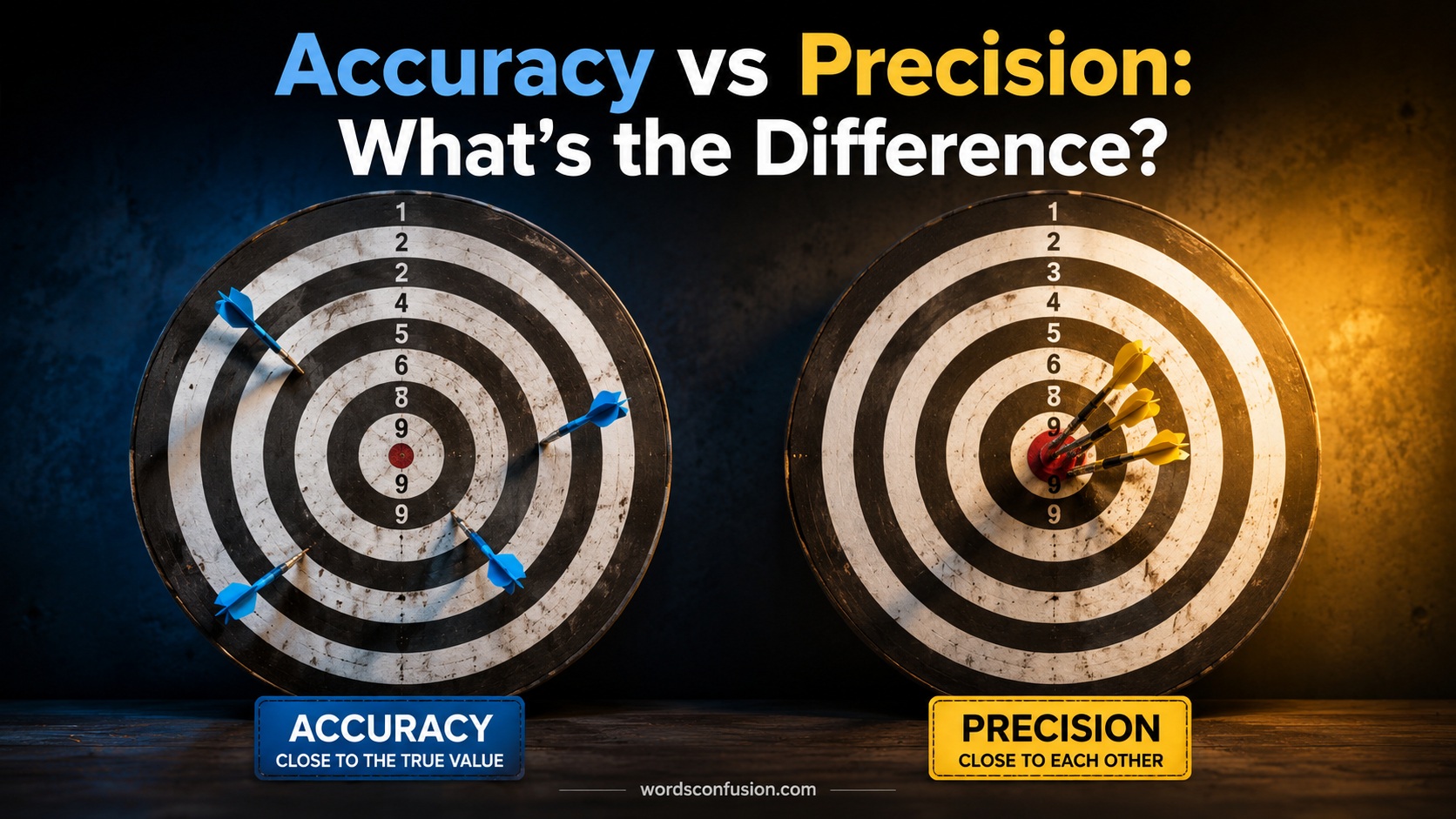
Imagine you’re throwing darts at a dartboard. If every dart lands close to the bullseye, your throws are accurate. If every dart lands close together, even if they miss the bullseye, your throws are precise. That simple example captures the heart of the difference.
The confusion doesn’t stop with dartboards. People often misuse these words when talking about GPS directions, medical tests, manufacturing, laboratory experiments, and statistical analysis. In many situations, using the wrong term can lead to misunderstandings about quality, reliability, or performance.
This guide explains accuracy vs precision in plain English. You’ll learn what each term means, how they differ, why both matter, and how to recognize them through practical examples you can relate to.
Quick Answer
Accuracy measures how close a result is to the true or accepted value.
Precision measures how close repeated results are to one another.
A measurement can be:
- Accurate but not precise.
- Precise but not accurate.
- Both accurate and precise.
- Neither accurate nor precise.
Here’s a quick comparison.
| Feature | Accuracy | Precision |
| Meaning | Closeness to the true value | Closeness of repeated measurements |
| Focus | Correctness | Consistency |
| Depends On | Low systematic error | Low random error |
| Repeatability | Not required | Essential |
| Best Example | Hitting the bullseye | Darts landing tightly together |
The ideal measurement achieves both accuracy and precision.
Accuracy vs Precision at a Glance
Although people often use these terms interchangeably, they answer different questions.
- Accuracy asks: Did you get the correct result?
- Precision asks: Can you get the same result repeatedly?
The following table highlights their differences.
| Aspect | Accuracy | Precision |
| Definition | Closeness to the correct value | Closeness among repeated values |
| Goal | Produce the correct measurement | Produce consistent measurements |
| Related Error | Systematic error | Random error |
| Measurement Quality | Correctness | Repeatability |
| Example | A thermometer reads exactly 98.6°F | A thermometer repeatedly reads 99.2°F |
| Can Exist Alone? | Yes | Yes |
| Best Outcome | High accuracy | High precision plus high accuracy |
Understanding this distinction makes it easier to evaluate experiments, compare products, and interpret reports correctly.
What Is Accuracy?
Accuracy refers to how close a measurement comes to the actual, accepted, or true value.
Think of accuracy as correctness. The closer your measurement is to reality, the more accurate it becomes.
Suppose a certified laboratory weight weighs exactly 500 grams.
- Scale A reads 500 g.
- Scale B reads 498 g.
Scale A is clearly more accurate because its reading matches the true weight.
Accuracy depends on comparing a measurement against a known reference. Without a reliable reference point, you can’t determine whether something is truly accurate.
Key Characteristics of Accuracy
Accuracy has several defining characteristics.
- It measures correctness.
- It compares results with a known standard.
- It reflects how close measurements come to reality.
- It improves when systematic errors decrease.
- It often requires calibration against trusted standards.
An accurate result doesn’t necessarily mean you’ll get the same value every time. It simply means the measurement closely matches the true value.
Everyday Examples of Accuracy
Accuracy appears in daily life more often than many people realize.
GPS Navigation
If your phone says you’re standing exactly outside your destination and you actually are, the GPS is accurate.
Bathroom Scale
A certified 20-pound weight placed on a scale should display 20 pounds. If it does, the scale demonstrates good accuracy.
Medical Thermometer
If your body temperature is truly 98.6°F and the thermometer reports 98.6°F, the reading is accurate.
Exam Scoring
Answering 48 out of 50 questions correctly produces an accurate assessment of your knowledge because the answers match the correct solutions.
Weather Forecast
If the forecast predicts rain and it rains in the expected location and timeframe, the prediction shows accuracy.
What Is Precision?
While accuracy focuses on correctness, precision focuses on consistency.
Precision describes how close repeated measurements are to one another, regardless of whether they match the true value.
Imagine measuring the same object five times.
You obtain these results:
- 10.21 cm
- 10.22 cm
- 10.20 cm
- 10.21 cm
- 10.22 cm
These measurements are extremely close together. That indicates high precision.
However, if the object’s actual length is 10.80 cm, the measurements remain highly precise but completely inaccurate.
Precision values consistency above correctness.
Key Characteristics of Precision
Precision has several important features.
- Results remain consistent.
- Measurements cluster closely together.
- Random errors stay low.
- Repeatability remains high.
- Reliable instruments usually produce better precision.
Scientists often perform repeated measurements specifically to evaluate precision.
Everyday Examples of Precision
Basketball Free Throws
A player repeatedly hits the exact same spot on the backboard. The shots are precise even if they don’t go into the basket.
Manufacturing
A machine produces thousands of bolts measuring exactly 5.00 centimeters each. The bolts demonstrate excellent precision because their sizes hardly vary.
Printing
Modern printers place ink dots in nearly identical positions on every page. That consistency reflects precision.
Laboratory Testing
A blood analyzer repeatedly reports nearly identical values when testing the same sample multiple times.
Accuracy vs Precision: The Main Difference
The simplest way to understand accuracy vs precision is to remember this:
- Accuracy means being correct.
- Precision means being consistent.
Both qualities matter, but they solve different problems.
Imagine two students estimating the height of a building.
Student A gives these answers:
- 150 feet
- 152 feet
- 149 feet
The building actually measures 150 feet.
Student A demonstrates both accuracy and precision.
Now consider Student B.
- 170 feet
- 171 feet
- 170 feet
Those measurements are nearly identical. Student B shows excellent precision. However, the estimates remain far from the true height, so accuracy is poor.
Side-by-Side Comparison
| Feature | Accuracy | Precision |
| Focus | Correct value | Consistent values |
| Measures | Closeness to truth | Closeness among results |
| Error Type | Systematic error | Random error |
| Depends On | Calibration | Repeatability |
| Evaluation | Compared with true value | Compared with previous measurements |
| Real-World Goal | Correct answer | Reliable repetition |
Understanding both concepts helps professionals identify whether problems stem from equipment, procedures, or measurement techniques.
Visualizing Accuracy and Precision
The classic dartboard example remains one of the easiest ways to understand these concepts.
High Accuracy and High Precision
Every dart lands close together and near the bullseye.
This represents the ideal situation.
Examples include:
- Properly calibrated laboratory equipment.
- High-quality manufacturing machines.
- Well-maintained medical instruments.
Both correctness and consistency remain excellent.
High Accuracy but Low Precision
The darts surround the bullseye but spread across different locations.
On average, the throws hit the correct target. Individual attempts vary significantly.
This situation often occurs when random factors affect measurements.
Examples include:
- Wind affecting outdoor measurements.
- Human reaction time during experiments.
- Small environmental fluctuations.
High Precision but Low Accuracy
Every dart lands tightly grouped, but the cluster sits far from the bullseye.
The measurements remain highly repeatable. Unfortunately, they’re consistently wrong.
This usually happens because of systematic error.
Examples include:
- A miscalibrated scale.
- A thermometer with a faulty sensor.
- Manufacturing equipment needing adjustment.
Low Accuracy and Low Precision
The darts scatter randomly around the board.
They’re neither close to one another nor close to the target.
Possible causes include:
- Faulty instruments.
- Poor measurement techniques.
- Untrained operators.
- Uncontrolled environments.
This represents the least reliable outcome.
Can Something Be Accurate but Not Precise?
Yes. Although it sounds unusual, it happens regularly.
Imagine five people estimate the weight of a suitcase.
Their guesses are:
- 45 pounds
- 55 pounds
- 52 pounds
- 48 pounds
- 50 pounds
The suitcase actually weighs 50 pounds.
The average estimate equals the correct value, making the overall result accurate. However, individual estimates differ considerably, so precision remains low.
Another example comes from weather forecasting.
Daily temperature predictions may average very close to actual temperatures across a month. Individual daily forecasts, however, might fluctuate more than expected.
That reflects reasonable accuracy but limited precision.
High accuracy without precision usually indicates that random errors influence individual measurements while systematic bias remains minimal.
Can Something Be Precise but Not Accurate?
Yes. In fact, this situation is common when measuring equipment hasn’t been calibrated correctly.
Imagine a digital scale that always reads 2 pounds heavier than the actual weight.
A 20-pound package produces these readings:
- 22.0 pounds
- 22.1 pounds
- 22.0 pounds
- 22.1 pounds
- 22.0 pounds
The readings barely change from one measurement to the next. That means the scale is highly precise. However, every result is incorrect because the true weight is 20 pounds. The scale lacks accuracy.
This type of problem usually results from a systematic error, which shifts every measurement in the same direction.
Another example involves a marksman aiming at a target. Every shot lands in the same small area, but all the shots miss the bullseye by several inches. The shooter demonstrates precision because the shots cluster together. Accuracy, however, remains low because none of the shots hit the intended target.
Businesses often encounter this issue during manufacturing. Suppose a machine consistently produces metal rods measuring 50.5 cm instead of the required 50 cm. Every rod has nearly identical dimensions, so production is precise. Since every rod exceeds the required length, production isn’t accurate.
The lesson is simple: Consistency doesn’t guarantee correctness.
Can You Have Both Accuracy and Precision?
Yes. In fact, this is the goal in nearly every field that relies on measurements.
When a measurement is both accurate and precise, it is:
- Close to the true value.
- Consistent across repeated measurements.
- Reliable enough for critical decisions.
- Less affected by random and systematic errors.
Scientists, engineers, manufacturers, and healthcare professionals all strive for this balance because reliable measurements reduce mistakes and improve outcomes.
Consider a pharmaceutical laboratory testing the concentration of an active ingredient in medicine.
If every test reports 100.0 mg, and the actual concentration is 100.0 mg, the measurements are both accurate and precise. Patients receive the correct dosage, manufacturers meet quality standards, and regulators can trust the results.
Another example comes from modern aircraft manufacturing. Engineers measure thousands of components before assembly. Every measurement must be correct and repeatable because even tiny deviations can affect safety.
High accuracy and high precision create confidence in data, products, and decisions.
Read More: Goal vs Objective: What’s the Difference? Definitions, and Examples
Why Accuracy and Precision Matter
Measurements influence countless decisions every day. When measurements become unreliable, the consequences range from minor inconveniences to life-threatening failures.
Understanding the difference between accuracy and precision helps professionals identify problems before they become expensive or dangerous.
Accuracy vs Precision in Science
Scientific research depends on trustworthy measurements.
Researchers measure temperature, mass, distance, pressure, and chemical concentrations throughout an experiment. If instruments aren’t accurate, the conclusions may be incorrect. If measurements aren’t precise, other researchers may struggle to reproduce the results.
Reliable experiments require both qualities.
Scientists improve measurement quality by:
- Calibrating instruments regularly.
- Repeating experiments.
- Recording multiple observations.
- Comparing results against recognized standards.
Without accuracy and precision, scientific discoveries become difficult to verify.
Accuracy vs Precision in Engineering
Engineering projects leave little room for measurement errors.
Whether designing bridges, airplanes, or electrical circuits, engineers depend on exact measurements to ensure structures remain safe and functional.
Imagine constructing a steel bridge.
If support beams are consistently cut one inch too short, production may be precise because every beam has the same length. However, the bridge may fail because the measurements aren’t accurate.
Accurate engineering saves lives.
Accuracy vs Precision in Manufacturing
Modern manufacturing relies on automated equipment capable of producing thousands of identical parts every hour.
Quality control teams monitor two important questions:
- Are products meeting the required specifications?
- Are products remaining consistent throughout production?
For example, a factory manufacturing automobile pistons may require a diameter of 80.00 mm.
If every piston measures 79.99 mm, production is highly accurate and precise.
If diameters vary between 79.40 mm and 80.60 mm, consistency drops, making precision poor.
Manufacturers routinely calibrate machines to maintain both qualities.
Accuracy vs Precision in Healthcare
Healthcare professionals make decisions based on measurements every day.
Doctors rely on:
- Blood pressure monitors.
- Blood glucose meters.
- Laboratory analyzers.
- MRI and CT scanners.
- Pulse oximeters.
Suppose a blood glucose meter consistently reports values that are 15 points higher than a patient’s actual blood sugar.
The readings may appear precise because they remain consistent. Unfortunately, they’re inaccurate, which could lead to incorrect treatment decisions.
Accurate medical measurements protect patient safety.
Accuracy vs Precision in Finance
Although finance doesn’t involve physical measurements, it still depends on accurate and consistent data.
Businesses analyze:
- Revenue.
- Expenses.
- Investment returns.
- Forecasts.
- Market trends.
An accurate financial report reflects the company’s actual performance.
A precise accounting system records transactions consistently over time.
Poor accuracy may produce incorrect reports. Poor precision creates inconsistent records that make comparisons difficult.
Accuracy vs Precision in Sports
Athletes constantly measure performance.
Coaches evaluate:
- Sprint times.
- Shooting percentages.
- Passing accuracy.
- Heart rate.
- Distance covered.
An archer who repeatedly strikes the center of the target demonstrates both qualities.
A golfer who consistently lands every shot several feet left of the hole displays precision without accuracy.
Performance analysis depends on understanding both concepts.
FAQs:
Is accuracy the same as precision?
No. Accuracy measures how close a result is to the true or accepted value, while precision measures how close repeated results are to one another. A measurement can be accurate without being precise, precise without being accurate, both, or neither.
Can a measurement be precise but not accurate?
Yes. This usually happens when there’s a systematic error, such as a miscalibrated instrument. For example, a scale that always reads 2 pounds too high will produce consistent measurements, making it precise. However, every reading will be incorrect, so it won’t be accurate.
Why are accuracy and precision important in science?
Scientific research depends on reliable data. Accuracy ensures measurements reflect the true value, while precision ensures experiments produce consistent results. Together, they make findings trustworthy, repeatable, and easier for other researchers to verify.
How can you improve both accuracy and precision?
You can improve both by:
- Calibrating instruments regularly.
- Using high-quality measuring tools.
- Following standardized measurement procedures.
- Repeating measurements and comparing results.
- Reducing environmental interference.
- Training operators to use equipment consistently.
- Performing routine maintenance on instruments.
These practices minimize both systematic and random errors.
What is the easiest way to remember the difference between accuracy and precision?
Think of a dartboard.
- Accuracy means hitting the bullseye.
- Precision means your darts land close together.
If your darts are tightly grouped in the center, you have both accuracy and precision. If they’re tightly grouped away from the center, you’re precise but not accurate. If they’re scattered around the bullseye, you’re accurate on average but not precise.
Conclusion:
Understanding accuracy vs precision is essential because the two terms describe different aspects of measurement quality. Accuracy tells you whether a result is correct, while precision tells you whether the result is consistent. Neither term replaces the other, and confusing them can lead to poor decisions in science, engineering, manufacturing, healthcare, and everyday life.
The best measurements achieve both. They closely match the true value and remain consistent across repeated tests. Reaching that standard requires proper calibration, reliable equipment, standardized procedures, and careful attention to both systematic and random errors.
Whenever you evaluate data, ask yourself two simple questions: “Is this measurement correct?” and “Can it be repeated consistently?” If the answer to both is yes, you’ve achieved the ideal balance of accuracy and precision. That’s the foundation of trustworthy measurements, better decisions, and higher-quality results in any field.

Andrew Wilson is an experienced language researcher and content writer specializing in WordsConfusion topics. He helps readers understand commonly confused English words, spelling differences, grammar rules, word meanings, and proper usage through clear explanations, practical examples, and easy-to-follow language guides. His goal is to make English learning simple, accurate, and accessible for students, writers, professionals, and everyday learners.