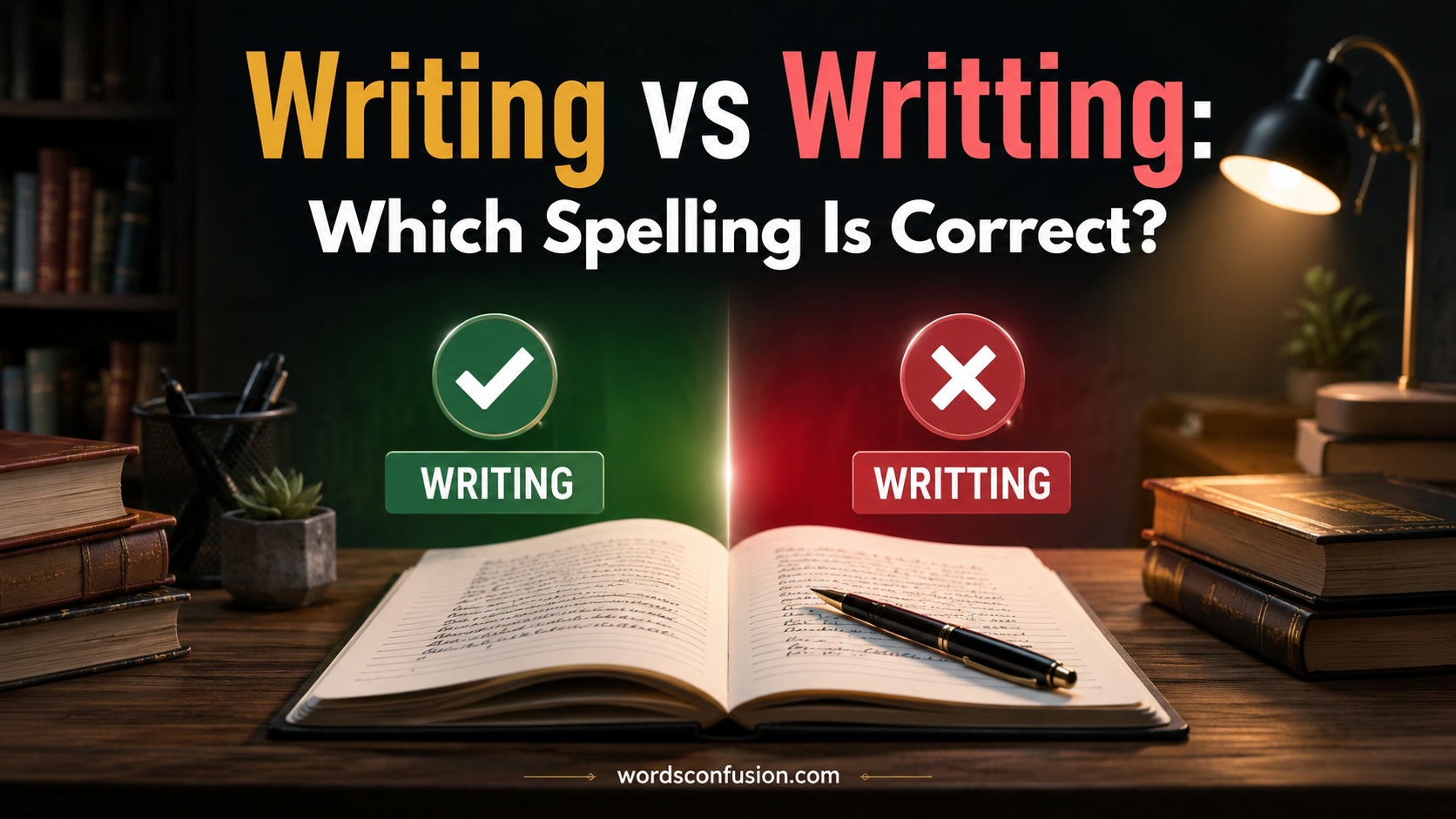
Writing is one of the most common English words people use every day. You see it in school assignments, emails, books, websites, reports, and casual messages. Yet many people still hesitate when they type writing because they wonder whether the word should contain one t or two.
So, which spelling is correct: writing or writting?
The correct spelling is writing. The spelling writting is incorrect in standard English.
The confusion usually happens because English has many words that double their final consonant before adding -ing, such as run → running and sit → sitting. However, write follows a different spelling pattern. When you add -ing, the final silent e disappears:
write − e + ing = writing
That simple rule explains why the correct word has one t, not two.
Quick Answer: Writing or Writting?
Writing is the correct spelling.
Writting is a misspelling and should not be used in standard American English.
| Spelling | Correct? | Meaning |
| Writing | Yes | The act of producing words, letters, or other written language |
| Writting | No | An incorrect spelling of writing |
Correct examples
- I am writing an email.
- She enjoys writing short stories.
- Writing takes patience and practice.
- He spent the evening writing his report.
Incorrect example
- I am writting an email.
The correct version is:
- I am writing an email.
Writing vs Writting: The Main Difference
The only visible difference between writing and writting is the extra t. However, that small difference makes one spelling correct and the other incorrect.
The correct spelling comes from the verb write:
write → writing
The final e disappears before the suffix -ing is added. The word does not become writting because English does not double the t in this formation.
Consider the spelling step by step:
| Step | Result |
| Base verb | write |
| Remove final silent e | writ |
| Add -ing | writing |
Therefore:
write + ing → writing
Not:
write + ing → writting
The extra t has no place in the standard spelling.
Why Is “Writing” Spelled Without a Double T?
The answer lies in the spelling pattern of the verb write.
The final e in write is silent. When English adds -ing to many verbs ending in a silent e, the final e disappears.
For example:
- make → making
- take → taking
- drive → driving
- give → giving
- hope → hoping
- use → using
- write → writing
The same basic pattern applies to each word.
The spelling rule in action
write → writ + ing → writing
Although the intermediate form writ isn’t used as the present participle, it helps show what happens during word formation.
The spelling becomes easier to remember when you focus on the base word. Start with write, remove the silent e, and add -ing. You get writing.
Memory rule: WRITE − E + ING = WRITING
This rule also explains why writeing is incorrect. The final e doesn’t remain before -ing.
What Does Writing Mean?
Writing can have several closely related meanings.
Most commonly, it refers to the act of forming words or expressing ideas through written language. It can also refer to the skill of producing written work or the written work itself.
For example:
- Writing helps people communicate across time and distance.
- Her writing is clear and easy to understand.
- Creative writing allows people to tell stories.
- His writing has improved since last year.
The word can describe both an activity and the result of that activity.
When someone says, “I enjoy writing,” they mean they enjoy the activity.
When someone says, “Her writing is excellent,” they may mean her written work or her overall writing style.
Is “Writting” Ever Correct?
No. Writting is not the standard spelling of the word.
It is simply a spelling error caused by adding an unnecessary second t.
The correct form is always:
writing
The incorrect form is:
writting
This applies in formal and informal writing alike. Whether you’re writing a school essay, a business email, a blog post, or a text message, writing remains the correct spelling.
Writing as a Verb
Writing functions as the present participle of write.
It often appears with forms of the verb be to describe an action in progress.
Examples
- I am writing a letter.
- She is writing a novel.
- They are writing their final exam.
- He was writing when the phone rang.
- We were writing notes during the lecture.
In each sentence, writing describes an ongoing action.
The action may be happening right now:
She is writing an email.
Or it may have been in progress at a particular time in the past:
She was writing an email when I called.
The spelling stays the same in both cases.
Writing as a Noun
Writing can also function as a noun.
In this use, it can describe the activity of producing written language or the written work itself.
Examples
- Writing requires regular practice.
- Academic writing follows specific conventions.
- His writing is direct and persuasive.
- Good writing can make complex ideas easier to understand.
Here, writing isn’t describing what someone is doing at this exact moment. Instead, it names an activity, skill, or type of work.
For example, in the sentence “Writing takes discipline,” the word writing refers to the activity as a general concept.
Writing as a Modifier
The word writing can also appear before another noun to describe something related to writing.
Common examples include:
- writing skills
- writing style
- writing process
- writing assignment
- writing class
- writing sample
- writing career
- writing system
For example:
Strong writing skills can help you communicate more effectively.
In this sentence, writing describes the type of skills being discussed.
Why Do People Spell It “Writting”?
The misspelling writting usually comes from confusion with other English spelling rules.
English has many words that double a final consonant before adding -ing. That pattern can make writting look plausible even though it is wrong.
Consider these examples:
- run → running
- sit → sitting
- stop → stopping
- swim → swimming
- plan → planning
Because these words double their final consonants, some writers assume that write should follow the same pattern.
However, write doesn’t follow that rule.
The word ends in a silent e, so the spelling changes differently:
write → writing
The spelling pattern depends on the base word. You can’t simply apply the same rule to every verb.
Writing vs Writting: A Simple Comparison
| Feature | Writing | Writting |
| Standard English spelling | Yes | No |
| Contains one t | Yes | No |
| Contains an unnecessary extra t | No | Yes |
| Derived from write | Yes | Incorrectly formed |
| Used in formal writing | Yes | No |
| Correct in American English | Yes | No |
The difference may seem small, but spelling accuracy matters. A single extra letter can turn a correct word into a spelling error.
Writing vs Similar Words: Write, Wrote, Written, and Writing
The word write belongs to an irregular verb family. Its different forms don’t follow one simple pattern.
| Verb Form | Use | Example |
| write | Base or present form | I write every morning. |
| writes | Present tense with he, she, or it | She writes clearly. |
| wrote | Simple past tense | He wrote a letter yesterday. |
| written | Past participle | She has written three pages. |
| writing | Present participle or gerund | They are writing a report. |
These forms can cause confusion because write, wrote, and written change considerably.
For example:
- I write every day.
- I wrote yesterday.
- I have written three pages.
- I am writing now.
The word writing specifically represents the -ing form of write.
Writing vs Writting in Example Sentences
The best way to understand the difference is to see the correct spelling in real sentences.
Correct usage
- I am writing a message to my friend.
- She spends an hour writing every morning.
- He is writing a report for his manager.
- Writing clearly takes practice.
- They were writing notes during the meeting.
- Good writing makes difficult ideas easier to understand.
- My brother enjoys writing science-fiction stories.
- The students are writing their final essays.
- She has been writing professionally for several years.
- Writing regularly can improve your vocabulary.
Incorrect and corrected examples
| Incorrect | Correct |
| I am writting a letter. | I am writing a letter. |
| She enjoys writting stories. | She enjoys writing stories. |
| He is writting an article. | He is writing an article. |
| Good writting takes practice. | Good writing takes practice. |
The correction is simple in every case: remove the extra t.
Common Spelling Mistakes Related to Writing
Mistake 1: Writing “Writting”
This is the most common mistake in the comparison.
Incorrect: writting
Correct: writing
The word has only one t.
Mistake 2: Writing “Writeing”
Some people remember the base word write but forget to remove the final e.
Incorrect: writeing
Correct: writing
The silent e drops before -ing.
Compare:
- write → writing
- make → making
- take → taking
- drive → driving
Mistake 3: Confusing Writing With Written
These words come from the same verb but serve different grammatical purposes.
Writing usually describes an ongoing action or the activity itself:
She is writing a book.
Written is the past participle:
She has written a book.
The difference matters because the words don’t work interchangeably.
Mistake 4: Confusing Writing With Wrote
Wrote is the simple past form of write.
- I wrote the letter yesterday.
- I am writing the letter now.
The first sentence describes a completed past action. The second describes an action in progress.
Why “Writing” Is Different From “Running”
This comparison helps explain the spelling rule.
Look at these words:
- run → running
- sit → sitting
- stop → stopping
These verbs double their final consonants before -ing.
Now compare:
- write → writing
- make → making
- take → taking
These verbs drop the final silent e instead.
The key point is that English spelling rules depend on the structure of the base word.
A quick comparison
| Base Verb | Correct -ing Form | Spelling Change |
| run | running | Double final consonant |
| sit | sitting | Double final consonant |
| stop | stopping | Double final consonant |
| make | making | Drop final silent e |
| take | taking | Drop final silent e |
| write | writing | Drop final silent e |
That’s why writting looks familiar but remains incorrect.
How to Remember the Correct Spelling of Writing
A good memory trick can prevent the mistake permanently.
Use this formula
WRITE − E + ING = WRITING
You can also remember:
One T in writing.
Imagine the word write losing its final e before -ing arrives. The result is:
writing
Not writting.
Another useful method involves comparing the word with writer:
- write
- writer
- writing
All three words belong to the same word family. The spelling of writing changes because the silent e disappears, not because the t doubles.
Read More: Weird vs Wierd: Which Spelling Is Correct?
The Word Family of Write
| Word | Meaning | Example |
| write | To produce words or symbols | I write in my journal. |
| writes | Present form for he, she, or it | She writes every day. |
| wrote | Simple past form | He wrote a poem. |
| written | Past participle | She has written a novel. |
| writing | Ongoing action or written work | They are writing an article. |
| writer | A person who writes | The writer published a book. |
Understanding the word family makes the spelling easier to remember.
The forms may change, but writting never becomes correct.
Writing in American English
In standard American English, writing is the accepted spelling.
The word appears in countless everyday expressions, including:
- creative writing
- technical writing
- academic writing
- business writing
- professional writing
- content writing
- writing skills
- writing practice
The spelling doesn’t change based on the type of writing.
For example:
- She teaches creative writing.
- He works in technical writing.
- Academic writing requires careful organization.
- Clear business writing saves time.
In every context, the correct spelling remains writing.
Why Correct Spelling Matters
A spelling mistake doesn’t always make a sentence impossible to understand. Most readers can still recognize writting as an attempt to write writing.
However, correct spelling still matters.
A misspelled word can:
- Distract readers
- Reduce the professionalism of your writing
- Create a poor impression in academic or business settings
- Make content appear less carefully edited
- Affect confidence in the rest of the text
One spelling error won’t define your writing ability. Still, fixing common mistakes is an easy way to make your communication sharper.
Think of spelling as the road signs of language. Readers can sometimes reach the destination without them. Clear signs simply make the journey smoother.
A Practical Case Study: Writing an Email
Consider this sentence:
I am writting to ask about the position.
The reader can understand the meaning. Yet the spelling error makes the sentence look careless.
The corrected version is:
I am writing to ask about the position.
This small correction matters even more in professional communication. An email to a potential employer, client, professor, or business partner should use the standard spelling.
Compare the two versions
| Version | Result |
| I am writting to ask about the position. | Understandable but contains a spelling error |
| I am writing to ask about the position. | Correct and professional |
The lesson is simple: writting may look close, but writing is the only correct spelling.
FAQs:
Is “writting” a correct spelling?
No. Writting is an incorrect spelling. The correct form is writing.
Which is correct: writing or writting?
Writing is correct. Writting contains an unnecessary second t.
Why does writing have only one t?
The word comes from write. Before adding -ing, the final silent e is removed:
write → writing
The t doesn’t double.
Is “writeing” correct?
No. The correct spelling is writing. The final silent e drops before -ing.
What is the past tense of write?
The simple past tense is wrote.
Example:
She wrote a letter yesterday.
What is the past participle of write?
The past participle is written.
Example:
She has written several letters.
Is writing a verb or a noun?
It can be both.
As a verb:
He is writing a report.
As a noun:
Writing requires practice.
How can I remember the spelling of writing?
Use this formula:
WRITE − E + ING = WRITING
Also remember: writing has one t.
Conclusion:
The correct spelling is writing.
The spelling writting is incorrect because English does not double the t in this word. The base verb write loses its final silent e before taking the -ing ending:
write → writing
So, whenever you’re unsure, remember:
Writing = correct
Writting = incorrect
Whether you’re writing an email, a story, an essay, or a professional report, use writing with one t. That small spelling detail keeps your English accurate, polished, and clear.

Andrew Wilson is an experienced language researcher and content writer specializing in WordsConfusion topics. He helps readers understand commonly confused English words, spelling differences, grammar rules, word meanings, and proper usage through clear explanations, practical examples, and easy-to-follow language guides. His goal is to make English learning simple, accurate, and accessible for students, writers, professionals, and everyday learners.