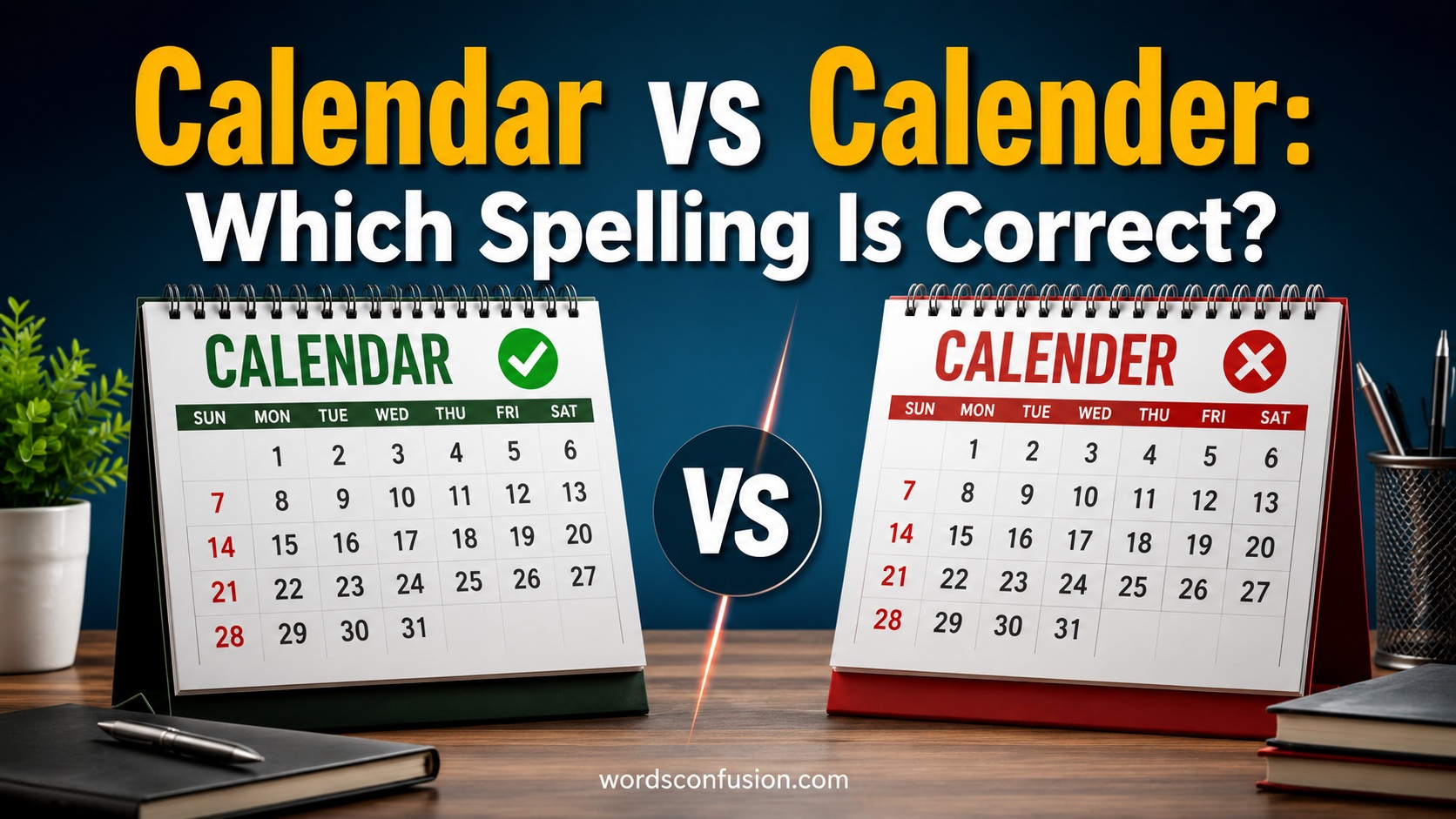
Choosing between Calendar vs Calender may seem like a small spelling issue, yet it causes confusion for thousands of English learners and native speakers every month. While one spelling refers to the familiar system of organizing days, weeks, and months, the other has a completely different meaning that most people never use.
A single misplaced letter can change the meaning of your sentence. Imagine writing “Check your calender” in a professional email. Most readers will understand what you mean, yet they’ll also notice the spelling mistake. In business, academics, and content writing, small errors like this can affect credibility.
The confusion happens because both words exist in English dictionaries. However, they belong to different contexts. One appears in everyday conversations, digital apps, office communication, and school schedules. The other belongs mainly to technical industries such as paper manufacturing and textile production.
This guide explains the difference between calendar and calender in simple language. You’ll learn the correct spelling, discover when each word applies, see real examples, and pick up practical tricks to remember the difference forever.
Quick Answer
If you’re talking about dates, months, schedules, appointments, or planners, the correct spelling is “calendar.”
The word “calender” is a real English word, yet it does not refer to a date planner. Instead, it describes a machine that presses paper, plastic, rubber, or fabric to make the surface smooth or glossy.
Example:
| Correct Usage | Example |
| Calendar | I added the meeting to my calendar. |
| Calender | The factory uses a calender to smooth the paper. |
For nearly everyone, calendar is the word you need.
Calendar vs Calender at a Glance
Understanding the distinction becomes much easier when you compare both words side by side.
| Feature | Calendar | Calender |
| Correct spelling for dates | Yes | No |
| Part of speech | Noun | Noun and verb |
| Primary meaning | A system for organizing days, weeks, months, and years | A machine that smooths or compresses materials |
| Everyday use | Very common | Rare |
| Used in schools and offices | Yes | No |
| Used in manufacturing | No | Yes |
| Found in dictionaries | Yes | Yes |
| Common spelling mistake | Often misspelled as “calender” | Often confused with “calendar” |
The table shows why people mix up these words. Both exist in English, yet only calendar belongs in everyday writing.
Is It Calendar or Calender?
If your sentence involves dates, events, appointments, holidays, deadlines, or planning, the answer is simple.
The correct spelling is calendar.
You use it when talking about:
- Wall calendars
- Desk calendars
- Digital calendars
- School calendars
- Editorial calendars
- Google Calendar
- Outlook Calendar
- Academic calendars
- Holiday calendars
- Content calendars
For example:
- My calendar is full this week.
- Please send me a calendar invite.
- Check the school calendar before booking your vacation.
- I update my content calendar every Monday.
Now compare these incorrect examples.
Incorrect
- Check your calender before scheduling the meeting.
- My phone calender reminds me about appointments.
Correct
- Check your calendar before scheduling the meeting.
- My phone calendar reminds me about appointments.
Although many people write calender, dictionaries do not recognize it as the correct spelling for schedules or dates.
The Correct Spelling
The word calendar has been part of English for centuries. It comes from the Latin word calendarium, which referred to an account book connected with the first day of each month, known as the calends.
Over time, the meaning shifted toward recording days, months, and important events. Today, the word appears in almost every area of daily life.
You can find calendars in:
- Smartphones
- Computers
- Offices
- Schools
- Hospitals
- Homes
- Websites
- Social media planning tools
Because the word appears so often, learning its correct spelling is essential.
Why “Calender” Is a Common Mistake
Several reasons explain why people accidentally write calender.
The pronunciation sounds almost identical in many English accents. When spoken quickly, the final syllable doesn’t clearly reveal whether the word ends with -ar or -er.
Another reason comes from spelling patterns.
English contains many words ending in -er:
- Teacher
- Driver
- Painter
- Computer
- Blender
As a result, writers naturally assume calendar follows the same pattern.
Typing quickly also contributes to the mistake. Since both spellings look believable, many people overlook the error before publishing an email or document.
Spell-check software usually catches the mistake. However, if you’re writing on a platform without automatic correction, the error may remain unnoticed.
What Does Calendar Mean?
A calendar is a system used to organize and measure time. It divides the year into months, weeks, and days while helping people plan activities, remember important dates, and manage schedules.
The word has become an essential part of modern life because nearly every organization depends on calendars to coordinate work and events.
Definition
A calendar is:
A chart, book, printed page, or digital application that shows days, weeks, months, and important dates.
Calendars help people:
- Plan meetings
- Schedule appointments
- Track birthdays
- Remember anniversaries
- Organize projects
- Monitor deadlines
- Manage vacations
- Record holidays
Without calendars, coordinating daily life would become much more difficult.
Origin of the Word
The English word calendar traces its roots to the Latin calendarium.
The Romans called the first day of each month the calends. Debts often became due on that day, so people kept records in books known as calendaria.
As language evolved, the meaning expanded from financial records to systems that organized time itself.
Today, almost every culture uses some form of calendar, although different societies may follow different calendar systems.
Common examples include:
- Gregorian Calendar
- Islamic Calendar
- Hebrew Calendar
- Chinese Calendar
- Hindu Calendar
The Gregorian Calendar remains the international standard for business, education, and government.
Modern Uses of Calendar
The meaning of calendar has expanded dramatically in the digital age.
Today, calendars appear in many forms.
Printed Calendars
Traditional wall and desk calendars remain popular in homes, schools, and offices.
Digital Calendars
Most smartphones include built-in calendar applications that synchronize across multiple devices.
Popular examples include:
- Google Calendar
- Apple Calendar
- Microsoft Outlook Calendar
These tools help users:
- Schedule meetings
- Receive reminders
- Share events
- Coordinate teams
- Plan travel
Business Calendars
Companies rely on calendars to manage projects, employee schedules, product launches, and marketing campaigns.
An organized calendar improves productivity because everyone knows what happens next.
Editorial Calendars
Content creators and marketers use editorial calendars to organize blog posts, videos, newsletters, and social media campaigns.
Instead of deciding topics at the last minute, teams plan weeks or even months in advance.
This approach saves time and improves consistency.
What Does Calender Mean?
Many people assume calender is simply a misspelling of calendar. In most everyday situations, that’s true. However, calender is also a legitimate English word with a specialized meaning.
Unlike calendar, which deals with dates and schedules, calender belongs to the world of manufacturing.
Definition
A calender is a machine made of heavy rollers that presses materials to create a smooth, glossy, or uniform surface.
Manufacturers use a calender to process materials such as:
- Paper
- Fabric
- Plastic
- Rubber
- Vinyl
- Leather
- Metal foil
The machine applies pressure and sometimes heat to improve the material’s finish.
Read More: Aggressive vs Agressive: Which Spelling Is Correct?
Industries That Use a Calender
Most people never encounter a calender machine because it operates behind the scenes in factories.
Common industries include:
Paper Manufacturing
Paper mills use calenders to make paper smoother and improve print quality.
For example, glossy magazine pages pass through a calender before printing.
Textile Industry
Fabric manufacturers use calenders to flatten cloth, create shine, or add decorative textures.
High-quality cotton often receives this finishing treatment.
Plastic Manufacturing
Plastic sheets move through calender rollers to achieve a consistent thickness before packaging or further processing.
Rubber Industry
Rubber factories use calenders to prepare materials for products such as conveyor belts, tires, and flooring.
Calender as a Verb
The word calender also works as a verb.
It means to smooth or press a material using a calender machine.
Examples:
- The workers calendered the paper before printing.
- The fabric was calendered to give it a glossy finish.
- Manufacturers often calender vinyl flooring during production.
Outside industrial settings, you rarely need this word.
Calendar vs Calender: The Key Differences
Although these words differ by only one letter, their meanings are completely unrelated.
| Feature | Calendar | Calender |
| Meaning | Organizes dates and time | Smooths materials using rollers |
| Common Use | Daily life | Manufacturing |
| Frequency | Extremely common | Rare |
| Used in Emails | Yes | Almost never |
| Used in Schools | Yes | No |
| Used in Factories | No | Yes |
| Refers to Scheduling | Yes | No |
The easiest way to remember the difference is this:
If you’re talking about time, use “calendar.” If you’re talking about machinery, use “calender.”
Meaning
A calendar helps people organize time.
A calender shapes physical materials.
These meanings never overlap.
Pronunciation
Both words sound almost identical in everyday speech.
That’s one reason so many writers confuse them.
Because pronunciation offers little help, you must rely on spelling and context.
Usage
You’ll probably write calendar hundreds of times throughout your life.
You may never need to write calender unless you work in manufacturing, engineering, or industrial production.
Context
Ask yourself one simple question:
Am I talking about dates or machines?
If the answer is dates, meetings, birthdays, or schedules, choose calendar.
If the answer involves paper, fabric, plastic, or rubber processing, choose calender.
Memory Tip
Think about the last two letters.
- Calendar ends with AR, just like year contains the letter A.
- Years belong on a calendar.
Meanwhile:
- Calender ends with ER, which appears in many machine-related words such as printer, roller, and loader.
That small association makes the correct spelling easier to recall.
Why People Misspell Calendar as Calender
Misspelling calendar isn’t a sign of poor English. In fact, it ranks among the most common spelling mistakes because both words exist.
Let’s look at why this happens.
Pronunciation Confusion
English pronunciation often hides spelling differences.
When people say “calendar” quickly, the final syllable sounds similar to “-er.”
As a result, many writers spell the word the way they hear it.
For example:
- calendar
- calender
In casual speech, these sound nearly identical.
Similar Word Patterns
English contains thousands of words ending in -er.
Examples include:
- Driver
- Teacher
- Reader
- Painter
- Writer
- Builder
- Speaker
Since those endings feel familiar, many people instinctively replace -ar with -er.
Fast Typing
Typing quickly increases spelling errors.
Someone writing an email or blog post may accidentally type calender without noticing.
Fortunately, modern spelling checkers usually highlight the mistake.
Autocorrect Isn’t Perfect
Autocorrect catches many spelling mistakes.
However, it doesn’t always help.
Because calender is a legitimate dictionary word, some writing tools won’t flag it as incorrect.
That means context matters.
If your sentence says:
Please update the office calender.
A basic spell checker may accept it because calender exists.
Only careful proofreading catches the error.
FAQs:
Is calendar or calender the correct spelling?
Calendar is the correct spelling when referring to dates, months, schedules, appointments, or planners. Calender is a different word that describes a machine used in manufacturing to smooth materials like paper, fabric, plastic, and rubber.
Is calender a real English word?
Yes. Calender is a legitimate English word found in major dictionaries. However, it has a specialized industrial meaning and should not be used when talking about calendars, events, or schedules.
Why do so many people spell calendar as calender?
The mistake happens because both words sound almost the same when spoken. Many English words also end in -er, which makes writers assume calendar follows the same pattern. Fast typing and relying on pronunciation instead of spelling also contribute to the confusion.
How can I remember the correct spelling of calendar?
A simple trick is to associate calendar with appointments and dates. Both ideas involve the letter A, just like calendar. If you’re talking about time, meetings, birthdays, or holidays, calendar is always the correct choice.
Can I use calender in everyday writing?
In almost every case, no. Unless you’re discussing paper manufacturing, textile production, plastic processing, or another industrial process, you should use calendar. For emails, school assignments, blog posts, business documents, and daily conversations, calendar is the correct spelling.
Conclusion:
The difference between calendar vs calender comes down to meaning and context. Although the two words differ by just one letter, they serve completely different purposes.
Use calendar whenever you’re referring to dates, schedules, appointments, holidays, planners, or digital calendar apps. It’s the correct spelling for everyday English and the one you’ll use in personal, academic, and professional writing.
Use calender only when discussing the industrial machine or process that smooths materials such as paper, fabric, plastic, or rubber. Outside manufacturing and engineering, you’ll rarely encounter this word.

Andrew Wilson is an experienced language researcher and content writer specializing in WordsConfusion topics. He helps readers understand commonly confused English words, spelling differences, grammar rules, word meanings, and proper usage through clear explanations, practical examples, and easy-to-follow language guides. His goal is to make English learning simple, accurate, and accessible for students, writers, professionals, and everyday learners.