Have you ever paused while writing a sentence and wondered whether to use backward or backwards? You’re not alone. These two words look almost identical and usually carry the same basic meaning. That tiny -s can still create a surprising amount of confusion.
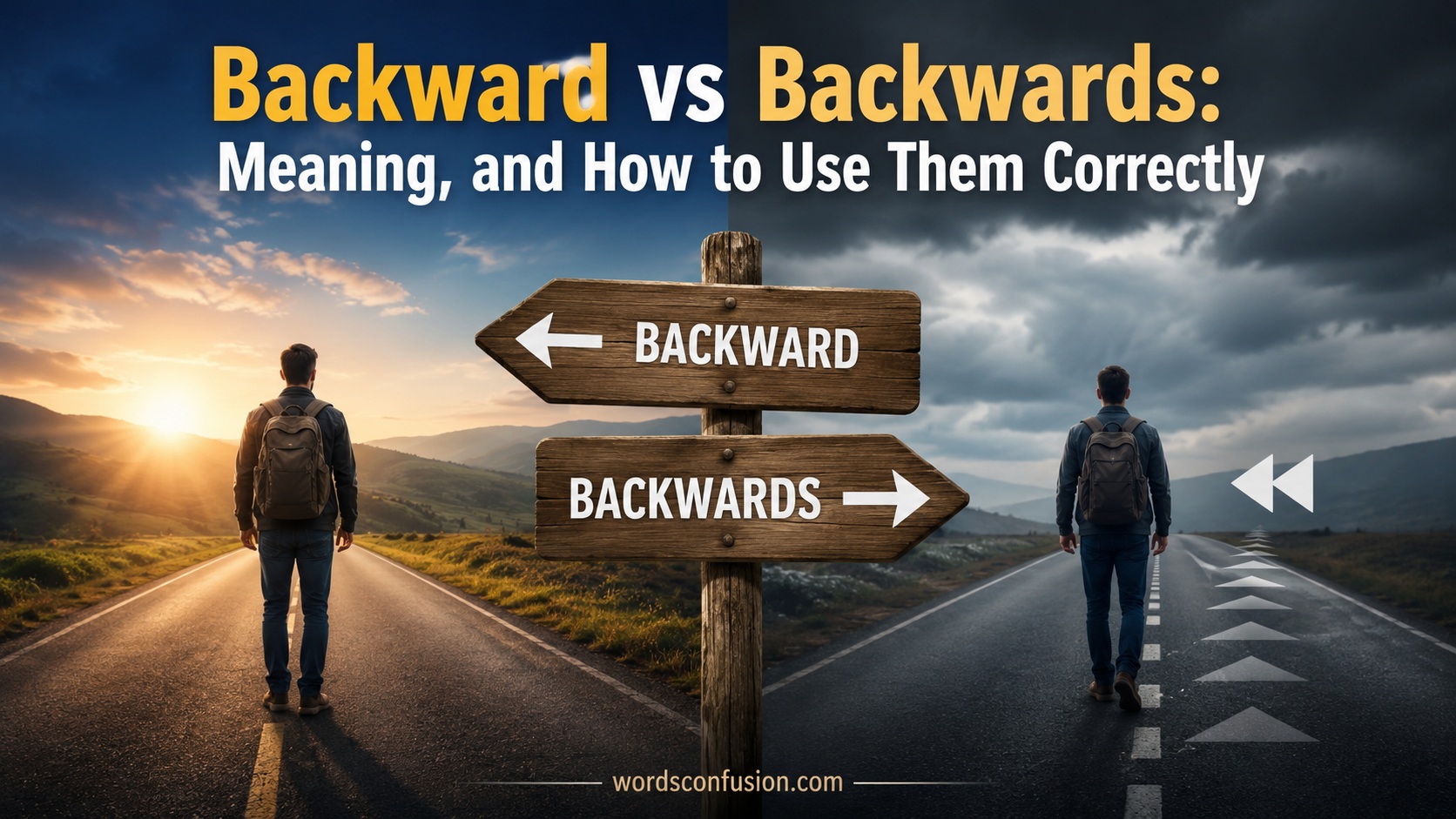
Both backward and backwards can describe movement toward the rear, a return to an earlier position, or movement in reverse. The main difference usually comes down to regional English preferences and grammatical context.
In American English, backward is generally the preferred form. In British English, backwards is often more common, especially when describing physical movement. However, both forms appear in different varieties of English.
So, which one should you use? Let’s untangle the difference.
Quick Answer: Backward vs Backwards
Backward and backwards are both correct words. They usually mean toward the back, in reverse, or toward an earlier point.
- Backward is more common in American English.
- Backwards is especially common in British English.
- Both words commonly function as adverbs.
- Backward also works as an adjective in phrases such as backward compatibility and a backward step.
- Backward compatibility is the standard technical term.
- For US English writing, backward is usually the safest choice.
| Word | Common Use | Regional Preference | Example |
| Backward | Movement, direction, regression, technical terms | American English | She took a step backward. |
| Backwards | Movement or direction | British English and other varieties | He walked backwards. |
The difference is usually one of style and regional usage, not a dramatic difference in meaning.
What Does “Backward” Mean?
Backward describes movement toward the back, a reverse direction, or a movement away from progress. The exact meaning depends on the sentence.
“Backward” as an Adverb
As an adverb, backward tells you how or where someone or something moves.
For example:
- The boy stepped backward.
- The car rolled backward down the hill.
- She glanced backward before opening the door.
- The dancer leaned backward.
- The machine moved backward into position.
In each example, backward modifies the action. It explains the direction of movement.
Imagine standing in a crowded room. If you take a step away from the person in front of you, you move backward. Nothing mysterious is happening. You’re simply moving toward the rear.
“Backward” as an Adjective
Backward can also describe a noun. This use often appears in formal, technical, or figurative language.
Examples include:
- The company took a backward step.
- The software provides backward compatibility.
- His backward-looking approach limited innovation.
- The country experienced backward economic development.
Here, backward doesn’t simply describe physical movement. It can suggest a return to an earlier state or a lack of progress.
For example, if a business abandons an efficient system and returns to an outdated process, you might call that a backward step. The company isn’t literally walking backward. It is losing progress.
What Does “Backwards” Mean?
Backwards generally means toward the back, in reverse, or in the opposite direction from normal progress.
Examples:
- She walked backwards across the room.
- He fell backwards onto the couch.
- The child read the sentence backwards.
- The machine moved backwards.
- She leaned backwards to avoid the ball.
The meaning remains almost identical to backward in these examples.
The main distinction is that backwards is particularly common in British English. A British speaker might naturally say:
“He took a step backwards.”
An American speaker might more naturally say:
“He took a step backward.”
Both sentences communicate the same idea.
Backward vs Backwards: What Is the Main Difference?
The most important difference involves regional preference.
American English Usually Prefers “Backward”
In US English, writers and speakers commonly use backward without the final -s.
Common American examples include:
- Move backward.
- Step backward.
- Look backward.
- Fall backward.
- Lean backward.
- Work backward from the answer.
If you’re writing an article, essay, business report, or website content for an American audience, backward usually sounds more natural.
British English Often Uses “Backwards”
British English frequently favors backwards in adverbial phrases.
Examples:
- Walk backwards.
- Move backwards.
- Lean backwards.
- Fall backwards.
- Look backwards.
This doesn’t make backward incorrect in British English. It simply means that backwards may sound more familiar to many British speakers.
The Meaning Usually Doesn’t Change
Compare these sentences:
- The dog ran backward.
- The dog ran backwards.
Both mean that the dog moved toward the rear.
Likewise:
- She looked backward.
- She looked backwards.
Again, the core meaning stays the same.
The difference resembles other regional variations in English. One audience may prefer one form while another chooses a slightly different form. Language isn’t always a courtroom where one version must be declared guilty.
Backward vs Backwards in American English
For US English, backward is generally the preferred form.
Consider these natural American English sentences:
- The child took a step backward.
- The truck moved backward.
- He leaned backward in his chair.
- The company is moving backward instead of forward.
- To solve the puzzle, work backward from the final answer.
In American writing, the shorter form often appears in both everyday language and formal writing.
However, backwards isn’t automatically wrong in American English. You may still encounter it in books, conversations, and certain expressions. The key point is that backward is usually the more standard choice for consistent US English style.
Backward vs Backwards in British English
British English commonly uses backwards, particularly when the word describes physical movement.
For example:
- The child walked backwards.
- He fell backwards.
- She looked backwards over her shoulder.
- The car rolled backwards.
- The athlete jumped backwards.
British English also uses backward in some established compounds and expressions.
For example:
- Backward compatibility
- Backward-looking
- A backward step
This creates an important point: English varieties don’t always follow one rigid rule for every situation.
A British writer may use backwards in one sentence and backward in a technical compound. Context matters.
Is “Backward” an Adverb or an Adjective?
The answer is: it can be both.
“Backward” as an Adverb
When backward describes an action, it usually functions as an adverb.
Examples:
- The man stepped backward.
- The chair tipped backward.
- She moved backward slowly.
- He looked backward.
The word tells you about the direction or manner of the action.
“Backward” as an Adjective
When backward modifies a noun, it functions as an adjective.
Examples:
- The company made a backward move.
- The system supports backward compatibility.
- The policy represents a backward step.
- The organization adopted a backward-looking strategy.
This use is particularly important because backward appears in many established compounds.
Is “Backwards” an Adverb or an Adjective?
Backwards is most commonly used as an adverb.
Examples:
- He walked backwards.
- She fell backwards.
- The car moved backwards.
- The child read the word backwards.
The word describes the action rather than directly modifying a noun.
For example:
The man walked backwards.
Here, backwards explains how the man walked.
By contrast:
The company took a backward step.
Here, backward directly modifies the noun step.
This distinction helps explain why phrases such as backward compatibility are much more established than backwards compatibility in standard technical English.
Backward vs Backwards in Common Expressions
Some expressions strongly favor one form. These phrases deserve special attention because English often preserves established terminology even when everyday usage varies.
Backward Compatibility
Backward compatibility describes a newer product, system, or technology that can still work with older versions.
Examples:
- The new console offers backward compatibility with older games.
- The software maintains backward compatibility with previous file formats.
- The updated operating system supports backward compatibility with older applications.
This phrase appears frequently in:
- Software development
- Gaming
- Hardware design
- Operating systems
- File formats
- Technology standards
The phrase backward compatibility is the widely established form.
Working Backward
Working backward means starting with a desired result and reasoning toward the beginning.
For example, suppose you need to arrive at work at 8:00 a.m. You know the journey takes 30 minutes and preparation takes 45 minutes. Working backward helps you determine when to wake up.
The phrase is also common in mathematics:
To solve the problem, work backward from the answer.
This strategy is useful because the final result can reveal the steps needed to reach it.
Working Backwards
Working backwards carries the same meaning. It appears especially often in British English.
For example:
We worked backwards from the deadline to create the schedule.
The phrase isn’t incorrect. It simply reflects a different regional preference.
Going Backward or Going Backwards
Both expressions can describe losing progress.
Examples:
- The project is going backward.
- The project is going backwards.
The meaning is similar: progress has reversed.
In US English, going backward is generally more common. In British English, going backwards may sound more natural.
Knowing Something Backward or Backwards
The expression know something backward or know something backwards means knowing it extremely well.
Examples:
- She knows the entire process backward.
- He knows the instructions backwards.
The phrase know it backwards is particularly common in British English.
Backward vs Backwards: Side-by-Side Comparison
| Feature | Backward | Backwards |
| Basic meaning | Toward the back or in reverse | Toward the back or in reverse |
| Common in American English | Yes | Less common |
| Common in British English | Yes | Very common |
| Adverb use | Yes | Yes |
| Adjective use | Yes | Less common |
| Technical compounds | Very common | Less common |
| Example | Walk backward | Walk backwards |
The simplest takeaway is this: the two forms often mean the same thing. Regional style usually determines which one sounds more natural.
Backward vs Backwards Example Sentences
Examples With “Backward”
- The child took one step backward.
- The truck rolled backward.
- She leaned backward to avoid the falling object.
- He looked backward before crossing the road.
- The company took a backward step by abandoning the improved system.
- The software offers backward compatibility.
- Work backward from the final answer.
- The chair tilted backward.
Examples With “Backwards”
- The child walked backwards across the room.
- He fell backwards onto the bed.
- She leaned backwards in her chair.
- The car moved backwards slowly.
- The dancer jumped backwards.
- He read the sentence backwards.
- The team worked backwards from the deadline.
- She knows the entire procedure backwards.
Notice something important: the meaning remains remarkably similar. The spelling difference doesn’t usually create a completely different idea.
Common Mistakes With Backward and Backwards
Mistake One: Assuming One Form Is Always Wrong
Many people believe that either backward or backwards must be incorrect. That isn’t true.
Both forms are standard English words.
The better question is:
Which form fits your audience, dialect, and context?
For US English, backward usually fits best. For British English, backwards often sounds more natural in adverbial phrases.
Mistake Two: Treating the “-s” as a Major Meaning Change
The final -s doesn’t usually create a major change in meaning.
Compare:
- She stepped backward.
- She stepped backwards.
The action remains the same.
The difference is mostly one of usage and regional preference.
Mistake Three: Using “Backwards” in Every Compound
Some writers assume that if they use backwards as an adverb, they should use it everywhere.
That approach can create awkward phrasing.
For example:
- Backward compatibility is the standard technical term.
- Backward-looking is an established compound.
Established expressions don’t always follow the same pattern as ordinary speech. That’s why learning common phrases matters.
Mistake Four: Mixing Regional Styles Without a Reason
If you write in American English, consistently using backward usually creates a smoother reading experience.
Likewise, a British English publication may naturally prefer backwards in many contexts.
Consistency matters because readers quickly notice uneven style. One sentence may say backward while the next says backwards without any clear reason. That isn’t always grammatically wrong. Still, a consistent style usually looks more polished.
Read More: Assure vs Ensure: Meaning, and How to Use Them Correctly
How to Choose Between Backward and Backwards
Choose “Backward” When:
- You’re writing in American English.
- You describe movement toward the rear.
- You use the word as an adjective.
- You write backward compatibility.
- You use backward-looking.
- You want the shorter standard form in US English.
Examples:
- Move backward.
- Step backward.
- Work backward.
- A backward step.
- Backward compatibility.
Choose “Backwards” When:
- You’re writing in British English.
- Your audience commonly uses British English.
- You’re describing movement in a style where backwards sounds natural.
- You use established expressions such as know it backwards.
Examples:
- Walk backwards.
- Fall backwards.
- Lean backwards.
- Know the answer backwards.
A Simple Memory Trick for Backward vs Backwards
Here’s an easy way to remember the difference:
American English usually moves backward. British English often moves backwards.
You can also remember the technical phrase:
Technology looks backward for compatibility.
That gives you two quick anchors:
- US English → backward
- British English → backwards
- Technical compounds → backward
This isn’t an absolute law of English. It’s a practical guide for choosing the most natural form.
Backward vs Backwards in Formal Writing
When writing professionally, your audience matters.
For a US audience, these forms usually sound natural:
- Backward movement
- Backward compatibility
- Work backward
- A backward step
For a British audience, these forms may sound more familiar:
- Move backwards
- Walk backwards
- Work backwards
The best approach is to follow the style of the publication, organization, or audience you’re writing for.
If your style guide specifies American English, backward is generally the better default. If the publication follows British English, backwards may be preferred in many adverbial contexts.
Backward vs Backwards in Technology
Technology provides one of the clearest examples of why backward matters.
What Is Backward Compatibility?
Backward compatibility means that a newer system can still work with older technology.
For example:
- A new gaming console can play games from an older console.
- New software can open older file formats.
- A modern operating system can run older applications.
- A newer device can connect with older accessories.
Think of it as a new key that still opens an older lock. The newer system moves forward without completely abandoning the past.
Why “Backward Compatibility” Is the Standard Phrase
The phrase has become established technical terminology.
Although people may say backwards in everyday British English, the technical expression is generally written as:
Backward compatibility
This is an excellent example of how fixed terminology can develop its own standard form.
FAQs:
Is “backward” or “backwards” correct?
Both backward and backwards are correct. They usually mean toward the back, in reverse, or toward an earlier position. Backward is more common in American English while backwards is especially common in British English.
Is “backward” more common in American English?
Yes. Backward is generally the preferred form in American English. For example, American writers commonly say, “She took a step backward” or “The car moved backward.”
Is “backwards” more common in British English?
Yes. British English often uses backwards when describing movement or direction. For example, “He walked backwards across the room” is a natural British English sentence.
Should I write “backward compatibility” or “backwards compatibility”?
The standard technical expression is backward compatibility. It describes newer technology that can still work with older software, hardware, systems, or file formats.
Can “backward” and “backwards” be used interchangeably?
In many sentences, yes. Both words can describe movement toward the rear or movement in reverse. However, regional preference and established expressions matter. Backward is usually better for US English while backwards is often preferred in British English.
Conclusion:
The difference between backward and backwards is mainly a matter of regional usage and context. Both words generally mean toward the back, in reverse, or toward an earlier point.
For American English, backward is usually the better choice. For British English, backwards often sounds more natural when describing movement. However, established expressions such as backward compatibility use backward as the standard form.
The easiest rule to remember is simple: Use “backward” for US English and “backwards” when following common British English usage. Whichever form you choose, match your audience and stay consistent throughout your writing.

Andrew Wilson is an experienced language researcher and content writer specializing in WordsConfusion topics. He helps readers understand commonly confused English words, spelling differences, grammar rules, word meanings, and proper usage through clear explanations, practical examples, and easy-to-follow language guides. His goal is to make English learning simple, accurate, and accessible for students, writers, professionals, and everyday learners.