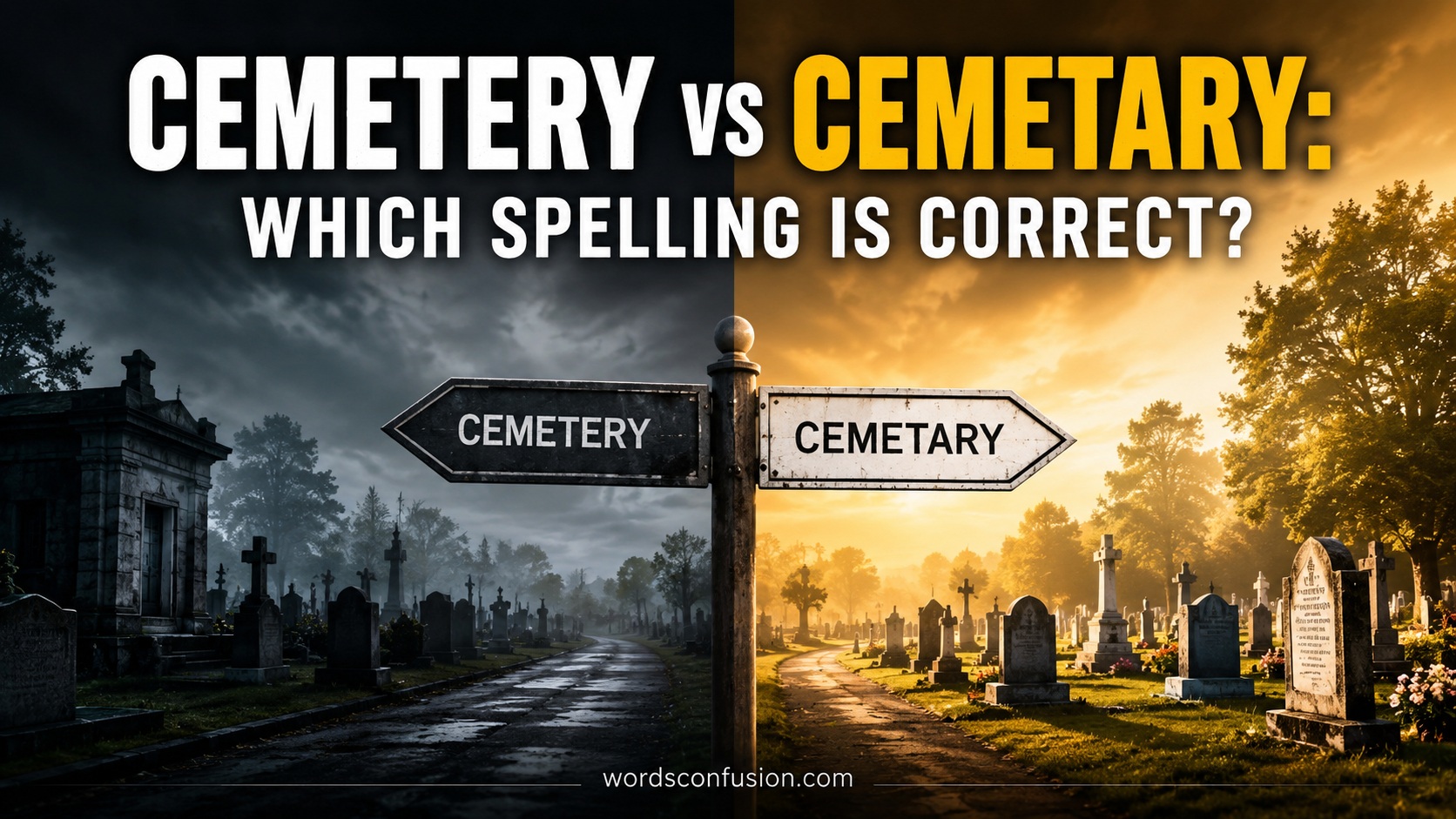
Have you ever paused while writing the word cemetery and wondered whether cemetary might actually be correct? You’re not alone. Thousands of people search for “cemetery vs cemetary” every month because this spelling mistake is surprisingly common. The two words look almost identical, yet only one belongs in standard English.
Spelling mistakes like this happen because English doesn’t always match pronunciation. When you say the word aloud, the middle vowel sounds unclear, which leads many writers to replace “e” with “a.” While the mistake is understandable, it can affect the professionalism of emails, school assignments, articles, and official documents.
Knowing the correct spelling helps you communicate with confidence. Whether you’re a student, teacher, writer, editor, or simply someone who enjoys improving their English, understanding why this error occurs will make it much easier to remember the right version forever.
This guide explains the difference between cemetery and cemetary, explores the history of the word, compares it with similar terms like graveyard, shares memory tricks, and provides plenty of real-world examples to help you master the spelling.
Quick Answer
Cemetery is the correct spelling in both American English and British English.
Cemetary is a misspelling and does not appear as a standard word in major English dictionaries such as Merriam-Webster, Oxford, or Cambridge.
If you’re writing anything formal or informal, always use cemetery.
| Feature | Cemetery | Cemetary |
| Correct spelling | Yes | No |
| Accepted in dictionaries | Yes | No |
| Used in American English | Yes | No |
| Used in British English | Yes | No |
| Appropriate for formal writing | Yes | No |
| Common spelling mistake | No | Yes |
Cemetery vs Cemetary at a Glance
Although these spellings differ by just one letter, they are not interchangeable. One is a legitimate English word, while the other is simply a common error.
| Feature | Cemetery | Cemetary |
| Status | Correct spelling | Incorrect spelling |
| Part of speech | Noun | Not a standard English word |
| Meaning | A place where people are buried | No accepted meaning |
| Dictionary recognition | Yes | No |
| Professional writing | Recommended | Avoid |
| Academic writing | Correct | Incorrect |
| Newspapers and books | Used consistently | Considered an error |
The simplest rule to remember is this:
Always write “cemetery” with an “e” before the final “r.”
Is It “Cemetery” or “Cemetary”?
The answer is simple.
Cemetery is the only correct spelling.
Many people mistakenly write cemetary because English pronunciation can be misleading. The unstressed vowel near the end of the word sounds similar to a short “a” for many speakers, especially in fast conversation.
However, spelling follows historical development rather than pronunciation alone. Every major dictionary recognizes cemetery, while cemetary appears only as a spelling error.
Consider these examples:
Correct
- The old cemetery overlooks the river.
- Visitors gathered at the cemetery to honor veterans.
- A new cemetery opened outside the city.
Incorrect
- We visited the cemetary yesterday.
- The historic cemetary attracts many tourists.
- Flowers covered the cemetary entrance.
In every case, replacing cemetary with cemetery makes the sentence correct.
The Correct Spelling Explained
The correct spelling contains four vowels arranged in a specific order:
C-E-M-E-T-E-R-Y
Notice that the word contains three separate e letters before the final y.
A helpful way to remember it is to break it into syllables:
cem – e – ter – y
That middle e often causes confusion because people expect an a based on pronunciation.
Why So Many People Write “Cemetary”
Several factors contribute to this spelling mistake.
Unclear pronunciation
Many English words reduce vowel sounds during everyday speech. Instead of hearing every vowel clearly, listeners hear a softer sound called a schwa, making it difficult to identify the correct letter.
Pattern confusion
English contains many words ending in -ary, such as:
- Dictionary
- Secretary
- Library
- Sanctuary
Because these endings are familiar, some writers instinctively type cemetary instead of cemetery.
Typing habits
Fast typing often leads to replacing letters without noticing. Since spell-check software sometimes isn’t available, the mistake remains in the final document.
Memory shortcuts
People frequently spell words based on sound rather than memorized spelling. Unfortunately, that approach doesn’t always work in English.
What Does “Cemetery” Mean?
A cemetery is a place where deceased people are buried. It usually contains individual graves, memorials, monuments, pathways, landscaping, and areas reserved for remembrance.
Modern cemeteries often serve both practical and historical purposes. Families visit loved ones, historians study grave markers, and communities preserve cultural heritage through these sites.
Dictionary Definition
Most major dictionaries define a cemetery as:
A burial ground where the dead are interred, usually with marked graves or memorials.
Unlike a graveyard, a cemetery does not have to be connected to a church.
Origin and History of the Word
The word cemetery has ancient roots.
Its journey through history looks like this:
| Language | Word | Meaning |
| Greek | koimeterion | Sleeping place |
| Late Latin | coemeterium | Burial place |
| Old French | cimetiere | Cemetery |
| English | Cemetery | Burial ground |
The original Greek word literally meant “sleeping place.” Early Christians used this expression because they viewed death as temporary until resurrection.
Over centuries, the spelling evolved into the modern English word cemetery.
How the Meaning Has Evolved
Ancient burial grounds were often simple areas outside towns.
Today, cemeteries may include:
- Memorial gardens
- Military sections
- Family plots
- Mausoleums
- Cremation gardens
- Historical monuments
- Religious burial areas
Many famous cemeteries also serve as cultural landmarks that attract historians, architects, and tourists.
Read More: Calendar vs Calender: Which Spelling Is Correct?
Why People Misspell Cemetery as Cemetary
Misspellings rarely happen by accident alone. They usually follow predictable patterns.
Understanding those patterns helps you avoid making the same mistake.
Pronunciation Confusion
The biggest reason is pronunciation.
When people say cemetery, the middle vowels become softer.
Instead of hearing every vowel distinctly, listeners often hear something similar to:
“SEM-uh-ter-ee.”
That pronunciation encourages writers to substitute a where e belongs.
Similar Spelling Patterns in English
English contains many words ending in -ary.
Examples include:
- Necessary
- Vocabulary
- January
- Ordinary
- Contemporary
Because these endings appear frequently, writers unconsciously expect cemetary to follow the same pattern.
Unfortunately, it doesn’t.
Typing and Autocorrect Errors
Another common cause is simple typing.
People often:
- Type too quickly.
- Skip proofreading.
- Ignore spell-check warnings.
- Depend entirely on autocorrect.
Although modern writing software usually flags cemetary, handwritten notes and social media posts often contain the mistake.
Memory Shortcuts That Lead to the Error
Our brains naturally simplify unfamiliar spellings.
Instead of recalling each letter individually, we remember the approximate sound.
That shortcut works for many words.
It doesn’t work here.
The safest approach is memorizing:
C-E-M-E-T-E-R-Y
Cemetery Pronunciation
Correct pronunciation also helps reinforce correct spelling.
American Pronunciation
In American English, cemetery is commonly pronounced:
SEM-uh-ter-ee
Phonetic form:
/ˈsɛməˌtɛri/
British Pronunciation
British English pronunciation remains very similar:
SEM-uh-tree
Some regional accents shorten the middle syllable slightly, but the spelling never changes.
Syllable Breakdown
The word has four syllables.
Cem – e – ter – y
Breaking it into smaller parts makes it much easier to remember.
Easy Pronunciation Tips
Try these techniques:
- Say the word slowly.
- Emphasize the first syllable.
- Repeat the spelling aloud while pronouncing it.
- Practice writing the word several times.
Many teachers encourage students to say:
“Cem-e-ter-y”
instead of speaking too quickly.
The slower pronunciation reinforces the correct spelling pattern.
Cemetery vs Cemetary: Spelling Breakdown
Looking closely at each section of the word reveals exactly where mistakes occur.
| Part | Correct | Incorrect |
| Beginning | Cem | Cem |
| Middle | e | a |
| Ending | tery | tary |
| Final spelling | Cemetery | Cemetary |
Only one letter changes.
Yet that single letter determines whether the spelling is correct.
Examples of “Cemetery” in Sentences
Reading words in context helps your brain remember them more effectively.
Here are examples from everyday English.
Everyday Conversations
- We visited the cemetery to place flowers on our grandparents’ graves.
- The cemetery is only ten minutes from our neighborhood.
- They built a beautiful memorial inside the cemetery.
Academic Writing
- Archaeologists studied the ancient cemetery to understand early burial customs.
- Researchers documented every grave in the historic cemetery.
- The university published a report about preservation efforts at the local cemetery.
News and Media Examples
- Volunteers cleaned the historic cemetery before Memorial Day.
- The city approved funding for cemetery restoration.
- Officials expanded the public cemetery to meet future needs.
Historical Examples
- The national cemetery contains thousands of military graves.
- Historians restored monuments throughout the nineteenth-century cemetery.
- Visitors travel worldwide to see famous historic cemeteries.
Examples of the Incorrect Spelling “Cemetary”
Although cemetary appears frequently online, it remains incorrect.
Here are common mistakes and their corrected versions.
| Incorrect Sentence | Correct Sentence |
| The cemetary closed before sunset. | The cemetery closed before sunset. |
| We walked through the old cemetary. | We walked through the old cemetery. |
| The town restored its historic cemetary. | The town restored its historic cemetery. |
| The cemetary contains several memorials. | The cemetery contains several memorials. |
Whenever you see cemetary, replace it with cemetery. That simple correction ensures your writing matches standard English usage.
FAQs:
Is cemetary ever the correct spelling?
No. Cemetary is never considered correct in standard English. The accepted spelling is cemetery, and it is the form used in dictionaries, books, newspapers, and academic writing.
Why do people spell cemetery as cemetary?
Most people make this mistake because of pronunciation. The middle vowel sounds weak when spoken, making it easy to confuse e with a. Fast typing and spelling by sound also contribute to the error.
Is cemetery the same spelling in American and British English?
Yes. Both American English and British English use the spelling cemetery. Unlike some words that have regional spelling differences, this word remains the same in both varieties of English.
What is the plural of cemetery?
The plural form is cemeteries. Simply replace the final y with ies.
Examples:
- The city has several historic cemeteries.
- Many cemeteries preserve local history.
What is the difference between a cemetery and a graveyard?
Although many people use the terms interchangeably, they are not always the same. A graveyard is traditionally located next to a church, while a cemetery is a separate burial ground that doesn’t have to be connected to a church. Today, cemetery is the broader and more commonly used term for public burial grounds.
Conclusion:
The debate over cemetery vs cemetary has a clear answer. Cemetery is the only correct spelling recognized in American English, British English, and every major English dictionary. Cemetary is simply a common misspelling that often appears because the word’s pronunciation doesn’t clearly reveal every vowel.
Fortunately, this mistake is easy to avoid once you understand the spelling pattern. Remember that cemetery contains three e letters before the final y: C-E-M-E-T-E-R-Y. A quick proofreading check or a simple memory trick can help you catch the error before you publish or submit your writing.

Andrew Wilson is an experienced language researcher and content writer specializing in WordsConfusion topics. He helps readers understand commonly confused English words, spelling differences, grammar rules, word meanings, and proper usage through clear explanations, practical examples, and easy-to-follow language guides. His goal is to make English learning simple, accurate, and accessible for students, writers, professionals, and everyday learners.