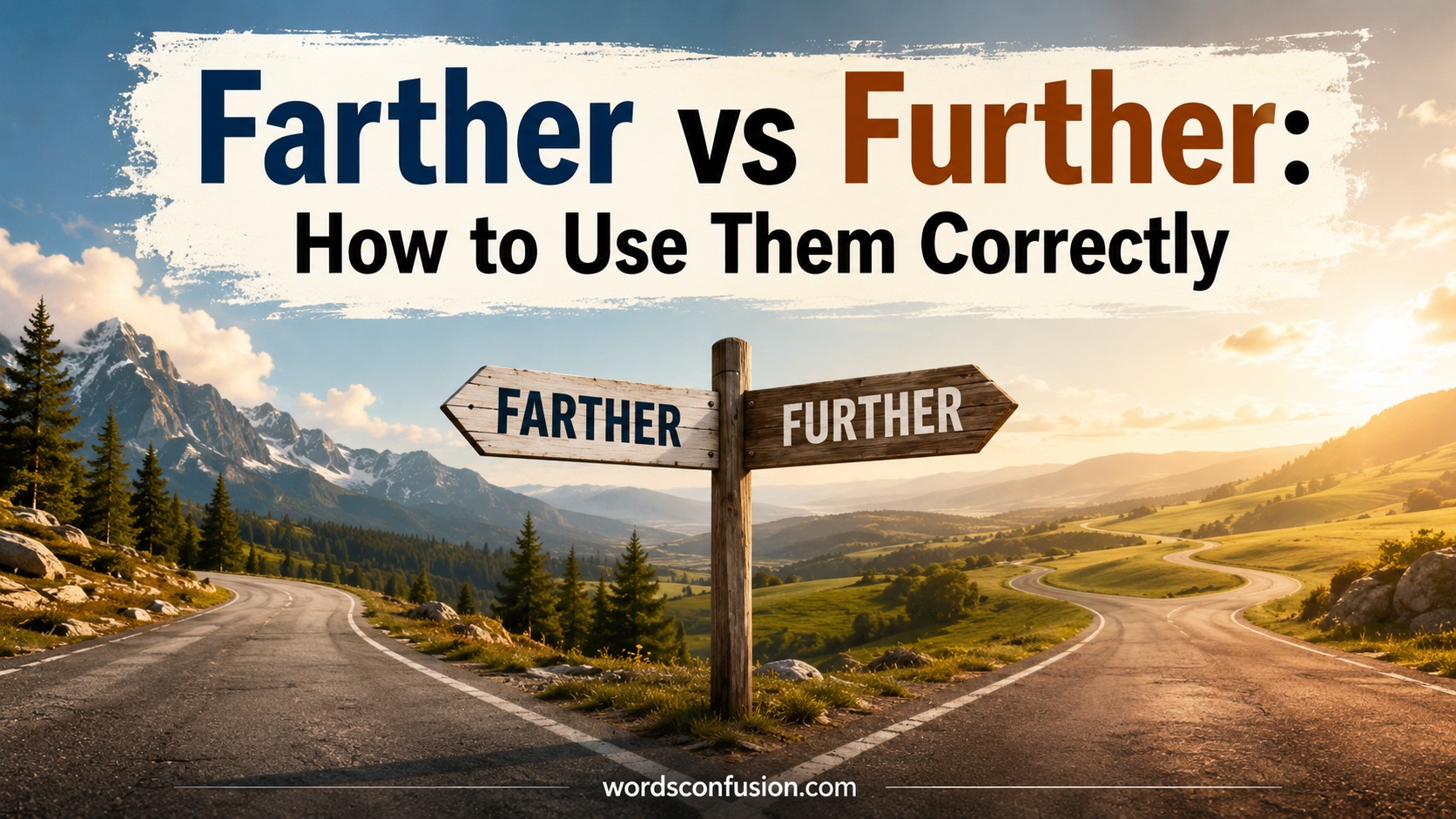
Farther vs further is one of those grammar questions that can make even confident writers pause. Both words come from far, both can relate to distance, and in everyday English, their meanings sometimes overlap. That’s where the confusion begins.
The simplest traditional rule says farther refers to physical distance while further refers to figurative distance, additional information, or progress. That rule works well in many situations. However, modern English gives further a wider range of uses than this simple distinction suggests.
For example, you might say:
- The next town is farther away.
- We need further information.
- Let’s discuss this matter further.
- The new program will further scientific research.
The difference becomes much easier once you understand what each word is doing in a sentence. Think of farther as a measuring tape stretching across physical space. Further often moves beyond a point in an idea, discussion, process, or goal.
Quick Answer
Farther usually refers to a greater physical distance.
The airport is farther from my house than the train station.
Further usually means additional, more, to a greater extent, or to advance something.
We need further information before making a decision.
A quick memory trick is simple:
Farther = far + physical distance
Further = additional progress, extent, or information
However, this isn’t an absolute rule. Further can also refer to physical distance, especially in modern English and common expressions.
| Word | Main Meaning | Example |
| Farther | Greater physical distance | We drove farther than expected. |
| Further | Additional or more | We need further details. |
| Further | To a greater extent | Let’s investigate further. |
| Further | To advance or promote | The program furthers education. |
What Does Farther Mean?
Farther is traditionally used to describe a greater physical distance. It compares one physical location, movement, or measurable distance with another.
The word often appears when you can imagine measuring the distance with miles, feet, kilometers, or some other physical measurement.
For example:
- The library is farther from my house than the grocery store.
- How much farther do we need to walk?
- She threw the ball farther than anyone else.
- The blue house is farther down the road.
- We traveled farther than we planned.
In each example, farther connects naturally with physical space. You can usually ask, “How far?” and receive a distance-based answer.
The farther you travel, the more the landscape changes.
Here, the word describes physical movement through space.
Farther as a Comparative Form
Farther works as a comparative form of far.
Consider this progression:
- Far — a considerable distance
- Farther — a greater distance
- Farthest — the greatest distance
For example:
The park is far from here.
The airport is farther from here.
The mountain is the farthest place we can reach today.
The word farther compares two distances. The word farthest identifies the greatest distance among three or more points.
What Does Further Mean?
Further has a broader meaning than farther. It can mean additional, more, to a greater degree, or beyond the current point.
Unlike farther, it commonly appears with abstract ideas. You can use it with information, research, discussion, education, progress, investigation, and development.
For example:
- We need further evidence.
- The company released further details.
- Let’s discuss the issue further.
- Further research could reveal new information.
- The training furthered her career.
The key idea is movement beyond what already exists. That movement doesn’t need to involve physical space.
Further as an Adjective
As an adjective, further usually means additional or more.
Examples include:
- Do you have any further questions?
- The company provided further details.
- Further research is necessary.
- No further action is required.
- The doctor requested further testing.
In these sentences, further doesn’t describe a physical location. It means something extra or additional.
Compare:
The farther building is across the street.
We need further information about the building.
The first sentence describes physical distance. The second asks for additional information.
Further as an Adverb
As an adverb, further can mean to a greater extent or beyond the current point.
Examples:
- We need to investigate further.
- The discussion went further than expected.
- She wanted to explore the topic further.
- The negotiations cannot continue further without an agreement.
Here, further describes the degree or extent of an action.
Further as a Verb
One important difference between farther and further is that further can function as a verb.
As a verb, further means to advance, promote, develop, or help something progress.
Examples:
- The scholarship furthered his education.
- The campaign aims to further public awareness.
- The research could further medical knowledge.
- Her efforts furthered the organization’s goals.
You cannot normally use farther this way.
Incorrect:
The scholarship farthered his education.
Correct:
The scholarship furthered his education.
This verb form makes further especially common in academic, professional, and formal writing.
Farther vs Further: The Main Difference
The traditional distinction is straightforward:
Use farther for measurable physical distance.
Use further for additional meaning, figurative distance, progress, or advancement.
Farther Usually Describes Physical Distance
Use farther when something exists at a greater physical distance or when someone moves a greater physical distance.
Examples:
- The next gas station is farther down the highway.
- The runner went farther than her competitor.
- We walked farther than we expected.
- The village is farther from the city.
- How much farther is the campsite?
You can often replace the word with a specific distance.
The village is 10 miles farther away.
That physical measurement makes farther a natural choice.
Further Usually Describes Additional Meaning
Use further when you mean additional, more, or to a greater extent.
Examples:
- Please send further information.
- The committee needs further evidence.
- We should discuss this further.
- Further investigation may be necessary.
- The course will further your professional development.
In these examples, there is no physical distance to measure. The word moves beyond a current point in an idea or process.
Can Further Refer to Physical Distance?
Yes. This is where the traditional rule becomes less rigid.
Many speakers use further to describe physical distance. This usage has a long history in English and remains common today.
For example:
The cabin is further down the trail.
We traveled further than we expected.
The store is further away than I remembered.
These sentences sound natural to many English speakers. In American English, farther is often preferred when the distance is clearly measurable. However, further isn’t automatically wrong in every physical-distance sentence.
A practical approach works best:
- Choose farther when you want to emphasize measurable physical distance.
- Choose further when the idea involves progression or movement beyond a point.
- Accept that further often works in physical contexts where modern usage allows it.
For example:
We walked farther than five miles.
This clearly emphasizes measurement.
We walked further into the forest.
This may emphasize movement beyond a particular point rather than a specific measurement.
The difference can be subtle. Language rarely behaves like a perfectly sealed toolbox.
Can Farther Be Used Figuratively?
Yes, although further is generally more common for figurative meanings.
A famous example is:
Nothing could be farther from the truth.
The word farther doesn’t describe a literal physical distance here. It expresses extreme difference or opposition.
You may also encounter:
- That idea is farther from reality than you realize.
- The argument couldn’t be farther from the original point.
These examples show why the physical-versus-figurative rule shouldn’t become an inflexible law. It serves as a useful guide. Context still matters.
Farther vs Further Examples in Real Sentences
Examples Using Farther
- The airport is farther from downtown than the train station.
- We drove farther than we planned.
- How much farther do we have to walk?
- The athlete threw the javelin farther than his rival.
- The farther side of the lake looked completely deserted.
- The second trail leads farther into the forest.
- Her new apartment is farther from work.
Each sentence focuses mainly on physical space or distance.
Examples Using Further
- We need further information before approving the proposal.
- The researchers conducted further analysis.
- Let’s discuss the problem further.
- The company needs further evidence before moving ahead.
- The new policy could further economic development.
- Please contact the office for further assistance.
- The investigation may continue further.
These sentences involve additional information, progress, development, or extent.
When Both Farther and Further Can Work
Some sentences can use either word. The preferred choice often depends on the meaning you want to emphasize.
Compare:
We walked farther into the forest.
We walked further into the forest.
The first sentence emphasizes physical distance. The second can emphasize continuing beyond the current point.
Another example:
The store is farther down the road.
The store is further down the road.
Both versions are widely understood. Farther follows the traditional physical-distance distinction more closely. Further sounds natural in everyday speech and appears frequently in modern usage.
A Useful Context Test
Ask yourself:
Can I measure the distance?
If yes, farther is usually the clearest choice.
Do I mean additional, more, or beyond the current stage?
If yes, further is usually the better choice.
This test won’t solve every unusual sentence. It will handle the vast majority of everyday writing.
Common Expressions With Further
Some phrases almost always use further because the word has become part of a fixed expression.
Common examples include:
- Further information
- Further details
- Further research
- Further discussion
- Further action
- Further notice
- Further education
- Further development
- Further investigation
- Without further ado
- Until further notice
Examples:
Please contact us for further information.
The office is closed until further notice.
Without further ado, let’s begin the presentation.
These expressions are deeply established in English. Replacing further with farther would sound incorrect.
Incorrect:
Please provide farther information.
Correct:
Please provide further information.
Common Expressions With Farther
Farther commonly appears in phrases connected with physical distance.
Examples include:
- Farther away
- Farther down the road
- Farther from home
- How much farther?
- Go farther
- Travel farther
- Reach farther
For example:
The farther away we traveled, the colder the weather became.
How much farther is the next town?
However, some fixed expressions create exceptions.
Nothing could be farther from the truth.
This phrase uses farther even though the meaning is figurative.
Read More: Economic vs. Economical: Meaning, Differences, and Examples
Farther vs Further: Common Mistakes
Mistake 1: Using Farther for Additional Information
Incorrect:
Please send me farther information.
Correct:
Please send me further information.
Further information means additional information. It has nothing to do with physical distance.
Mistake 2: Using Further When You Mean a Clearly Measurable Distance
This isn’t always grammatically wrong. However, farther often provides greater precision.
Less precise:
The town is further away.
More precise:
The town is farther away.
The second sentence clearly signals physical distance.
Mistake 3: Treating the Traditional Rule as Absolute
The rule farther = physical distance and further = figurative distance is useful. However, English usage has never followed it perfectly.
Further can refer to physical distance. Farther can appear in figurative expressions.
The better approach is to understand the main pattern rather than treating every exception as a grammatical disaster.
Mistake 4: Confusing Farther and Farthest
Farther is comparative.
Farthest is superlative.
Examples:
- The second house is farther away.
- That mountain is the farthest point visible from here.
Use farther when comparing two distances. Use farthest when identifying the greatest distance.
Mistake 5: Confusing Further and Furthest
Further generally means additional or greater in degree.
Furthest means the greatest degree or extent.
Examples:
- We need further discussion.
- That was the furthest point in the debate.
Both forms can sometimes refer to physical distance too.
Farther vs Further: Related Forms
| Comparative Form | Superlative Form | Typical Meaning |
| Farther | Farthest | Greater or greatest physical distance |
| Further | Furthest | Additional degree, extent, or progress |
Examples:
The blue house is farther away.
The red house is the farthest one on the street.
We need further research.
That was the furthest the investigation could go.
Farther vs Further in Academic Writing
Academic writing frequently uses further because researchers constantly discuss additional evidence, analysis, investigation, and research.
Common academic phrases include:
- Further research
- Further analysis
- Further investigation
- Further evidence
- Further study
- Further discussion
Examples:
Further research is needed to understand the long-term effects.
The findings require further analysis.
Further investigation revealed several important factors.
Using farther in these sentences would be incorrect because the meaning involves additional work rather than physical distance.
Farther vs Further in Business Writing
Professional communication also relies heavily on further.
You may see phrases such as:
- For further information, contact our support team.
- No further action is required.
- The project needs further review.
- We will provide further updates soon.
- The issue requires further investigation.
- Until further notice, the office will remain closed.
These phrases all involve additional steps, information, or action.
By contrast, farther usually appears when business writing discusses actual locations or transportation.
The new warehouse is farther from the city center.
Farther vs Further in Everyday Conversation
In casual speech, people often use further broadly.
For example:
How much further do we have to go?
This sentence is extremely common. Many speakers use further even when discussing physical distance.
You might also hear:
I don’t want to take this any further.
Here, further clearly refers to continuing an action or situation.
The important point is that everyday English doesn’t always draw a sharp line between the two words. Formal writing often benefits from the traditional distinction. Conversation allows more flexibility.
FAQs:
Is “farther” or “further” better for physical distance?
Farther is usually the clearest choice when you mean measurable physical distance.
The next town is farther from here.
However, further also appears frequently in modern English, especially in phrases such as further down the road or how much further do we have to go? Both forms can be acceptable depending on the context and style preference.
Can I use “further” instead of “more”?
Often, yes. Further can mean additional or more.
For example:
We need further information.
This means:
We need more information.
Similarly:
The company needs further evidence.
means:
The company needs additional evidence.
However, further isn’t a universal replacement for more. The sentence must involve the idea of something additional, continued, or extended.
Is “further away” grammatically correct?
Yes. Further away is widely used and grammatically acceptable.
The new school is further away than the old one.
Many speakers also use farther away, especially when emphasizing physical distance.
The new school is farther away than the old one.
In practical writing, farther away can make the physical-distance meaning more obvious. Further away remains common in everyday English.
Should I use “farther” or “further” in formal writing?
For formal writing, use farther for clearly measurable physical distance and further for additional or figurative meanings.
Examples:
- The research center is farther from the city.
- Further analysis is required.
- The project needs further development.
- The second location is farther away.
This approach gives your writing precision without forcing an artificial rule onto every sentence.
What is the easiest way to remember farther vs further?
Use this simple memory trick:
Farther contains “far,” so connect it with physical distance.
The mountain is farther away.
Further means additional, more, or continued progress.
We need further information.
When you encounter an unusual sentence, focus on the intended meaning. Is the sentence describing a physical distance or moving beyond an existing point? That distinction usually reveals the correct choice.
Conclusion:
The difference between farther vs further isn’t as complicated as it first appears.
Use farther when you’re talking about a greater physical distance:
The airport is farther from the city than the train station.
Use further when you mean additional, more, deeper, or continued:
We need further information before making a decision.
The traditional rule provides a reliable starting point:
Farther = physical distance.
Further = additional meaning, figurative distance, or progress.
Still, modern English allows some overlap. Further can describe physical distance in many everyday sentences while farther appears in certain figurative expressions. The goal isn’t to memorize an inflexible rule. Instead, understand the meaning you want to express.
When you remember that farther usually measures distance while further usually extends an idea, action, or process, choosing the right word becomes much easier.

Andrew Wilson is an experienced language researcher and content writer specializing in WordsConfusion topics. He helps readers understand commonly confused English words, spelling differences, grammar rules, word meanings, and proper usage through clear explanations, practical examples, and easy-to-follow language guides. His goal is to make English learning simple, accurate, and accessible for students, writers, professionals, and everyday learners.