Have you ever paused while writing and wondered whether you should use economic or economical? You’re not alone. These two words look almost identical, share the same root, and even sound similar. Yet they carry different meanings. Choosing the wrong one can make a sentence sound awkward or even change its meaning entirely.
For example, consider these two sentences:
- The government introduced new economic policies.
- This hybrid car is very economical.
Both are correct. Now switch the words:
- The government introduced new economical policies.
- This hybrid car is very economic.
Both sentences sound unnatural because each adjective belongs in a different context.
The distinction is simple once you understand it:
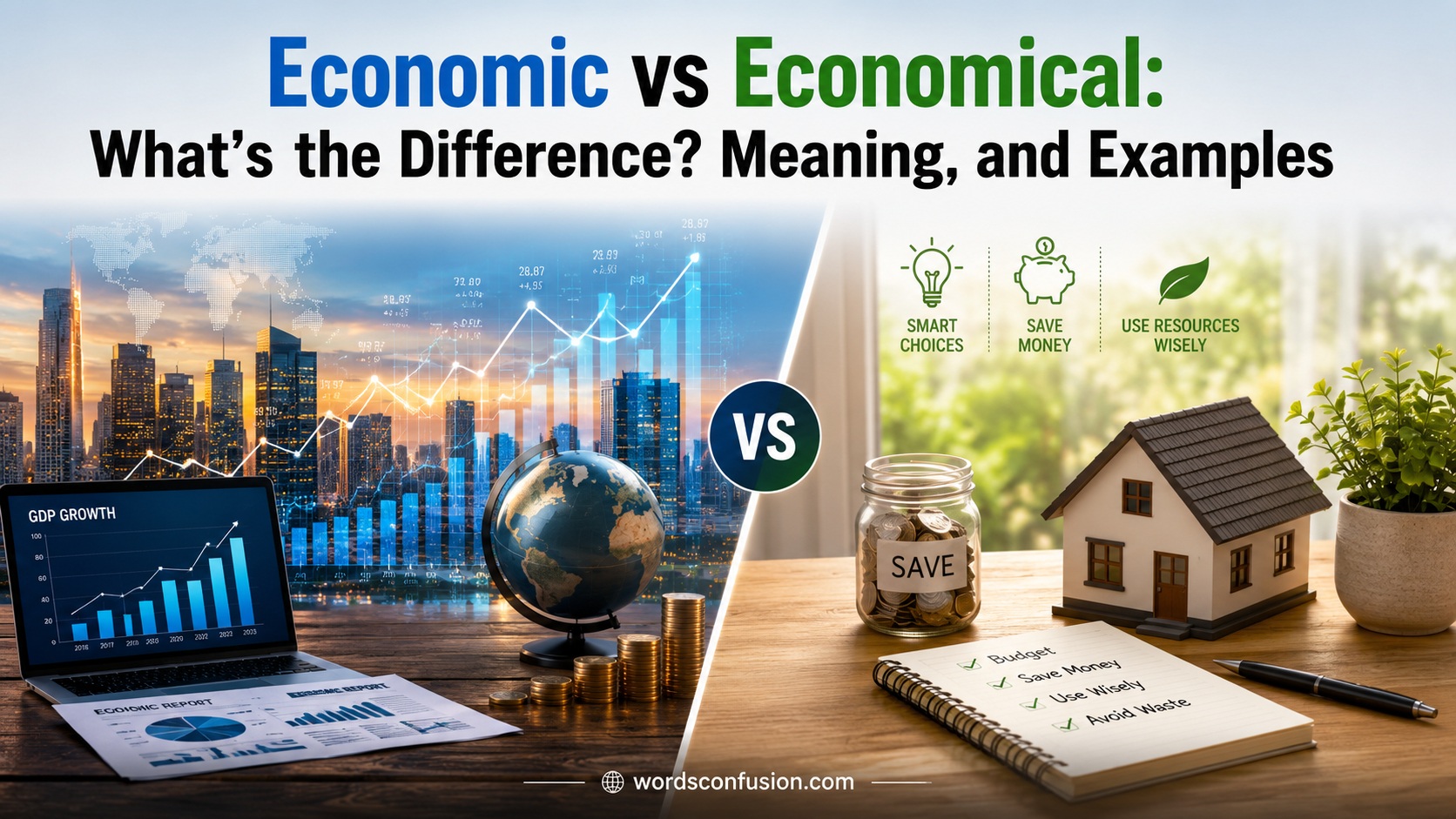
- Economic relates to the economy, finance, trade, business, or economics.
- Economical describes something that saves money, time, fuel, energy, or other resources.
This guide explains the difference in plain English. You’ll learn definitions, examples, common mistakes, memory tricks, and real-world applications so you can confidently choose the right word every time.
Economic vs Economical at a Glance
| Feature | Economic | Economical |
| Meaning | Related to the economy or economics | Uses money or resources efficiently |
| Part of Speech | Adjective | Adjective |
| Common Context | Government, finance, trade, employment | Cars, appliances, lifestyles, business operations |
| Focus | Economic systems and financial conditions | Saving money and reducing waste |
| Tone | Formal and professional | Everyday and practical |
| Example | Economic growth boosted employment. | This dishwasher is economical to operate. |
Although both words come from the same root, they describe different ideas. Understanding that single difference eliminates most confusion.
What Does Economic Mean?
Economic is an adjective that relates to economics, the economy, financial systems, production, trade, markets, employment, and government policy.
Whenever you discuss how money moves through a country, how businesses operate, or how markets perform, economic is almost always the correct choice.
Definition of Economic
Economic means:
Relating to the production, distribution, and consumption of goods and services or to the financial condition of a country, organization, or society.
Simply put, if your topic involves economics, use economic.
When to Use Economic
Use economic when talking about:
- National economies
- Global markets
- Inflation
- Employment
- Government spending
- Business growth
- International trade
- Taxes
- Interest rates
- Financial development
Common Collocations with Economic
Some phrases appear regularly in newspapers, research papers, and business reports.
| Phrase | Meaning |
| Economic growth | Increase in a country’s production and income |
| Economic development | Long-term improvement in living standards |
| Economic policy | Government plans affecting the economy |
| Economic recovery | Improvement after a recession |
| Economic crisis | Serious financial problems |
| Economic activity | Buying, selling, producing, and investing |
| Economic reform | Changes made to improve an economy |
| Economic outlook | Expected future economic performance |
| Economic stability | Steady and predictable economy |
| Economic impact | Financial effect of an event |
These combinations are standard English and appear frequently in professional writing.
Examples of Economic in Sentences
- Rising exports strengthened the country’s economic performance.
- Tourism creates significant economic opportunities.
- Experts expect stronger economic growth next year.
- The government announced several economic reforms.
- Inflation remains one of the biggest economic challenges.
Notice that every sentence refers to money, markets, governments, or the economy rather than saving resources.
Understanding Economical
Economical describes someone or something that uses money, energy, materials, fuel, or time carefully and efficiently.
Instead of discussing the economy, this word focuses on avoiding waste.
Definition of Economical
Economical means:
Achieving good results while using the least amount of money, effort, fuel, or other resources.
It often suggests smart spending rather than simply spending less.
When to Use Economical
Choose economical when describing:
- Fuel-efficient vehicles
- Energy-saving appliances
- Cost-effective business practices
- Budget-friendly lifestyles
- Efficient manufacturing
- Resource management
- Household expenses
- Sustainable habits
Common Collocations with Economical
| Phrase | Meaning |
| Economical car | Uses little fuel |
| Economical choice | Saves money |
| Economical solution | Low-cost and efficient |
| Economical lifestyle | Careful spending habits |
| Economical appliance | Consumes less electricity |
| Economical design | Uses fewer materials |
| Economical heating | Reduces energy costs |
| Economical method | Efficient approach |
These phrases appear in everyday conversations, advertisements, and consumer reviews.
Examples of Economical in Sentences
- A hybrid vehicle is more economical than a traditional SUV.
- LED bulbs are extremely economical because they use less electricity.
- She found an economical way to renovate her kitchen.
- Walking instead of driving is both healthy and economical.
- Cloud computing offers an economical solution for many small businesses.
Here, the focus is saving resources rather than discussing economics.
Economic vs Economical: The Key Difference
At first glance, economic and economical seem interchangeable because they share the same root word. In reality, they describe completely different ideas.
Think of it this way:
- Economic = connected to the economy.
- Economical = connected to saving money or resources.
That simple rule solves almost every situation.
| Aspect | Economic | Economical |
| Main Meaning | Related to economics or the economy | Efficient and cost-saving |
| Used For | Countries, governments, markets, businesses | People, products, services, machines |
| Focus | Financial systems | Resource efficiency |
| Typical Context | Finance, trade, employment, inflation | Fuel, electricity, money, time |
| Everyday Usage | Formal | Everyday |
| Example | Economic policy | Economical washing machine |
Notice how one word belongs to discussions about economics, while the other belongs to discussions about efficiency.
How to Decide Which Word to Use
A quick question can help you choose the right word.
Ask Yourself: “Am I Talking About the Economy?”
If the answer is yes, use economic.
Examples:
- Economic recession
- Economic policy
- Economic growth
- Economic forecast
- Economic sanctions
Ask Yourself: “Am I Talking About Saving Money or Resources?”
If the answer is yes, use economical.
Examples:
- Economical printer
- Economical vacation
- Economical packaging
- Economical lighting
- Economical transportation
This two-question method works almost every time.
Read More: Story vs History: What’s the Difference? Meaning, and Example
Real-World Examples of Economic vs Economical
Understanding grammar becomes much easier when you see words used in everyday situations.
Business
A company may invest in economic research before entering a new market.
The same company may purchase economical office equipment to reduce operating costs.
Government
Governments create economic policies to improve employment, increase investment, and stabilize inflation.
They may also encourage people to buy economical electric vehicles by offering tax incentives.
Transportation
A transportation expert studies the economic impact of expanding public transit.
Meanwhile, a commuter chooses an economical motorcycle because it consumes less fuel.
Education
Universities teach economic theory to explain how markets work.
Students often look for economical textbooks or digital alternatives to reduce expenses.
Healthcare
Healthcare economists analyze the economic effects of rising medical costs.
Hospitals purchase economical medical equipment that lowers long-term maintenance expenses without sacrificing quality.
Technology
Technology companies evaluate the economic benefits of artificial intelligence before investing billions of dollars.
Consumers prefer economical laptops that offer excellent performance at a reasonable price.
Everyday Comparison Examples
The easiest way to remember the difference is to compare similar sentences.
| Correct Sentence | Why It Is Correct |
| Economic growth increased employment. | Refers to the economy. |
| This heater is economical to operate. | Refers to saving energy. |
| The country experienced economic instability. | Talks about national finances. |
| Solar panels are economical over time. | Talks about lower operating costs. |
| Experts predict economic recovery next year. | Discusses the economy. |
| Buying in bulk is often economical. | Discusses saving money. |
One word changes the entire meaning of the sentence.
Common Mistakes People Make
Many writers confuse these words because they look so similar. Fortunately, the mistakes follow predictable patterns.
Mistake: Using Economic Instead of Economical
Incorrect:
- This car is very economic.
Correct:
- This car is very economical.
A car doesn’t belong to the economy. Instead, it saves fuel or money.
Mistake: Using Economical When Discussing a Country
Incorrect:
- The country’s economical performance improved.
Correct:
- The country’s economic performance improved.
National performance relates to economics, not resource efficiency.
Mistake: Assuming They Are Synonyms
Some learners believe both words mean “cheap.”
They don’t.
Consider these examples:
- An economic report discusses jobs, inflation, taxes, and GDP.
- An economical report would describe a report produced efficiently using minimal resources, which is rarely what writers intend.
The context completely changes the meaning.
Economic Does Not Mean Cheap
One of the biggest misconceptions is that economic means inexpensive.
It doesn’t.
For example:
- Economic policy
- Economic development
- Economic forecast
None of these phrases has anything to do with low prices.
Instead, they refer to the broader economy.
Economical Does Not Mean Low Quality
People sometimes assume an economical product must be inferior.
That’s not true.
Being economical simply means delivering good value while minimizing waste.
For example:
- LED lighting costs less to operate than traditional bulbs.
- Hybrid vehicles consume less fuel.
- Energy-efficient appliances reduce electricity bills.
These products aren’t cheap because they’re poorly made. They’re economical because they save resources over time.
Economic vs Economical in British and American English
The meanings of these words remain the same in both American English and British English.
There is no significant difference in grammar or usage.
For example:
| American English | British English |
| Economic policy | Economic policy |
| Economic growth | Economic growth |
| Economical washing machine | Economical washing machine |
| Economical lifestyle | Economical lifestyle |
Both varieties of English follow the same distinction.
The only noticeable difference is that British speakers may use economical slightly more often when describing practical spending habits, while American English frequently uses cost-effective in business writing. Even so, economical remains perfectly natural in both countries.
Economic vs Economical in Business Writing
Professional writers choose these words carefully because using the wrong one can reduce credibility.
Consider this sentence.
Incorrect:
Our company offers economic office furniture.
This suggests the furniture relates to economics rather than affordability.
Correct:
Our company offers economical office furniture.
Now the meaning becomes clear. The furniture saves money while providing good value.
Similarly:
Correct:
- Economic analysis
- Economic indicators
- Economic outlook
- Economic forecasts
These phrases belong in finance, economics, and government reports.
Meanwhile:
Correct:
- Economical production
- Economical manufacturing
- Economical packaging
- Economical shipping methods
These focus on reducing costs and waste while maintaining quality.
FAQs:
Is economic the same as economical?
No. Economic relates to the economy, economics, finance, trade, and government policies. Economical means using money, fuel, time, or other resources efficiently. Although the words share the same root, they are not interchangeable.
Can a person be economical?
Yes. An economical person spends money wisely and avoids unnecessary waste. For example, someone who compares prices, sticks to a budget, and reduces energy consumption can be described as economical.
Is an economical car the same as an economic car?
No. An economical car is fuel-efficient and inexpensive to operate. The phrase economic car is generally incorrect because a car does not relate to the economy. In almost every context, economical car is the correct expression.
What is the difference between economic growth and economical growth?
Economic growth is the correct term. It refers to an increase in a country’s production of goods and services, often measured by Gross Domestic Product (GDP). The phrase economical growth is incorrect because growth relates to the economy, not resource efficiency.
Why do people confuse economic and economical?
People confuse these words because they have similar spellings, pronunciations, and origins. Both come from the Greek word oikonomia, meaning household management. Over time, however, English assigned different meanings to each word. Today, economic refers to economics and the economy, while economical describes efficiency and careful use of resources.
Conclusion:
Understanding the difference between economic vs economical becomes much easier once you focus on the context instead of the spelling.
Use economic whenever your sentence relates to economics, the economy, finance, trade, markets, employment, inflation, or government policy. It describes financial systems and broader economic conditions rather than personal spending or efficiency.
Choose economical when you want to describe something that saves money, fuel, energy, time, or other resources. Whether you’re talking about a fuel-efficient car, an energy-saving appliance, or a cost-effective business solution, economical is the right choice.

Andrew Wilson is an experienced language researcher and content writer specializing in WordsConfusion topics. He helps readers understand commonly confused English words, spelling differences, grammar rules, word meanings, and proper usage through clear explanations, practical examples, and easy-to-follow language guides. His goal is to make English learning simple, accurate, and accessible for students, writers, professionals, and everyday learners.