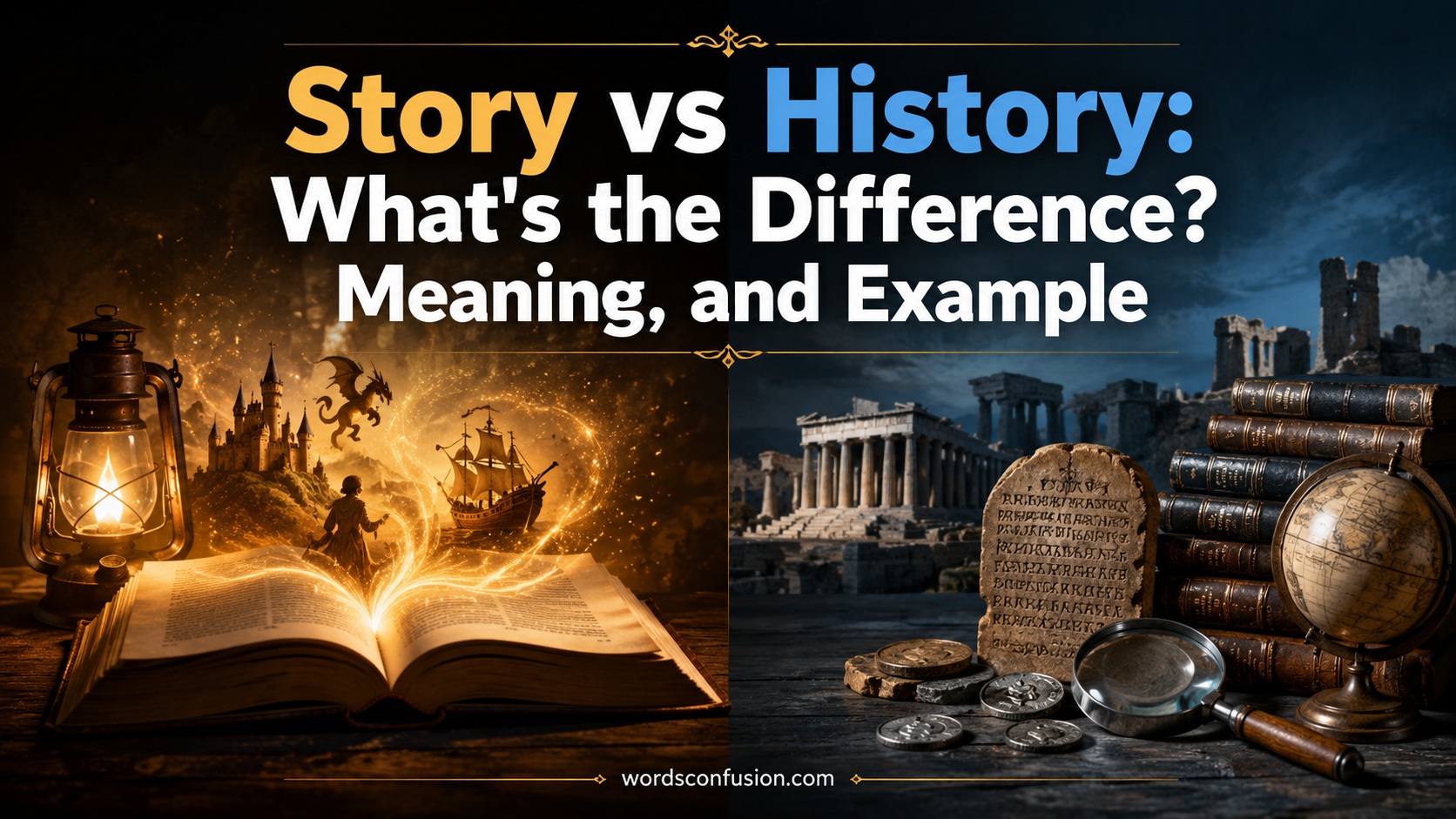
Have you ever wondered whether story and history mean the same thing? Many people use these words interchangeably because they both involve telling events. However, they are not synonyms. A story can be fictional, factual, or a mix of both, while history is the documented record of real events based on evidence and research.
Understanding the difference between story vs history is important for students, writers, educators, and anyone who wants to communicate clearly. Whether you’re reading a novel, studying world events, or sharing a personal experience, choosing the right word makes your message more accurate.
In this guide, you’ll learn what story and history mean, how they differ, where they overlap, and when to use each one. You’ll also find comparison tables, real-world examples, common mistakes, and practical tips that make the distinction easy to remember.
Story vs History: Quick Comparison
| Feature | Story | History |
| Definition | A narrative that tells events or experiences | A factual record of past events |
| Purpose | To entertain, inform, inspire, or persuade | To document, explain, and preserve the past |
| Based on Facts | May or may not be factual | Based on evidence and verified facts |
| Fiction Allowed | Yes | No |
| Main Focus | Characters, events, and narrative | Real people, places, and events |
| Sources | Imagination, personal experience, or facts | Documents, artifacts, records, eyewitness accounts |
| Examples | Fairy tales, novels, personal anecdotes | World War II, the American Revolution, Ancient Rome |
The table shows the simplest way to remember the difference. Every history is a factual account of the past, while a story can exist with or without factual accuracy.
What Does Story Mean?
A story is a sequence of events presented to an audience. Those events may come from imagination, personal experience, or real-life situations. The goal of a story isn’t always to present facts. Sometimes it aims to entertain, teach a lesson, inspire emotion, or help readers understand an idea through narrative.
Stories have existed for thousands of years. Before writing became common, people passed knowledge from one generation to another through oral storytelling. These stories preserved traditions, beliefs, and cultural values.
Most stories include several essential elements:
- Characters
- Setting
- Conflict
- Plot
- Resolution
- Theme
Without these elements, a narrative usually feels incomplete.
Types of Stories
Stories appear in many different forms. Each serves a unique purpose.
Fiction
Fiction comes entirely from imagination. Although fictional stories may include realistic settings or historical periods, the events themselves are invented.
Examples include:
- Fantasy novels
- Science fiction
- Fairy tales
- Mystery books
- Adventure stories
Nonfiction Stories
Not every story is imaginary. Many nonfiction stories describe real events while using storytelling techniques.
Examples include:
- Memoirs
- Autobiographies
- Biographies
- Travel writing
- Investigative journalism
Personal Stories
People share personal stories every day.
For example:
“When I graduated from college, my family surprised me with a celebration.”
The event really happened, yet it’s still considered a story because it’s being told as a narrative.
Myths and Folktales
Cultures worldwide preserve myths and legends to explain traditions, beliefs, or natural events. Although these stories often contain fictional elements, they remain culturally significant.
Why Stories Matter
Stories influence nearly every part of life.
They help people:
- Build emotional connections
- Understand different perspectives
- Remember information
- Teach values
- Inspire creativity
- Preserve traditions
Research consistently shows that people remember information better when it’s presented as a narrative instead of isolated facts.
Everyday Examples of Stories
You probably encounter stories every single day.
Examples include:
- Watching a movie
- Reading a novel
- Listening to a podcast
- Hearing a friend describe their vacation
- Reading a news feature about someone’s life
- Playing a story-driven video game
Each example presents events in a structured narrative.
What Does History Mean?
Unlike stories, history focuses on real events that actually happened. Historians gather evidence, compare sources, verify facts, and interpret the past as accurately as possible.
History isn’t simply a list of dates. Instead, it explains how people, societies, governments, economies, and cultures changed over time.
The word history comes from the Greek word historia, meaning inquiry or investigation. That origin reflects exactly what historians do—they investigate the past.
History answers questions like:
- What happened?
- When did it happen?
- Why did it happen?
- Who was involved?
- What were the consequences?
Unlike fictional narratives, historical accounts depend on reliable evidence rather than imagination.
Primary Sources
Primary sources are original records created during the time being studied.
Examples include:
- Letters
- Diaries
- Government documents
- Newspapers
- Photographs
- Maps
- Official speeches
- Court records
- Military reports
Primary sources provide direct evidence.
Secondary Sources
Secondary sources analyze or interpret primary sources.
Examples include:
- History textbooks
- Academic articles
- Biographies
- Documentaries
- Research papers
Historians usually compare multiple primary and secondary sources before reaching conclusions.
Why Evidence Matters
History depends on evidence because memories can fade, stories can change, and myths can develop over time.
A responsible historian asks questions such as:
- Is the source authentic?
- Who created it?
- Why was it created?
- Does other evidence support it?
This careful process helps separate fact from legend.
Everyday Examples of History
History surrounds us more than most people realize.
Examples include:
- Family genealogy
- Local town history
- National independence movements
- Ancient civilizations
- Scientific discoveries
- Presidential elections
- Archaeological findings
Each example documents real events supported by historical evidence.
Story vs History: The Core Difference
At first glance, story and history seem closely related because they both describe events. The difference lies in purpose, evidence, and accuracy.
A story focuses on presenting events through a narrative. It may be fictional, based on real experiences, or inspired by actual events. Its main goal is often to entertain, educate, inspire, or evoke emotion.
History, on the other hand, seeks to record and explain real events that happened in the past. Historians don’t rely on imagination. Instead, they use evidence such as documents, artifacts, photographs, government records, and eyewitness accounts to reconstruct the past as accurately as possible.
Think of it this way:
- Every history tells a story.
- Not every story is history.
That simple distinction helps clear up much of the confusion.
For example, a novel about ancient Rome may tell a fascinating story, but unless every event and character is historically verified, it isn’t history. Conversely, a history book about ancient Rome may read like an engaging story while remaining grounded in documented evidence.
Story vs History Comparison Table
| Aspect | Story | History |
| Primary Goal | Entertain, educate, or inspire | Record and explain real events |
| Truthfulness | May be true or fictional | Must be based on evidence |
| Research Required | Optional, depending on the type | Essential |
| Creativity | Often encouraged | Limited to presenting facts accurately |
| Characters | Real or fictional | Real people only |
| Timeline | Flexible | Chronological and evidence-based |
| Sources | Imagination, memories, interviews, or facts | Documents, artifacts, archives, eyewitness records |
| Writing Style | Narrative and descriptive | Analytical, factual, and explanatory |
| Audience | General readers | Students, researchers, historians, and the public |
| Examples | Fairy tales, novels, memoirs | Civil War records, historical research, official archives |
Although their purposes differ, skilled writers often combine the strengths of both. History becomes more engaging when presented through compelling storytelling, while true stories become more credible when supported by factual evidence.
Can a Story Be True?
Absolutely.
One of the biggest misconceptions is believing that every story is fictional. In reality, many stories describe events exactly as they happened.
A story simply means a narrative about events. Those events may be completely true.
Examples include:
- A firefighter describing a rescue.
- A traveler sharing experiences from Japan.
- A cancer survivor writing a memoir.
- A journalist covering someone’s life journey.
- A grandparent telling childhood memories.
Each example is a story because it follows a sequence of events with people, actions, challenges, and outcomes.
Examples of True Stories
| Type | True Story? | Description |
| Memoir | Yes | Personal life experiences |
| Biography | Yes | Someone else’s documented life |
| Autobiography | Yes | The author’s own life story |
| Documentary | Usually | Real events supported by evidence |
| News Feature | Yes | Narrative reporting based on facts |
A true story doesn’t lose its identity as a story simply because it’s factual. Instead, it becomes a nonfiction story.
Can History Include Stories?
Yes. In fact, historians frequently use storytelling techniques to make historical events easier to understand.
Imagine reading this sentence:
“In 1776, a declaration was signed.”
Now compare it with:
“Delegates gathered in a crowded room, debating every word before signing a document that would reshape a nation.”
Both sentences describe the same historical event. The second version uses storytelling while remaining historically accurate.
This approach is called historical narrative.
Why Historians Tell Stories
Stories help readers:
- Understand complex events.
- Remember historical facts.
- Connect emotionally with historical figures.
- See cause-and-effect relationships.
- Appreciate the human side of history.
Good historians never invent facts to make history more exciting. Instead, they organize verified information into a compelling narrative.
Oral History
Not every historical source begins as a written document.
Oral history preserves firsthand memories through recorded interviews.
Examples include:
- Veterans describing wartime experiences.
- Civil rights activists sharing personal memories.
- Indigenous communities preserving traditions.
- Holocaust survivors recounting their lives.
Researchers often compare oral histories with other evidence to improve historical accuracy.
Story vs History in Education
Students encounter both stories and history throughout their education, but each subject develops different skills.
Stories encourage creativity, imagination, empathy, and communication.
History develops critical thinking, evidence evaluation, research skills, and chronological understanding.
Both are valuable because they teach different ways of understanding the world.
What Students Learn from Stories
Stories help students:
- Expand vocabulary.
- Improve reading comprehension.
- Understand emotions.
- Build creativity.
- Learn moral lessons.
- Develop communication skills.
Reading fiction also strengthens imagination by encouraging readers to visualize people, places, and events.
What Students Learn from History
History teaches students to:
- Analyze evidence.
- Recognize bias.
- Compare multiple viewpoints.
- Understand cultural change.
- Identify historical causes and effects.
- Make informed decisions based on evidence.
These skills remain useful far beyond the classroom.
Story vs History in Literature
Literature often blurs the line between story and history.
Some books are entirely fictional.
Others are based on real historical events.
Still others combine both.
Understanding the genre helps readers know what to expect.
Historical Fiction
Historical fiction places fictional characters inside real historical settings.
For example:
- A fictional family living during World War II.
- An imaginary soldier fighting in the American Revolution.
- A made-up detective solving crimes in Victorian London.
The historical background may be accurate, but the characters and events are partly fictional.
Biography
A biography tells the true story of someone’s life.
Good biographies rely on:
- Letters
- Interviews
- Public records
- Photographs
- Diaries
- Historical documents
Since biographies are evidence-based, they belong closer to history than fiction.
Autobiography
An autobiography tells the author’s own life story.
Although memory isn’t always perfect, autobiographies generally aim to present truthful accounts of real experiences.
Memoir
Memoirs focus on a specific period or theme rather than an entire life.
Examples include:
- Military service
- Childhood
- Immigration
- Recovery from illness
- Professional careers
Memoirs emphasize personal perspective while remaining grounded in real events.
Creative Nonfiction
Creative nonfiction combines factual accuracy with literary storytelling.
Writers use vivid scenes, dialogue, and descriptive language without inventing events.
This style appears frequently in:
- Long-form journalism
- Nature writing
- Travel writing
- Narrative history
- Personal essays
It demonstrates that factual writing doesn’t have to be dull.
Story vs History in Everyday Conversation
Outside the classroom, people use the words story and history in many different situations. Most of the time, the intended meaning is clear from the context. Even so, confusing the two can lead to misunderstandings.
For example, if someone says, “Tell me your story,” they’re asking about your experiences, background, or journey. They aren’t asking for a detailed historical record supported by documents.
On the other hand, if someone asks, “What’s the history of this building?” they’re looking for factual information about when it was built, who owned it, how it changed over time, and why it’s important.
Knowing which word fits the situation makes your communication more precise.
Common Phrases with “Story”
Here are some everyday expressions that use story:
- Tell me your story.
- That’s an incredible story.
- What’s the story behind this photo?
- Long story short…
- Stick to the story.
- The story doesn’t add up.
- Every picture tells a story.
- Success story.
- Love story.
- Bedtime story.
Each phrase focuses on a narrative rather than a documented historical record.
Common Phrases with “History”
The word history appears in expressions related to the past or factual records.
Examples include:
- History repeats itself.
- Make history.
- Ancient history.
- Family history.
- Medical history.
- Employment history.
- Credit history.
- World history.
- History books.
These phrases emphasize documented events, records, or past experiences rather than fictional narratives.
Real-Life Examples
Consider these examples:
Example 1
“My grandfather told me a story about growing up on a farm.”
This sentence refers to a narrative. It may be completely true, but it’s still called a story because someone is telling events.
Example 2
“The museum explains the history of the town.”
Here, history refers to researched facts supported by historical evidence.
Example 3
“The movie tells the story of the Titanic.”
The film presents a story, even though it’s based on a historical event.
Example 4
“Historians continue studying the history of the Titanic disaster.”
In this sentence, the focus shifts from storytelling to factual investigation.
Read More: House vs Building: What’s the Difference? Examples, and Key Distinctions
Examples of Story and History
Looking at examples side by side makes the distinction much easier to understand.
Story Examples
These examples focus on narrative.
- A fantasy novel about dragons.
- A grandmother sharing childhood memories.
- A detective solving a fictional crime.
- A child telling what happened at school.
- A movie about superheroes.
- A memoir describing life after retirement.
- A podcast sharing a survivor’s experience.
- A short story published in a magazine.
Some are fictional. Others are completely true. They all qualify as stories because they present events in narrative form.
History Examples
These examples document real events.
- The fall of the Roman Empire.
- The American Revolution.
- Ancient Egyptian civilization.
- The Industrial Revolution.
- The Civil Rights Movement.
- The construction of the Great Wall of China.
- The Apollo 11 Moon landing.
- The invention of the printing press.
Each topic relies on historical evidence rather than imagination.
When to Use “Story”
Choosing story is appropriate whenever you’re talking about a narrative, whether it’s fictional or factual.
Use story when discussing:
- Novels
- Movies
- Fairy tales
- Personal experiences
- Family memories
- Children’s books
- Podcasts
- Interviews
- Marketing campaigns
- Brand journeys
Example Sentences
- She wrote a touching story about friendship.
- His life story inspired thousands of people.
- Every business has a unique story.
- The teacher read a short story to the class.
- My grandmother shared stories about her childhood.
Notice that none of these examples require historical documentation.
When to Use “History”
Use history whenever you’re referring to actual events, records, or the documented past.
History fits discussions involving:
- Schools
- Universities
- Museums
- Government records
- Archaeology
- Genealogy
- Academic research
- Historical documentaries
- Timelines
- Archives
Example Sentences
- We studied European history this semester.
- The castle has a fascinating history.
- Doctors reviewed her medical history.
- Researchers uncovered new evidence about ancient history.
- The company’s history dates back more than 100 years.
In every example, history refers to factual records rather than storytelling.
Commonly Confused Expressions
Many words related to story and history overlap in meaning. Understanding the differences helps you choose the most accurate term.
Story vs Tale
A story is a broad term that covers almost any narrative.
A tale usually refers to a traditional, imaginative, or fictional narrative.
| Story | Tale |
| Can be true or fictional | Often fictional or legendary |
| Modern or traditional | Frequently traditional |
| Very broad meaning | More specific |
Story vs Narrative
A story refers to the events themselves.
A narrative refers to how those events are presented.
For example, two writers can tell the same story using completely different narratives.
Story vs Plot
People often confuse these terms.
A story includes all the events, characters, and themes.
A plot is the organized sequence of events that moves the story forward.
Think of the plot as the framework that supports the larger story.
History vs Past
The past simply refers to everything that has already happened.
History is the researched and recorded interpretation of selected past events.
Not every event from the past becomes part of history because many events leave no surviving evidence.
History vs Heritage
These words aren’t interchangeable.
| History | Heritage |
| Focuses on past events | Focuses on cultural inheritance |
| Evidence-based | Passed through generations |
| Includes research | Includes traditions and customs |
A family’s heritage may include language, food, music, and traditions, while its history includes documented events and records.
History vs Historical Record
A historical record refers to the actual documents, photographs, letters, maps, and artifacts that preserve evidence.
History is the interpretation built from those records.
Story vs History: Side-by-Side Examples
The following examples show how changing one word changes the meaning of a sentence.
| Sentence | Correct Word | Why |
| She told an inspiring story about her childhood. | Story | It’s a personal narrative. |
| The museum explains the history of the city. | History | It presents documented facts. |
| The novel tells a fictional story. | Story | The events are imaginary. |
| Students studied the history of Ancient Greece. | History | The subject involves researched past events. |
| His life story became a bestselling memoir. | Story | It’s presented as a narrative. |
| Archaeologists discovered new evidence about Roman history. | History | The findings relate to factual historical research. |
| Every successful company has a unique story. | Story | It describes a journey or narrative. |
| The palace has a rich history spanning centuries. | History | The focus is on documented events. |
FAQs:
Is history a type of story?
In one sense, yes. History is often told as a story because narratives help readers understand complex events and remember important details. However, history is much more than storytelling. It relies on evidence, research, and verified facts rather than imagination. A history book may read like an engaging story, but every claim should be supported by reliable sources.
Can a story be completely true?
Yes. A story doesn’t have to be fictional. Many stories describe real events exactly as they happened. Memoirs, autobiographies, biographies, documentaries, and personal experiences are all examples of true stories. The word story refers to the way events are presented, not whether those events are real or imagined.
Is every historical book considered history?
No. Some books take place during historical periods but include fictional characters or invented events. These books belong to the historical fiction genre rather than history. A true history book is based on primary and secondary sources, careful research, and factual evidence. Before assuming a book is history, check whether the author distinguishes between documented facts and creative storytelling.
What is historical fiction?
Historical fiction combines real historical settings with fictional characters or imagined events. The background may accurately reflect a specific time period, including clothing, culture, politics, and major historical events, but parts of the narrative are created by the author. Popular novels set during World War II or Ancient Rome often fall into this category. They can teach readers about history while still telling an original story.
What’s the easiest way to remember the difference between story and history?
A simple memory trick is this:
- Story = Someone tells events.
- History = Historians verify events.
Another helpful reminder is that every history tells a story, but not every story is history. If imagination plays a role, you’re probably dealing with a story. If the information comes from documented evidence and research, you’re reading history.
Conclusion:
Understanding the difference between story vs history helps you communicate with greater accuracy and confidence. Although the two words share similarities, they serve different purposes.
A story is a narrative that presents events in a meaningful way. It may entertain, inspire, teach, or inform. Stories can be fictional, factual, or somewhere in between. From bedtime tales to personal memoirs, storytelling has shaped human culture for thousands of years.
History, in contrast, is the careful study and documentation of real events from the past. Historians rely on evidence such as letters, government records, photographs, artifacts, and eyewitness accounts to reconstruct what happened. Their goal is not to invent compelling narratives but to explain the past as accurately as possible.

Andrew Wilson is an experienced language researcher and content writer specializing in WordsConfusion topics. He helps readers understand commonly confused English words, spelling differences, grammar rules, word meanings, and proper usage through clear explanations, practical examples, and easy-to-follow language guides. His goal is to make English learning simple, accurate, and accessible for students, writers, professionals, and everyday learners.