When people discuss right and wrong, they often use ethics and morals as if they mean the same thing. In everyday conversation, that usually doesn’t create problems. However, in philosophy, law, business, healthcare, and professional settings, the distinction matters.
Imagine a doctor whose personal beliefs conflict with a medical procedure that is legally approved and professionally accepted. The doctor’s morals may point in one direction while professional ethics point in another. Situations like this happen every day.
Understanding the difference between ethics and morals helps you make better decisions, evaluate behavior more accurately, and navigate complex situations where values clash.
This guide explains what ethics and morals are, how they differ, where they overlap, and why understanding the distinction matters in modern life.
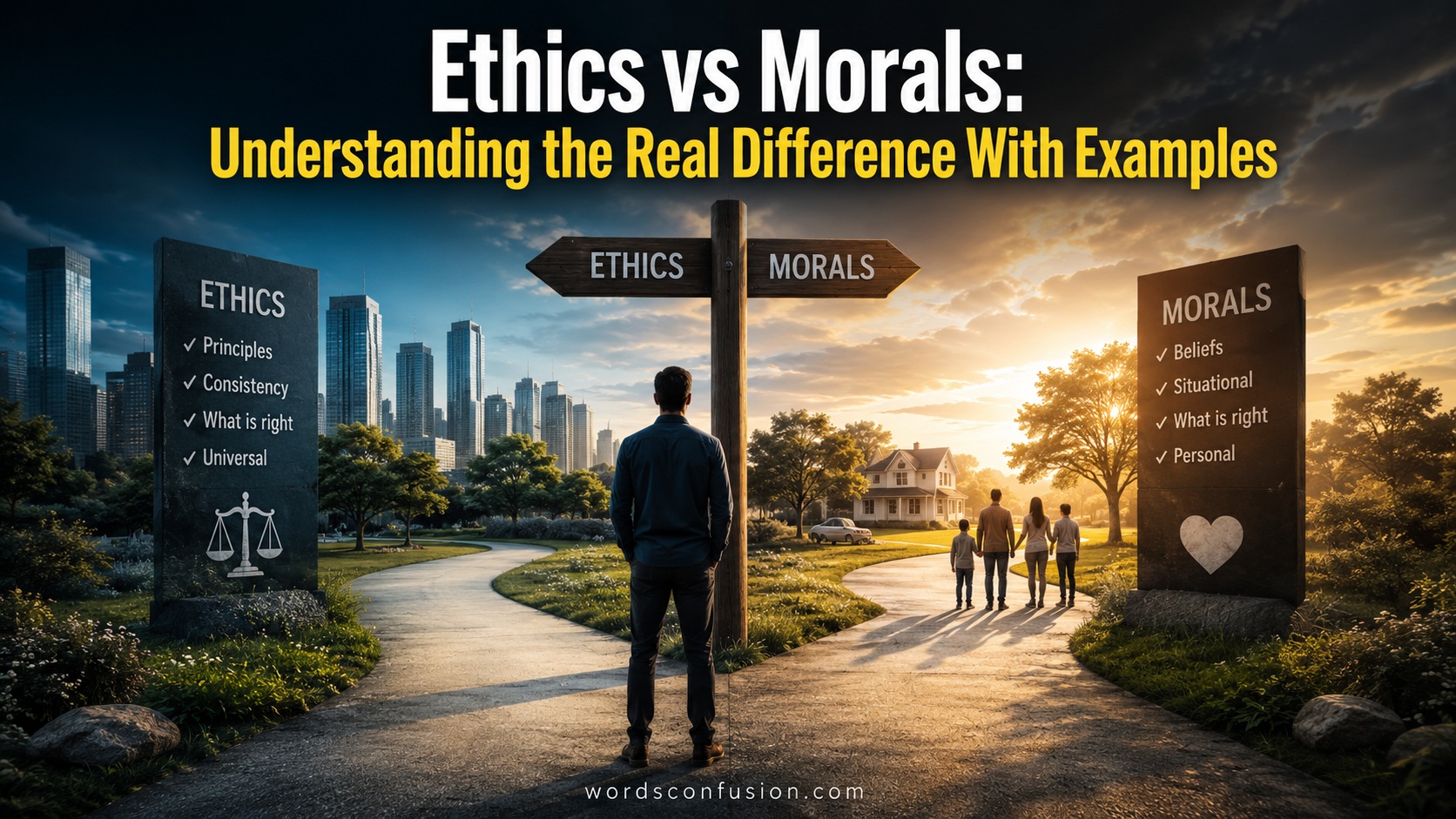
Ethics vs Morals — Quick Answer
Ethics are external standards of behavior established by groups, professions, organizations, or societies.
Morals are personal principles and beliefs about what is right and wrong.
In simple terms:
- Ethics come from outside sources.
- Morals come from within the individual.
- Ethics are often formalized.
- Morals are usually personal.
Ethics Defined
Ethics refers to a system of rules or standards that guides behavior within a group or profession.
These standards help people make decisions that are fair, responsible, and socially acceptable.
Examples include:
- Medical ethics
- Business ethics
- Legal ethics
- Research ethics
- Journalism ethics
A doctor follows ethical guidelines established by the medical profession. A lawyer follows ethical standards established by legal organizations.
Morals Defined
Morals are personal beliefs about what is right and wrong.
They develop through:
- Family upbringing
- Cultural traditions
- Religious teachings
- Life experiences
- Personal reflection
For example, someone may believe lying is always wrong because of their moral values, even when no law or professional rule prohibits it.
The Simplest Way to Remember the Difference
| Ethics | Morals |
| External standards | Internal beliefs |
| Group-based | Individual-based |
| Often written down | Usually unwritten |
| Enforced by organizations | Enforced by conscience |
| Professional focus | Personal focus |
A useful memory trick is:
Ethics guide groups. Morals guide individuals.
Ethics vs Morals Comparison Table
| Feature | Ethics | Morals |
| Definition | Rules governing conduct | Personal beliefs about right and wrong |
| Source | Society, profession, organization | Individual conscience |
| Authority | External | Internal |
| Enforcement | Professional or social consequences | Personal guilt or conviction |
| Flexibility | Can change with society | Often deeply rooted |
| Application | Workplace and public settings | Personal life and decisions |
| Documentation | Usually written | Usually unwritten |
| Examples | Medical code of conduct | Belief that stealing is wrong |
What Are Ethics?
Ethics provide a framework for making decisions that affect others.
Rather than relying on personal feelings, ethical systems establish common standards that allow groups to function fairly and consistently.
The Origin of Ethics
The word ethics comes from the Greek word ethos, meaning character or custom.
Ancient Greek philosophers such as Socrates, Plato, and Aristotle explored questions about virtue, justice, and the good life.
Aristotle argued that ethical behavior comes from developing good habits and virtues rather than merely following rules.
His ideas still influence modern ethical thinking.
How Ethical Standards Are Formed
Ethical standards usually emerge when groups need consistent rules for behavior.
Common sources include:
- Professional associations
- Government agencies
- Educational institutions
- Businesses
- International organizations
For example, healthcare professionals follow ethical principles such as:
- Beneficence
- Nonmaleficence
- Autonomy
- Justice
These principles help medical workers make fair decisions when facing difficult situations.
Common Types of Ethics
Professional Ethics
Professional ethics establish standards within specific careers.
Examples include:
- Confidentiality
- Honesty
- Competence
- Accountability
Violating professional ethics can lead to disciplinary action or loss of certification.
Business Ethics
Business ethics focuses on responsible corporate behavior.
Key issues include:
- Fair treatment of employees
- Honest advertising
- Consumer protection
- Environmental responsibility
- Corporate transparency
Medical Ethics
Medical ethics addresses complex healthcare decisions.
Important topics include:
- Patient consent
- Privacy
- End-of-life care
- Resource allocation
- Medical research
Legal Ethics
Legal ethics governs attorneys and judges.
Core principles include:
- Client confidentiality
- Loyalty
- Fair representation
- Avoiding conflicts of interest
Research Ethics
Research ethics protects participants and ensures scientific integrity.
Researchers must:
- Obtain informed consent
- Avoid fabrication of data
- Protect participants from harm
- Report findings honestly
Media and Journalism Ethics
Journalists follow ethical principles that promote trustworthy reporting.
These include:
- Accuracy
- Fairness
- Independence
- Transparency
- Accountability
What Are Morals?
Morals represent personal convictions regarding right and wrong.
Unlike ethics, morals do not necessarily come from formal institutions.
Instead, they emerge from an individual’s worldview and experiences.
The Origin of Morals
Human societies have developed moral systems for thousands of years.
Long before written laws existed, communities relied on shared moral principles to maintain order and cooperation.
These principles often focused on:
- Honesty
- Loyalty
- Fairness
- Respect
- Compassion
Although moral standards vary across cultures, many societies value similar virtues.
Where Moral Values Come From
Several influences shape moral beliefs.
Family Upbringing
Parents and guardians often provide a person’s first moral lessons.
Children learn concepts such as:
- Sharing
- Kindness
- Responsibility
- Respect
Culture
Cultural traditions influence beliefs about acceptable behavior.
What one culture considers respectful may differ from another.
Religion
Many religious traditions provide moral frameworks.
These frameworks often address:
- Compassion
- Charity
- Honesty
- Forgiveness
- Justice
Personal Experiences
Life experiences frequently reshape moral perspectives.
People may reconsider long-held beliefs after encountering new situations or viewpoints.
Community Influence
Friends, mentors, and social groups can reinforce or challenge moral beliefs.
Common Moral Principles
Many moral systems emphasize similar values.
Examples include:
- Honesty
- Compassion
- Integrity
- Courage
- Respect
- Responsibility
- Fairness
- Loyalty
These principles often guide decisions even when no formal rule exists.
Key Differences Between Ethics and Morals
Although ethics and morals overlap, several important distinctions separate them.
Source of Authority
The most significant difference involves where the standards come from.
| Ethics | Morals |
| Created by groups | Created by individuals |
| External authority | Internal authority |
| Formal standards | Personal convictions |
A company may require employees to report conflicts of interest. That requirement reflects ethics.
An employee may choose to be truthful because honesty aligns with personal beliefs. That reflects morals.
Individual vs Collective Perspective
Morals focus on individual judgment.
Ethics focuses on collective expectations.
A person might personally oppose gambling on moral grounds. However, an organization may ethically permit gambling activities if they comply with regulations.
Enforcement and Accountability
Ethics often carries formal consequences.
Examples include:
- Suspension
- Termination
- Professional sanctions
- License revocation
Morals usually involve internal consequences such as:
- Guilt
- Shame
- Pride
- Personal satisfaction
Consistency Across Groups
Ethical codes aim for consistency.
Morals vary significantly between individuals and cultures.
Two doctors working in the same hospital follow the same ethical guidelines even if they hold different personal beliefs.
Adaptability Over Time
Ethical standards often evolve as society changes.
Consider attitudes toward:
- Artificial intelligence
- Genetic engineering
- Data privacy
- Environmental responsibility
Moral beliefs can also change, although deeply held convictions may remain stable for decades.
Ethics vs Morals in Real-Life Situations
The difference becomes clearer when examining real-world examples.
Workplace Example
An employee discovers that a coworker has violated company policy.
Ethically, reporting the violation may be required.
Morally, the employee may struggle because reporting could harm a friend.
This creates tension between professional responsibility and personal loyalty.
Healthcare Example
A physician may personally oppose a particular treatment.
However, professional ethics may require providing accurate information and respecting patient autonomy.
The physician’s morals and ethical obligations may not align perfectly.
Business Example
A company can legally collect customer data.
Ethical questions arise when deciding:
- How much data to collect
- How data should be stored
- Whether customers fully understand consent
Ethics often addresses issues that laws have not fully resolved.
Technology and AI Example
Artificial intelligence presents new ethical challenges.
Questions include:
- Should AI systems make hiring decisions?
- How should personal data be protected?
- Who is responsible when AI makes mistakes?
These concerns extend beyond personal morality and require broader ethical frameworks.
Journalism Example
A journalist may personally dislike a public figure.
Professional ethics requires fair reporting regardless of personal opinions.
The journalist’s moral beliefs must not interfere with factual accuracy.
Can Ethics and Morals Conflict?
Yes. Conflicts between ethics and morals occur regularly.
In fact, many difficult decisions arise because ethical duties and moral beliefs point in different directions.
Situations Where Conflict Occurs
Common examples include:
- Medical treatment decisions
- Military service
- Whistleblowing
- Confidentiality obligations
- Corporate decision-making
Famous Ethical Dilemmas
Whistleblowing
An employee discovers wrongdoing within an organization.
Morally, exposing misconduct may seem right.
Ethically, confidentiality agreements may complicate the situation.
Confidentiality Issues
Healthcare professionals often face situations where protecting confidentiality conflicts with preventing harm.
Resource Allocation
Hospitals sometimes face shortages of staff, beds, or equipment.
Ethical frameworks help determine fair allocation even when no perfect solution exists.
How People Resolve These Conflicts
Effective approaches include:
- Reviewing ethical guidelines
- Considering long-term consequences
- Consulting experts
- Seeking diverse perspectives
- Applying structured decision-making models
The goal is not always finding a perfect answer. Often the goal is identifying the most responsible course of action.
Similarities Between Ethics and Morals
Despite their differences, ethics and morals share important characteristics.
Shared Goal of Guiding Behavior
Both aim to help people distinguish right from wrong.
Influence on Decision-Making
Ethics and morals influence choices in:
- Business
- Politics
- Healthcare
- Education
- Personal relationships
Focus on Right and Wrong
Both systems evaluate behavior according to standards and values.
Impact on Communities and Relationships
Strong ethical and moral foundations encourage:
- Trust
- Cooperation
- Accountability
- Social stability
Without them, relationships and institutions struggle to function effectively.
Ethics vs Morals in Different Philosophical Traditions
Philosophers have debated ethics and morality for centuries.
Ancient Greek Thought
Greek philosophers emphasized virtue and character.
They believed ethical living required developing good habits and pursuing excellence.
Western Philosophy
Major approaches include:
| Theory | Main Idea |
| Virtue Ethics | Focus on character |
| Deontology | Focus on duties and rules |
| Utilitarianism | Focus on outcomes |
| Social Contract Theory | Focus on agreements within society |
Eastern Philosophical Perspectives
Eastern traditions often emphasize harmony, balance, compassion, and social responsibility.
Many focus less on strict rules and more on cultivating character and relationships.
Modern Ethical Theory
Modern discussions increasingly address:
- Technology
- Human rights
- Globalization
- Sustainability
- Artificial intelligence
These issues require ethical frameworks capable of addressing complex global challenges.
Ethics vs Morals in Religion and Secular Society
Religion and secular philosophy both contribute to discussions about right and wrong.
Religious Perspectives
Many religions provide moral guidance through sacred teachings and traditions.
Common themes include:
- Compassion
- Justice
- Honesty
- Service
- Respect for others
Secular Ethical Frameworks
Secular ethics relies on reason, evidence, and shared social values.
It seeks principles that apply regardless of religious belief.
Areas of Agreement and Disagreement
Different systems may disagree on specific issues.
However, many share common values such as:
- Fairness
- Honesty
- Respect
- Human dignity
Read More: Training vs Education: Key Differences, Benefits, Examples, and Which One You Need
Common Misconceptions About Ethics and Morals
Several myths contribute to confusion.
“They Mean Exactly the Same Thing”
Although related, ethics and morals are not identical.
Ethics generally refers to external standards. Morals refer to personal convictions.
“Ethics Only Applies to Businesses”
Ethics applies across numerous fields including:
- Medicine
- Law
- Education
- Science
- Government
- Journalism
“Morals Come Only From Religion”
Religion influences many moral systems.
However, people also develop moral beliefs through culture, experience, and personal reflection.
“Ethical Behavior Is Always Moral Behavior”
A person can follow ethical rules while personally disagreeing with them.
Likewise, someone can act according to personal morals while violating professional ethics.
Why Understanding Ethics vs Morals Matters Today
Modern society presents increasingly complex decisions.
Understanding ethics and morals helps individuals navigate these challenges.
Workplace Decisions
Employees regularly encounter situations involving:
- Confidentiality
- Fairness
- Accountability
- Professional responsibility
Social Media and Digital Conduct
Online behavior raises ethical questions about:
- Privacy
- Misinformation
- Harassment
- Digital responsibility
Leadership and Governance
Leaders must balance:
- Organizational goals
- Ethical obligations
- Public trust
Personal Relationships
Ethics and morals shape trust, honesty, and mutual respect.
Emerging Technologies
Artificial intelligence, biotechnology, and data analytics create questions that traditional rules may not fully address.
Ethical reasoning helps society respond responsibly.
Ethics vs Morals vs Values
People often confuse values with ethics and morals.
The three concepts are related but distinct.
| Concept | Meaning |
| Values | What a person considers important |
| Morals | Personal beliefs about right and wrong |
| Ethics | External standards governing conduct |
Example
A person may value success.
Their morals may prevent them from cheating to achieve it.
Professional ethics may require fair competition.
The three concepts work together while serving different roles.
Ethics vs Morals vs Laws
Another common source of confusion involves the relationship between ethics, morals, and laws.
| Ethics | Morals | Laws |
| Professional standards | Personal beliefs | Government rules |
| May exceed legal requirements | May exceed legal requirements | Legally enforceable |
| Varies by profession | Varies by individual | Applies to everyone in a jurisdiction |
Important Insight
Something can be:
- Legal but unethical
- Ethical but illegal
- Moral but unethical
- Ethical but personally immoral
For example, a business practice may be legal while still raising ethical concerns about fairness or transparency.
Ethics, Morals, and Integrity Explained
Integrity connects ethics and morals.
A person demonstrates integrity when actions align with stated values and principles.
Integrity involves:
- Consistency
- Honesty
- Accountability
- Reliability
Someone with integrity acts ethically in public and morally in private.
Trust often depends on this consistency.
Decision Framework: Is It an Ethical Issue or a Moral Issue?
When facing a difficult decision, ask these questions:
Does a professional rule apply?
|
Yes
|
Ethical Issue
|
No
|
Does it involve personal beliefs
about right and wrong?
|
Yes
|
Moral Issue
In many situations, both categories overlap.
Quick Assessment Checklist
- Does a professional code apply?
- Is an organization involved?
- Are personal beliefs driving the decision?
- Could professional consequences occur?
- Does conscience play a major role?
The answers often reveal whether ethics, morals, or both are involved.
10 Everyday Examples of Ethics and Morals
| Situation | Ethics | Morals |
| Workplace reporting | Follow company policy | Loyalty to coworkers |
| Returning lost property | Follow procedures | Desire to help |
| Healthcare decisions | Professional standards | Personal beliefs |
| Journalism | Accurate reporting | Personal convictions |
| School exams | Academic integrity rules | Honesty |
| Social media | Platform guidelines | Respectfulness |
| Research | Participant protection | Concern for others |
| Sports | Fair play regulations | Sportsmanship |
| Business sales | Honest marketing | Personal integrity |
| Community service | Organizational standards | Compassion |
FAQs:
Is ethics the same as morals?
No. Ethics refers to external standards established by groups or professions. Morals refer to personal beliefs about right and wrong.
Which comes first, ethics or morals?
Historically, moral beliefs often develop first at the individual level. Ethical systems then emerge to create shared standards within larger groups.
Can a person be ethical but not moral?
Yes. Someone may follow professional rules while personally disagreeing with them.
Can morals change over time?
Yes. Experiences, education, and changing circumstances can influence moral beliefs.
Are ethics universal?
Some ethical principles are widely accepted, but ethical standards often vary across professions, cultures, and societies.
Why do different cultures have different morals?
History, traditions, religion, social structures, and lived experiences shape cultural moral beliefs.
What is an example of ethics versus morals?
A lawyer may ethically defend a client because professional standards require fair representation. Personally, the lawyer may believe the client’s actions were morally wrong.
How do ethics influence laws?
Ethical debates frequently shape legislation. Many laws originate from broader ethical concerns about fairness, justice, and public welfare.
Conclusion:
The distinction between ethics and morals becomes clear once you understand their source. Ethics are standards established by groups, professions, organizations, or societies. Morals are personal beliefs about right and wrong.Although they often overlap, they are not identical.
Ethics helps communities, professions, and institutions operate consistently. Morals guide individual behavior and personal decision-making. Sometimes they work together seamlessly. Other times they clash, creating difficult choices that require careful judgment.

Andrew Wilson is an experienced language researcher and content writer specializing in WordsConfusion topics. He helps readers understand commonly confused English words, spelling differences, grammar rules, word meanings, and proper usage through clear explanations, practical examples, and easy-to-follow language guides. His goal is to make English learning simple, accurate, and accessible for students, writers, professionals, and everyday learners.