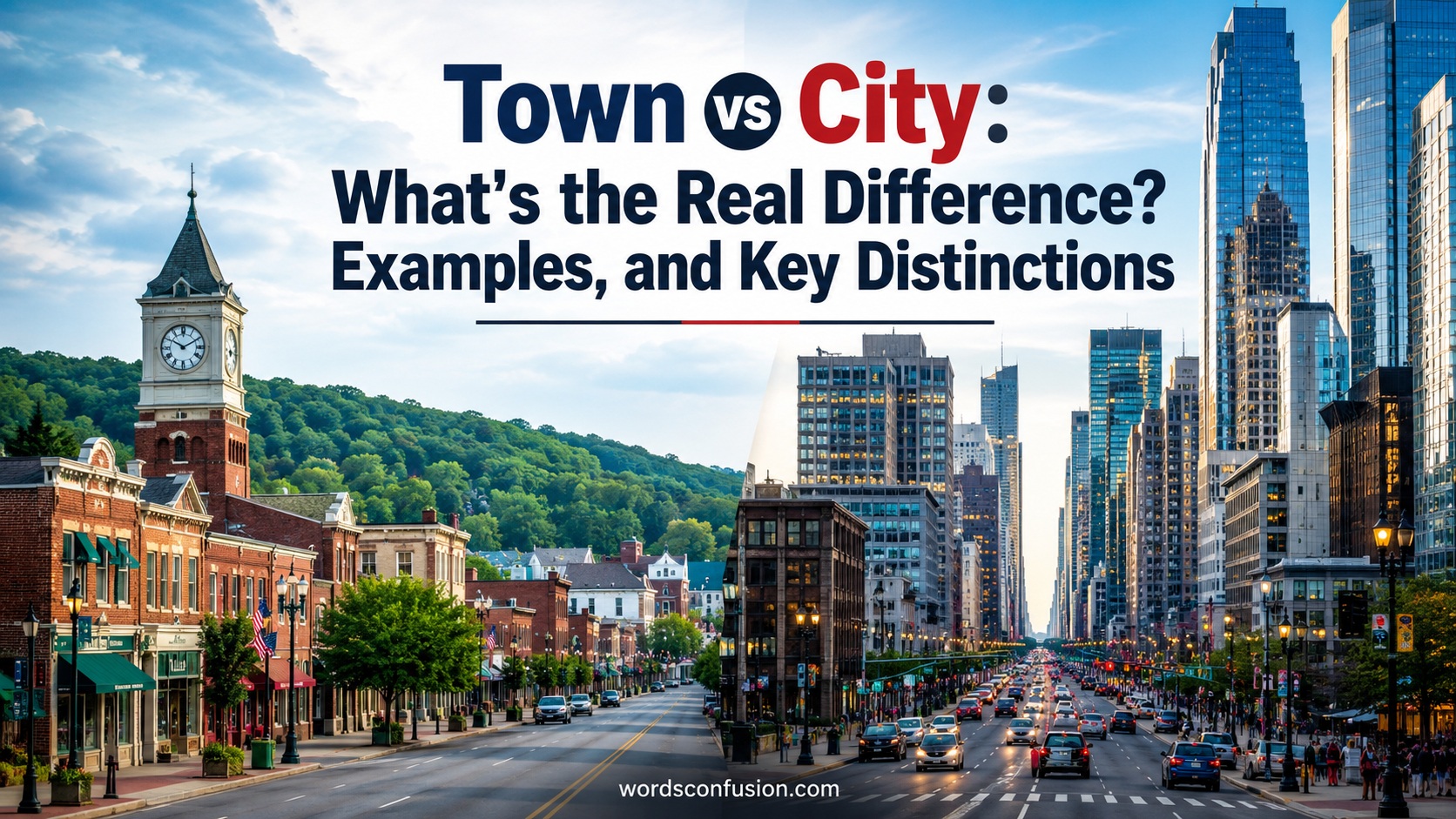
When people compare a town vs city, they often assume the difference comes down to population alone. A city is big. A town is small. Simple, right?
Not quite.
In reality, the distinction between a town and a city is far more complex. Population plays a role, yet legal status, government structure, infrastructure, economic activity, and historical factors often matter just as much. In some countries, a town with 100,000 residents may still be classified as a town, while a city with fewer than 10,000 residents can legally hold city status.
Understanding the difference helps you make sense of geography, urban planning, government administration, real estate markets, and even travel guides. It also explains why two places with similar populations can be labeled differently.
This guide breaks down everything you need to know about town vs city, including definitions, key differences, international examples, common misconceptions, and the factors governments use when assigning these classifications.
Town vs City – Quick Answer
A town is generally a populated area that is larger than a village but smaller and less developed than a city.
A city is usually a larger urban settlement with greater population density, more developed infrastructure, broader government authority, and a more diverse economy.
The simplest way to understand the difference is this:
A city typically serves as a major economic, administrative, and cultural center, while a town functions on a smaller scale and often serves a more localized community.
Quick Comparison Table
| Feature | Town | City |
| Population | Usually smaller | Usually larger |
| Population Density | Lower | Higher |
| Infrastructure | Basic to moderate | Advanced and extensive |
| Public Transport | Limited | Well-developed |
| Economic Activity | Local businesses dominate | Diverse industries and sectors |
| Government Powers | More limited | Broader authority |
| Public Services | Basic services | Extensive services |
| Urban Development | Less intensive | Highly developed |
| Employment Opportunities | Fewer | More numerous |
What Is a Town?
Definition of a Town
A town is a human settlement that occupies a middle ground between a village and a city. Historically, towns developed as trading centers where people gathered to buy goods, sell products, and conduct business.
Today, the definition varies by country. Some governments use population thresholds, while others rely on legal designations.
In general, towns have:
- Permanent populations
- Local government structures
- Commercial centers
- Residential neighborhoods
- Public facilities such as schools and clinics
A town may serve as the economic hub for nearby villages and rural communities.
Common Characteristics of a Town
Although no universal definition exists, most towns share several features.
Moderate Population
Most towns have populations ranging from a few thousand residents to tens of thousands.
Examples include:
- Princeton, New Jersey
- Banff, Alberta
- Kendal, England
Strong Community Identity
People in towns often know one another more closely than residents of large cities.
Community events may include:
- Farmers markets
- Local festivals
- Sports competitions
- Cultural celebrations
Limited Infrastructure
Most towns provide essential services but lack the extensive transportation networks found in major cities.
Common features include:
- Local roads
- Basic public transportation
- Small hospitals
- Public schools
Smaller Economic Base
The economy often depends on:
- Retail businesses
- Agriculture
- Tourism
- Small manufacturing
- Local services
Examples of Well-Known Towns Around the World
| Town | Country | Known For |
| Banff | Canada | Tourism and national parks |
| Stratford-upon-Avon | United Kingdom | Birthplace of Shakespeare |
| Carmel-by-the-Sea | United States | Coastal tourism |
| Queenstown | New Zealand | Adventure tourism |
These towns attract visitors worldwide despite not having city status.
What Is a City?
Definition of a City
A city is a large and permanent urban settlement that typically serves as an important center for government, commerce, education, transportation, and culture.
Unlike towns, cities often hold greater legal authority and administrative responsibilities.
Many cities function as regional or national hubs.
Common Characteristics of a City
Several factors commonly distinguish cities from towns.
Large Population
Cities generally have larger populations than towns.
For example:
| City | Population |
| San Francisco | Over 800,000 |
| Manchester | Over 550,000 |
| Brisbane | Over 2.5 million |
Population alone does not determine city status, yet cities tend to be more populous.
Advanced Infrastructure
Cities usually offer:
- Airports
- Rail systems
- Public transit networks
- Large hospitals
- Universities
- High-speed communication systems
Diverse Economy
Cities support multiple economic sectors.
Examples include:
- Finance
- Technology
- Manufacturing
- Healthcare
- Education
- Entertainment
A city’s economy often extends far beyond its local population.
Administrative Importance
Many cities serve as:
- State capitals
- Provincial capitals
- County seats
- Regional headquarters
This role increases their political significance.
Examples of Major Cities Around the World
| City | Country | Approximate Population |
| New York City | United States | 8.5 million |
| London | United Kingdom | 9 million |
| Sydney | Australia | 5.4 million |
| Tokyo | Japan | 14 million |
These cities influence national and international economies.
Town vs City: The Key Differences Explained
Population Size
Population remains one of the most visible differences.
Generally:
- Villages have the smallest populations.
- Towns have moderate populations.
- Cities have larger populations.
However, population alone can be misleading.
Some towns have more residents than legally recognized cities.
Legal Status
Legal designation often matters more than population.
A government may officially classify a settlement as a city through legislation, charter status, or administrative authority.
For example:
- Some UK cities have fewer than 20,000 residents.
- Some large UK towns exceed 200,000 residents.
The legal title remains unchanged regardless of size.
Infrastructure and Development
Infrastructure often reveals whether a settlement functions as a town or city.
Cities usually have:
- Extensive road networks
- Multiple hospitals
- Universities
- Mass transit systems
- Large commercial districts
Towns typically provide fewer specialized facilities.
Economic Activity
The scale of economic activity differs significantly.
Town Economies
Often centered around:
- Retail
- Tourism
- Agriculture
- Local services
City Economies
Often include:
- International trade
- Technology firms
- Financial institutions
- Large manufacturing operations
- Corporate headquarters
Cities usually create more employment opportunities.
Public Services
Cities typically provide broader services.
| Service | Town | City |
| Hospitals | Limited | Multiple specialized facilities |
| Public Transit | Basic | Extensive networks |
| Universities | Rare | Common |
| Emergency Services | Smaller scale | Larger departments |
| Utilities | Standard | Highly developed |
Population Density
Cities generally contain more people per square mile or kilometer.
This creates:
- High-rise buildings
- Apartment complexes
- Dense commercial zones
Towns often feature:
- Detached homes
- Open spaces
- Lower-density neighborhoods
Cultural and Social Life
Cities offer greater diversity due to larger populations.
Examples include:
- Museums
- Theaters
- International cuisine
- Concert venues
- Professional sports teams
Towns often focus on local traditions and community events.
Why Population Doesn’t Always Decide Whether a Place Is a Town or a City
Many people assume a settlement automatically becomes a city once it reaches a certain population.
That assumption is often wrong.
Legal Designation Matters
Governments establish official classifications based on laws and regulations.
A settlement may remain a town even after substantial population growth.
Likewise, a small settlement can retain city status because of historical designation.
Surprising Examples
Several examples challenge the population myth.
St Davids, Wales
St Davids is officially a city despite having fewer than 2,000 residents.
Reading, England
Reading has a population exceeding 170,000 yet remains a town.
These examples show why legal status frequently outweighs population.
Historical Influences
Historically, some places gained city status because they hosted important religious institutions, royal charters, or administrative functions.
Modern classifications often reflect those historical decisions.
Town vs City in Different Countries
United States
No nationwide definition exists.
Each state establishes its own rules.
Some states classify municipalities as:
- Towns
- Cities
- Villages
- Boroughs
A city in one state may resemble a town in another.
United Kingdom
The United Kingdom uses a unique system.
Historically, city status often depended on royal approval or cathedral presence.
Today, official city status is granted by the Crown.
Population alone does not determine classification.
Canada
Canadian classifications vary by province.
Municipal governments determine categories such as:
- Town
- Township
- Village
- City
Population thresholds differ between provinces.
Australia
Australian cities generally function as major urban centers.
Towns typically serve smaller regional communities.
State governments establish classification rules.
India
India uses several classifications.
Statutory Towns
Officially recognized urban areas with municipal governments.
Census Towns
Areas meeting urban population and employment criteria.
Cities
Larger urban centers with significant administrative and economic importance.
India’s classification system combines legal and statistical criteria.
Can a Town Become a City?
The answer is yes.
Many cities began as small towns.
Growth often drives the transition.
Common Requirements
Factors frequently considered include:
- Population growth
- Economic development
- Infrastructure expansion
- Administrative importance
- Regional influence
Real Examples
Phoenix, Arizona
Phoenix started as a small agricultural settlement.
Today, it is one of America’s largest cities.
Milton Keynes, England
Established as a new town in 1967, Milton Keynes later received official city status.
These examples demonstrate how urban growth can transform communities over time.
Typical Signs a Town Is Becoming a City
- Rapid population increases
- New transportation systems
- Expanding business districts
- Growing employment opportunities
- Construction of universities and hospitals
Read More: Ethics vs Morals: Understanding the Real Difference With Examples
Town, City, Village, and Municipality: How They Compare
Comparison Table
| Feature | Village | Town | City | Municipality |
| Population | Small | Moderate | Large | Varies |
| Infrastructure | Limited | Moderate | Extensive | Varies |
| Government | Local | Local | Broader | Administrative structure |
| Economy | Basic | Growing | Diverse | Varies |
| Services | Minimal | Standard | Advanced | Depends on jurisdiction |
Village vs Town
Villages are generally smaller and less developed.
Most villages rely heavily on nearby towns for services.
Town vs City
Cities typically offer:
- More jobs
- More transportation options
- More educational institutions
- More healthcare services
Towns provide a more localized experience.
City vs Municipality
A municipality is an administrative unit.
A city may be a municipality, yet not every municipality is a city.
The terms are not interchangeable.
Advantages of Living in a Town
Many people prefer towns because of their lifestyle benefits.
Stronger Community Connections
Neighbors often know one another.
Community participation tends to be higher.
Lower Congestion
Traffic levels are generally lower than in cities.
Commutes are often shorter.
Potentially Lower Living Costs
Housing prices and daily expenses may be more affordable.
This varies by region but remains a common advantage.
Greater Access to Nature
Many towns sit near:
- Parks
- Forests
- Lakes
- Mountains
Outdoor recreation is often easier to access.
Advantages of Living in a City
Cities attract millions of residents for good reasons.
More Career Opportunities
Large employers often concentrate in cities.
Industries include:
- Technology
- Finance
- Healthcare
- Education
- Media
Better Transportation
Cities frequently offer:
- Subways
- Trains
- Bus systems
- Airports
Residents can travel more easily.
Diverse Entertainment Options
Cities provide:
- Museums
- Concerts
- Sporting events
- Restaurants
- Cultural festivals
There is usually something happening year-round.
Greater Access to Services
Cities often contain:
- Specialized hospitals
- Research universities
- Government agencies
- Business centers
These resources improve convenience and opportunity.
Is a Town Better Than a City?
There is no universal answer.
The best choice depends on your priorities.
A Town May Be Better If You Want
- A quieter lifestyle
- Strong community ties
- Less traffic
- More open space
- Closer access to nature
A City May Be Better If You Want
- Career growth
- Diverse entertainment
- Public transportation
- Higher education opportunities
- Specialized healthcare
Key Factors to Consider
| Factor | Town | City |
| Cost of Living | Often lower | Often higher |
| Job Opportunities | Fewer | More numerous |
| Transportation | Limited | Extensive |
| Community Feel | Strong | More anonymous |
| Entertainment | Limited | Extensive |
| Green Space | More common | Less common |
The ideal location depends on your personal goals and lifestyle preferences.
Common Misconceptions About Towns and Cities
Every City Is Large
Not true.
Some cities have surprisingly small populations due to historical designations.
Every Town Is Small
Also false.
Many towns have populations larger than officially recognized cities.
Population Is the Only Difference
Population is important, yet legal status, infrastructure, and economic function often matter more.
Cities Always Offer Better Quality of Life
Quality of life depends on individual preferences.
Some people thrive in busy urban environments.
Others prefer the slower pace of town life.
Neither option is automatically better.
FAQs:
Is a town smaller than a city?
Usually yes. However, legal classifications can create exceptions where a town has more residents than a city.
Can a town have more people than a city?
Yes. Several towns around the world have larger populations than officially recognized cities.
Who decides whether a place is a town or a city?
The decision is usually made by national, state, provincial, or local governments according to legal frameworks.
What is the largest town in the world?
Reading in England is often cited among the largest towns in the United Kingdom, though definitions vary internationally.
Can a city lose its city status?
Yes. While uncommon, governments can revoke city status under certain circumstances.
What is the difference between a town and an urban area?
A town is a specific type of settlement. An urban area is a broader term describing densely populated developed regions that may contain multiple towns or cities.
Conclusion:
The debate over town vs city isn’t as straightforward as many people think. While cities are generally larger, more densely populated, and more economically diverse, population alone does not determine whether a place is a town or a city. Legal designation, administrative authority, infrastructure, and historical context often play an even bigger role.
A town usually serves a smaller regional community with moderate services and infrastructure. A city functions as a larger hub for commerce, government, education, healthcare, and transportation.

Andrew Wilson is an experienced language researcher and content writer specializing in WordsConfusion topics. He helps readers understand commonly confused English words, spelling differences, grammar rules, word meanings, and proper usage through clear explanations, practical examples, and easy-to-follow language guides. His goal is to make English learning simple, accurate, and accessible for students, writers, professionals, and everyday learners.