
If you’ve ever paused before writing “less people” or “fewer people,” you’re not alone. The difference between fewer vs. less seems simple at first, yet certain expressions make the rule surprisingly tricky.
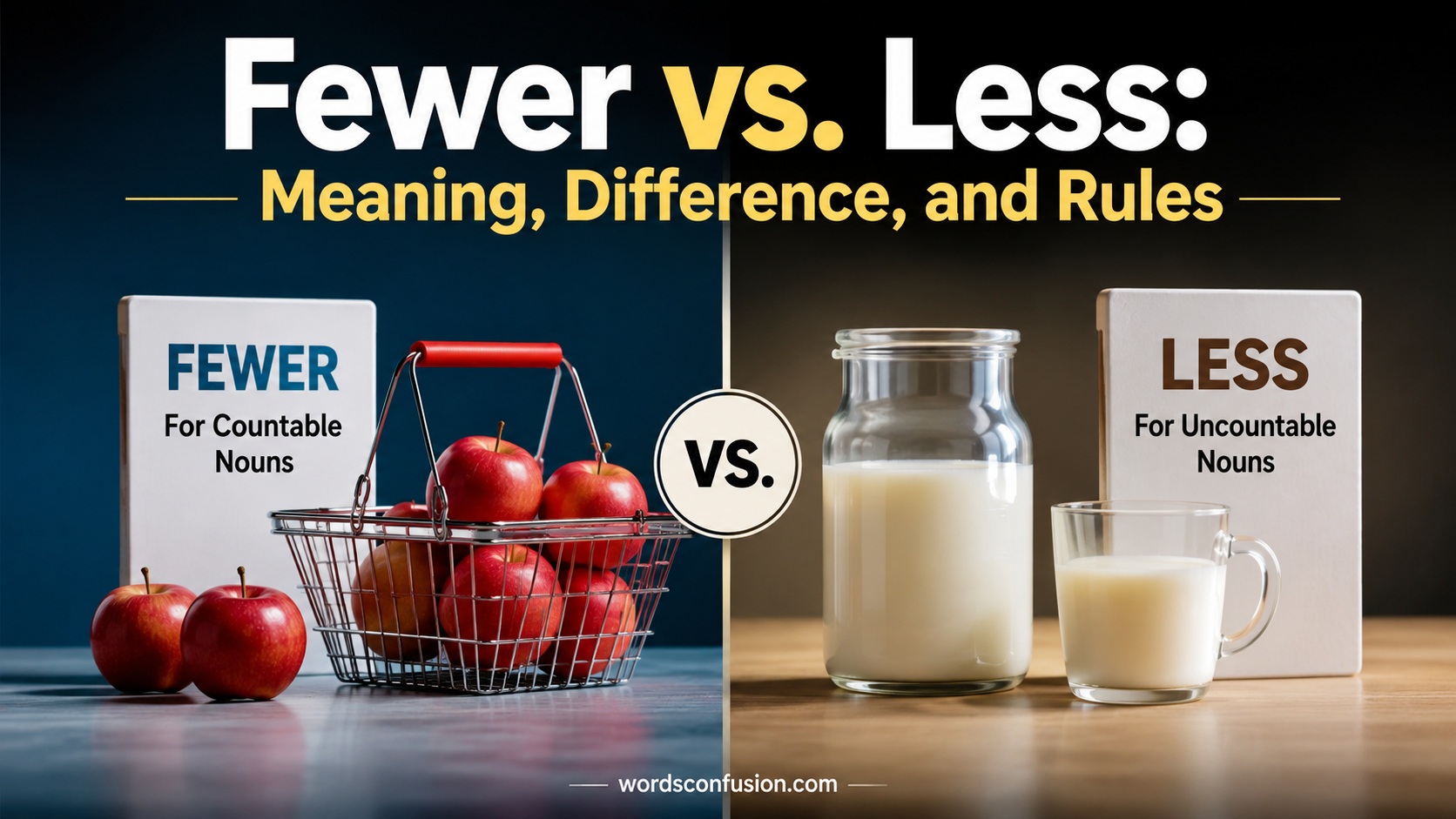
The basic distinction is straightforward: fewer usually refers to a smaller number of countable things, while less usually refers to a smaller amount of something uncountable. However, English has a few important exceptions, especially with time, money, distance, weight, and other measurements.
Once you understand what you’re counting or measuring, the choice becomes much easier.
Quick Answer: Fewer vs. Less
Use fewer with plural countable nouns:
- fewer books
- fewer students
- fewer mistakes
- fewer cars
- fewer people
Use less with uncountable nouns or amounts:
- less water
- less time
- less money
- less information
- less traffic
The simplest rule is:
Fewer = a smaller number. Less = a smaller amount.
For example:
- Fewer apples means a smaller number of individual apples.
- Less juice means a smaller amount of juice.
That rule solves most cases. However, expressions such as less than five minutes and less than 10 miles require a closer look.
What Is the Difference Between Fewer and Less?
The difference between fewer and less depends mainly on whether the noun refers to separate items you can count or a quantity you generally treat as a whole.
| Word | Meaning | Commonly Used With | Example |
| Fewer | A smaller number | Plural countable nouns | fewer students |
| Less | A smaller amount | Uncountable nouns | less water |
Think of it this way: if you can line up the items and count them one by one, fewer usually fits.
You can count:
- one book
- two books
- three books
Therefore, you say:
I bought fewer books this year.
You generally don’t count water as one water, two waters, three waters when you mean the substance itself. Instead, you measure it.
So you say:
I drank less water today.
The distinction is essentially number versus amount.
When to Use Fewer
Use fewer when you’re talking about a smaller number of separate, countable things.
Fewer With Plural Countable Nouns
A countable noun can usually take a number such as one, two, three, or 100.
Examples include:
- books
- houses
- employees
- questions
- mistakes
- emails
- opportunities
- customers
Use fewer with these nouns:
- The new system produced fewer errors.
- Fewer customers visited the store this week.
- She made fewer mistakes on the second test.
- The company now has fewer employees.
The noun usually appears in the plural after fewer.
fewer chairs
fewer chairs
fewer problems
Not:
fewer chair
Fewer With People
People is one of the most important examples.
Because you can count people individually, standard English uses fewer:
- Fewer people attended the meeting.
- Fewer people are using the service.
- Fewer people visited the museum this year.
The phrase “less people” appears frequently in casual speech. However, “fewer people” remains the traditional and widely recommended choice in formal writing.
The logic is simple. You can count people:
- one person
- two people
- three people
Therefore:
fewer people
Fewer With Numbers of Items
Use fewer when the number refers to countable objects or individuals.
Examples:
- fewer than 20 students
- fewer than 50 applicants
- fewer than 100 pages
- fewer than 10 mistakes
Here, the number represents separate units.
Fewer than 50 applicants applied for the position.
You can count the applicants individually. That makes fewer the natural choice.
When to Use Less
Use less when you’re talking about a smaller amount of something that you generally don’t count as separate individual units.
Less With Uncountable Nouns
Uncountable nouns usually describe substances, ideas, qualities, or general quantities.
Common examples include:
- water
- milk
- information
- advice
- money
- traffic
- noise
- stress
- patience
- time
Examples:
- I need less information, not more.
- The city has less traffic on weekends.
- She wants less stress in her daily life.
- We have less time than expected.
- The recipe requires less sugar.
You don’t normally count information as individual pieces by saying one information, two informations. Instead, you refer to an amount of information.
Therefore:
less information
The same principle applies to advice.
Correct:
She gave me less advice than I expected.
Incorrect in standard English:
She gave me fewer advice.
Fewer vs. Less Comparison Table
| Use Fewer With | Use Less With |
| fewer books | less information |
| fewer people | less traffic |
| fewer mistakes | less confusion |
| fewer questions | less noise |
| fewer employees | less money |
| fewer apples | less sugar |
| fewer cars | less fuel |
| fewer choices | less stress |
| fewer emails | less time |
The key isn’t simply the subject. The noun determines the choice.
Compare:
- fewer dollars but less money
- fewer apples but less fruit
- fewer bottles but less water
- fewer hours but less time
The same general idea can take either word depending on how you express it.
Fewer vs. Less With Time
Time creates one of the most common areas of confusion.
Use fewer when you’re counting separate hours, days, weeks, or other units.
I worked fewer hours this week.
Here, you’re comparing the number of hours worked.
Use less when you’re talking about time as a general amount.
I spent less time on the project.
Here, you’re discussing the overall duration.
Compare These Sentences
- She worked fewer hours this month.
- She spent less time at the office this month.
Both sentences can be correct. The difference comes from the noun:
- hours = countable units → fewer
- time = an amount → less
This distinction works like a measuring tape. Are you counting the individual marks or discussing the total length? The answer guides your choice.
Fewer vs. Less With Money
Money is another area where both words can appear.
Use less when you mean a smaller total amount of money:
- I have less money this month.
- The project needs less money than expected.
- She spent less money on groceries.
Use fewer when you refer to separate countable units such as dollars, coins, or bills:
- He had fewer coins in his wallet.
- She used fewer dollar bills than expected.
- The cashier counted fewer coins than yesterday.
Compare:
I spent less money.
with:
I used fewer coins.
The first sentence focuses on the total amount. The second focuses on the number of individual objects.
A Practical Comparison
| Meaning | Correct Example |
| Total amount of money | less money |
| Individual dollar bills | fewer bills |
| Individual coins | fewer coins |
| Total price | less than $100 |
| Countable currency units | fewer than 100 coins |
Fewer vs. Less With Measurements
Measurements create an important exception to the basic rule.
In everyday English, less commonly appears before measurements when the measurement represents one overall amount.
Examples include:
- less than five minutes
- less than 10 miles
- less than 20 pounds
- less than $50
- less than three gallons
For example:
The trip takes less than five hours.
Although hours are technically countable units, the phrase focuses on the total duration.
Similarly:
The store is less than 10 miles away.
The sentence focuses on the total distance.
Why Do Measurements Use Less?
Measurements often function as a single quantity.
Consider:
The package weighs less than 20 pounds.
The speaker isn’t focusing on 20 separate pounds. The speaker is describing the package’s total weight.
Likewise:
The meeting lasted less than two hours.
The focus is the total duration.
However, the context can change the word:
- The meeting lasted less than two hours.
- The course contains fewer than two-hour sessions.
The first sentence describes duration. The second describes separate sessions.
Fewer Than vs. Less Than
Both fewer than and less than are correct. The noun or measurement determines which one you need.
Use Fewer Than With Countable Items
Examples:
- fewer than 10 students
- fewer than 25 questions
- fewer than 100 pages
- fewer than 50 employees
Fewer than 10 students passed the advanced exam.
Students are separate individuals. You can count them.
Use Less Than With Amounts and Measurements
Examples:
- less than five minutes
- less than $100
- less than one gallon
- less than 10 miles
The journey takes less than 10 minutes.
The phrase describes the total duration.
Quick Test
Ask yourself:
Am I counting separate things?
- Yes → fewer than
- No → less than
This test won’t explain every unusual expression in English. Still, it works remarkably well in everyday writing.
Read More: Farther vs Further: How to Use Them Correctly
Fewer vs. Less With Food
Food provides some of the clearest examples because the same food can be countable or uncountable depending on how you view it.
Use fewer for separate individual items:
- fewer apples
- fewer cookies
- fewer sandwiches
- fewer eggs
- fewer chocolates
Use less for a substance or general quantity:
- less rice
- less milk
- less sugar
- less soup
- less chocolate
Compare:
I ate fewer chocolates.
This means you ate a smaller number of individual chocolate pieces.
I ate less chocolate.
This means you consumed a smaller amount of chocolate overall.
The noun hasn’t magically changed. Your perspective has changed.
That idea is worth remembering because English often distinguishes between individual units and the substance or quantity they represent.
Fewer vs. Less With Common Noun Pairs
Some pairs make the distinction especially clear.
Fewer Problems vs. Less Trouble
- fewer problems = a smaller number of specific problems
- less trouble = a smaller amount of difficulty or inconvenience
Examples:
The new software caused fewer problems.
The new software caused less trouble.
Both sentences can describe an improvement. The first counts problems. The second describes the overall difficulty.
Fewer Mistakes vs. Less Confusion
- fewer mistakes = a smaller number of errors
- less confusion = a smaller amount of uncertainty
Fewer Choices vs. Less Freedom
- fewer choices = a smaller number of options
- less freedom = a smaller amount of freedom
These contrasts show why replacing every less with fewer won’t work. The noun carries the grammatical weight.
Common Mistakes With Fewer and Less
Mistake: Less People
In traditional standard English, the preferred form is:
Fewer people attended the event.
Because people refers to countable individuals, fewer fits the traditional rule.
Mistake: Fewer Money
The correct expression is:
less money
Money is generally treated as an uncountable amount.
Correct:
The company spent less money this year.
Mistake: Less Books
The correct expression is:
fewer books
Books are separate objects you can count.
Correct:
The library bought fewer books this year.
Mistake: Fewer Information
The correct expression is:
less information
Information is uncountable in standard English.
Correct:
The report contains less information than the original version.
If you want a countable expression, you can say:
fewer pieces of information
Mistake: Fewer Time
The correct expression is:
less time
Correct:
We need less time to complete the task.
However:
We need fewer hours to complete the task.
Both sentences work because time and hours function differently.
FAQs:
Is it fewer or less people?
Fewer people is the standard choice because you can count people individually.
Fewer people attended the meeting.
Is it fewer or less time?
Use less time when you mean a smaller amount of time.
I need less time to finish the task.
Use fewer hours when you mean a smaller number of individual hours.
I worked fewer hours this week.
Is it fewer or less money?
Use less money for a total amount of money.
She spent less money this month.
Use fewer coins or fewer bills for individual countable units.
Is it fewer or less than 10?
The answer depends on what you’re describing.
- Fewer than 10 students → countable people
- Less than 10 minutes → total duration
- Less than $10 → total price
- Fewer than 10 books → countable objects
Can “less” be used with plural nouns?
Yes, less sometimes appears with plural nouns in informal usage or in expressions involving measurements and totals. However, fewer remains the standard choice for most plural countable nouns in formal writing.
What is the easiest way to remember fewer vs. less?
Remember this simple contrast:
Fewer counts. Less measures.
If you can count the items separately, choose fewer. If you’re describing an amount, quantity, substance, or overall measurement, choose less.
Conclusion:
The difference between fewer vs. less becomes much easier once you focus on the noun that follows.
Use fewer for a smaller number of countable items:
- fewer people
- fewer books
- fewer mistakes
- fewer employees
Use less for a smaller amount of something uncountable:
- less time
- less money
- less information
- less traffic
Measurements create a small but important wrinkle. English commonly uses less than with total amounts of time, distance, weight, and money.
So, when you’re stuck, ask one question:
Am I counting separate things or describing one overall amount?
If you’re counting, choose fewer. If you’re describing an amount, choose less.
Fewer counts. Less measures. That simple rule will steer you right in most situations.

Andrew Wilson is an experienced language researcher and content writer specializing in WordsConfusion topics. He helps readers understand commonly confused English words, spelling differences, grammar rules, word meanings, and proper usage through clear explanations, practical examples, and easy-to-follow language guides. His goal is to make English learning simple, accurate, and accessible for students, writers, professionals, and everyday learners.