
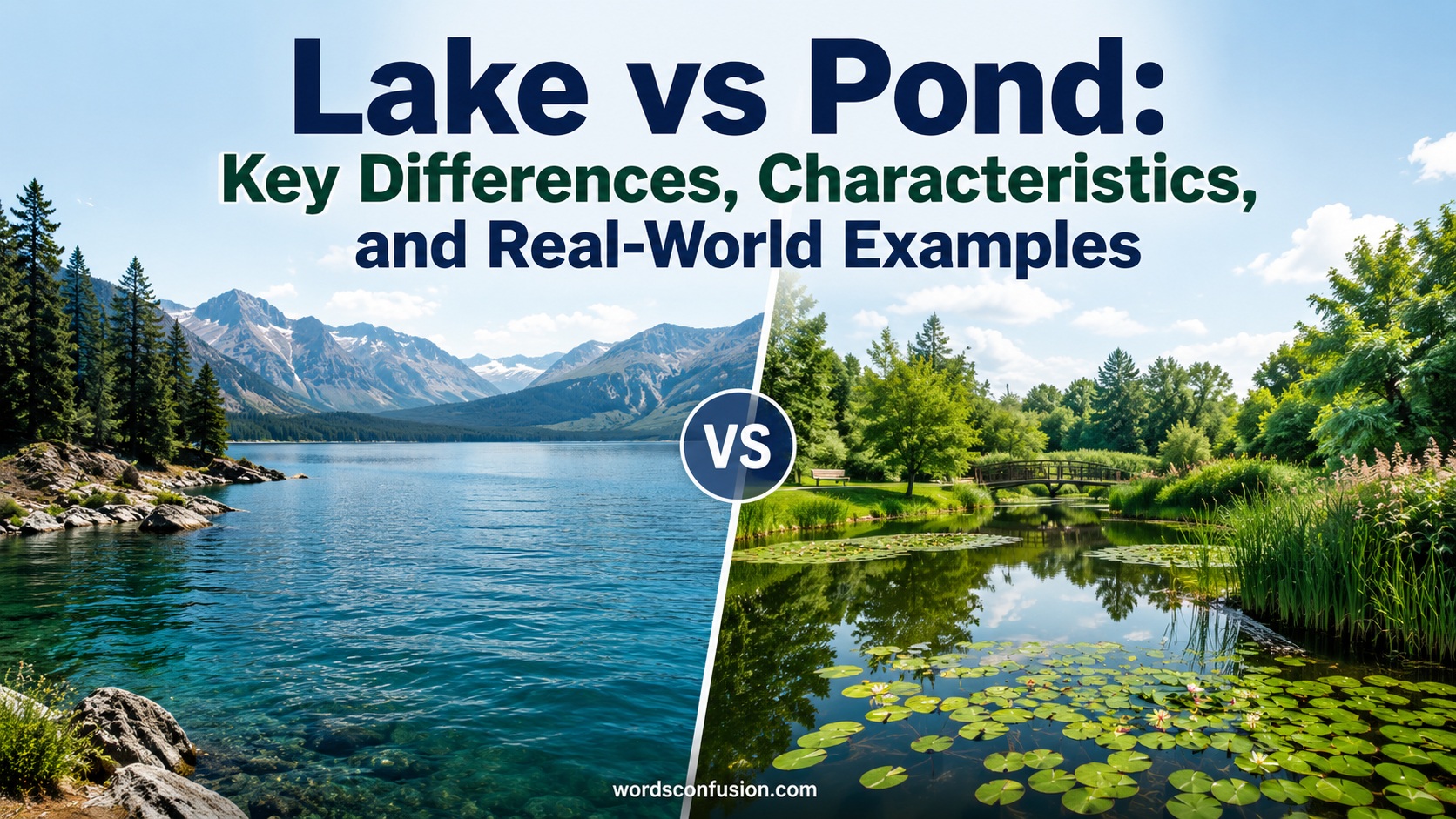
When you look at a body of water, it’s easy to assume the distinction is simple. Large bodies of water are lakes. Small ones are ponds. That sounds logical, yet nature rarely follows neat rules.
In fact, scientists, ecologists, and geographers have debated the lake vs pond question for decades. Some ponds are larger than certain lakes. Some lakes are shallow enough for sunlight to reach the bottom. Others are deep enough to create completely different underwater environments.
So what actually separates a lake from a pond?
The answer goes beyond size. Depth, sunlight penetration, water circulation, temperature layers, and ecosystem complexity all play important roles.
This guide explores the real differences between lakes and ponds, how they form, why scientists sometimes disagree on their classification, and how you can identify them in the real world.
Lake vs Pond – Quick Answer
A lake is generally a larger and deeper inland body of standing water that often develops distinct temperature layers and ecological zones.
A pond is usually smaller and shallower, allowing sunlight to reach most or all of the bottom. Because of this, ponds often support aquatic plant growth throughout the entire water body.
Although size is commonly used as a guide, there is no universal scientific size limit that officially separates a lake from a pond.
| Feature | Lake | Pond |
| Typical Size | Larger | Smaller |
| Depth | Usually deeper | Usually shallower |
| Sunlight Reach | Limited in deep areas | Often reaches the bottom |
| Water Layers | Common | Rare |
| Wave Activity | Stronger | Minimal |
| Aquatic Plants | Mostly near shore | Throughout much of the water |
| Ecosystem Complexity | More complex | Simpler |
For many scientists, light penetration and ecological structure matter more than surface area.
What Is a Lake?
A lake is an inland body of standing water surrounded by land. Lakes can form naturally through geological processes or be created by humans through dam construction.
Some lakes cover only a few acres. Others are so large that they resemble inland seas.
Definition of a Lake
Most scientific definitions describe a lake as:
- A relatively large body of standing freshwater or saltwater
- Surrounded by land
- Deep enough to develop distinct ecological conditions
- Capable of supporting different water layers
Lakes may contain freshwater, brackish water, or saltwater.
Famous examples include:
- Lake Superior
- Lake Victoria
- Lake Baikal
- Lake Tahoe
How Lakes Form
Lakes originate through several natural processes.
Glacial Lakes
During ice ages, massive glaciers carved depressions into the landscape. When the glaciers melted, water filled these basins.
Examples include many lakes in Canada, Scandinavia, and the northern United States.
Tectonic Lakes
Movements in Earth’s crust can create deep basins that eventually fill with water.
Lake Baikal formed through tectonic activity and is the deepest lake on Earth at approximately 1,642 meters (5,387 feet).
Volcanic Lakes
Volcanic eruptions sometimes leave behind craters that later fill with rainwater or groundwater.
These crater lakes often feature dramatic scenery and unusual water chemistry.
River-Formed Lakes
Changes in river courses can isolate sections of water, creating lakes.
Oxbow lakes are a common example.
Artificial Lakes
Humans build reservoirs by damming rivers.
Many reservoirs function exactly like natural lakes and support diverse ecosystems.
Common Features of Lakes
Most lakes share several characteristics:
- Greater depth
- Larger water volume
- Distinct shoreline and offshore habitats
- Stronger wave action
- Seasonal temperature changes
- Diverse fish populations
The deeper portions of lakes often receive little sunlight. As a result, different biological communities occupy different depths.
What Is a Pond?
A pond is a standing body of water that is generally shallower than a lake.
Because ponds are shallow, sunlight can often reach the bottom. This allows aquatic plants to grow across much of the pond floor.
Definition of a Pond
A pond is commonly described as:
- A small to medium-sized body of standing water
- Shallow enough for sunlight penetration
- Rich in aquatic vegetation
- Often lacking distinct temperature layers
Ponds can occur naturally or be created intentionally.
How Ponds Form
Ponds form through various natural and human-made processes.
Natural Depressions
Rainwater and groundwater collect in low-lying areas.
Floodplain Ponds
Rivers occasionally leave behind isolated pools during floods.
Wetland Development
Water accumulation in wetlands can create permanent ponds.
Human Construction
People create ponds for:
- Irrigation
- Livestock watering
- Landscaping
- Wildlife conservation
- Stormwater management
- Aquaculture
Common Features of Ponds
Most ponds exhibit:
- Shallow depths
- Extensive plant growth
- Warmer water temperatures
- Limited wave activity
- Strong interaction between water and sediments
Because sunlight reaches the bottom, plants can thrive almost everywhere.
This single characteristic explains many of the differences in the lake vs pond debate.
Lake vs Pond: The Main Differences Explained
People often focus on size. Scientists focus on ecology.
Several important characteristics separate lakes from ponds.
Size and Surface Area
Size seems like an obvious difference.
However, there is no globally accepted size threshold.
Some organizations classify ponds as water bodies smaller than 5 acres. Others use 10 acres, 20 acres, or even larger measurements.
The problem is that many real-world examples don’t fit neatly into these categories.
A large pond may exceed the size of a small lake.
That’s why size alone cannot provide a reliable answer.
Depth
Depth often provides a more useful distinction.
Ponds tend to be shallow enough for sunlight to penetrate throughout the water column.
Lakes usually contain deeper regions where sunlight cannot reach.
This affects everything from plant growth to oxygen levels.
Sunlight Penetration
Many limnologists consider sunlight penetration the most practical difference.
If sunlight reaches the entire bottom:
- Plants can grow almost everywhere
- The ecosystem behaves more like a pond
If deeper areas remain dark:
- Plant growth becomes restricted
- Distinct habitats emerge
- The water body behaves more like a lake
Water Circulation
Wind plays a major role in water movement.
In ponds:
- Water mixes frequently
- Temperature remains relatively uniform
In lakes:
- Different layers may develop
- Mixing becomes more complex
- Deep waters may remain isolated
Temperature Stratification
One of the most important scientific differences involves thermal stratification.
During summer, many lakes develop three distinct layers.
| Lake Layer | Characteristics |
| Epilimnion | Warm surface water |
| Metalimnion | Rapid temperature change |
| Hypolimnion | Cold deep water |
Ponds usually remain mixed because their shallow depth prevents stable layering.
Plant Growth
Plant distribution differs dramatically.
In ponds:
- Vegetation may cover most of the bottom
- Rooted plants dominate
In lakes:
- Plants concentrate near shorelines
- Deep water limits plant growth
Wildlife and Biodiversity
Lakes often support:
- Trout
- Salmon
- Deep-water fish
- Large predator species
Ponds frequently support:
- Frogs
- Turtles
- Dragonflies
- Small fish populations
Neither ecosystem is better. They simply support different forms of life.
Water Quality Characteristics
Water quality changes with depth.
Deep lakes may experience:
- Lower oxygen levels at depth
- Nutrient cycling between layers
- Seasonal turnover events
Ponds generally maintain more uniform conditions throughout the water column.
Scientific Debate: Is There an Official Difference Between a Lake and a Pond?
One surprising fact is that there is no universally accepted scientific definition.
Ask ten experts and you might receive several different answers.
Why Experts Disagree
Natural environments exist on a spectrum.
Water bodies don’t suddenly transform from ponds into lakes at a specific size.
Nature produces endless variations.
Scientists therefore rely on ecological characteristics rather than arbitrary measurements.
Definitions Used by Scientists
Many modern ecologists focus on:
- Light penetration
- Thermal stratification
- Biological productivity
- Water circulation
These factors often provide more meaningful distinctions than surface area.
Why Some Ponds Are Larger Than Certain Lakes
History complicates classification.
Many names were assigned centuries ago before scientific standards existed.
As a result:
- Some lakes are tiny
- Some ponds are surprisingly large
The name often reflects local tradition rather than scientific accuracy.
Case Study: When Names Don’t Match Reality
A water body may have “pond” in its name despite covering hundreds of acres.
Conversely, some lakes occupy only a few acres.
This demonstrates why naming conventions cannot determine classification.
Ecological Zones Found in Lakes and Ponds
Large lakes develop distinct ecological zones.
Each zone supports different organisms.
Littoral Zone
The littoral zone occupies shallow shoreline areas.
Characteristics include:
- High sunlight levels
- Dense plant growth
- Rich biodiversity
- Nursery habitat for fish
Most aquatic life begins here.
Limnetic Zone
The limnetic zone consists of open water away from shore.
Key features include:
- Plankton communities
- Schooling fish
- Active water movement
This zone forms the lake’s primary open-water habitat.
Profundal Zone
The profundal zone exists below the reach of sunlight.
Conditions include:
- Darkness
- Cooler temperatures
- Reduced plant growth
- Specialized organisms
Not all lakes possess a significant profundal zone.
Benthic Zone
The benthic zone includes the lake bottom.
Important organisms include:
- Worms
- Insect larvae
- Crustaceans
- Decomposers
These creatures recycle nutrients and support food webs.
Which Zones Exist in Ponds?
Most ponds lack extensive deep-water zones.
Instead, much of the pond functions similarly to a littoral zone.
This creates a more uniform habitat structure.
Lake vs Pond Ecosystems
Ecosystems differ because depth influences nearly every biological process.
Aquatic Plants
Ponds often support:
- Water lilies
- Duckweed
- Cattails
- Pondweed
Lakes usually restrict rooted plants to shoreline areas.
Fish Communities
Large lakes may contain:
- Trout
- Salmon
- Pike
- Walleye
Ponds commonly support:
- Bluegill
- Minnows
- Carp
- Bass
Fish diversity often increases with habitat complexity.
Amphibians and Reptiles
Ponds provide ideal breeding conditions for:
- Frogs
- Salamanders
- Newts
- Turtles
Their shallow waters warm quickly during spring.
Birds and Mammals
Both habitats attract wildlife.
Common visitors include:
- Ducks
- Herons
- Geese
- Otters
- Beavers
The surrounding habitat often influences wildlife presence more than waterbody classification.
Invertebrates
Invertebrates form the foundation of aquatic food webs.
Examples include:
- Dragonfly larvae
- Snails
- Freshwater shrimp
- Beetles
Healthy populations indicate strong ecosystem function.
Examples of Famous Lakes Around the World
Several lakes illustrate the diversity found in freshwater systems.
| Lake | Location | Notable Fact |
| Lake Superior | North America | Largest freshwater lake by surface area |
| Lake Victoria | Africa | Largest lake in Africa |
| Lake Baikal | Russia | Deepest lake in the world |
| Lake Tahoe | United States | Known for exceptional water clarity |
Lake Superior
Contains roughly 10% of the world’s surface freshwater.
Lake Victoria
Supports millions of people through fishing and transportation.
Lake Baikal
Holds approximately 20% of Earth’s unfrozen freshwater reserves.
Lake Tahoe
Famous for its remarkable visibility and mountain scenery.
Examples of Common Types of Ponds
Ponds occur in many forms.
Farm Ponds
Built to provide water for livestock and irrigation.
Garden Ponds
Designed primarily for aesthetics and landscaping.
Wildlife Ponds
Created to support biodiversity.
Retention Ponds
Used to manage stormwater runoff in urban areas.
Natural Woodland Ponds
Found in forests and natural wetlands.
These ponds often support unique amphibian communities.
Can a Pond Become a Lake?
The boundary between ponds and lakes isn’t fixed.
Environmental conditions can change over time.
Natural Changes
Several factors influence transformation:
- Sediment accumulation
- Rising water levels
- Climate shifts
- Erosion
Human Influence
People can alter water bodies through:
- Excavation
- Dredging
- Dam construction
- Water diversion
A small pond may eventually develop characteristics associated with lakes.
Likewise, a lake can gradually become shallower through sedimentation.
Read More: Town vs City: What’s the Real Difference? Examples, and Key Distinctions
Lake vs Pond for Fishing, Recreation, and Property Owners
The differences extend beyond science.
They affect how people use these water bodies.
Fishing Opportunities
Lakes often offer:
- Larger fish species
- More fishing locations
- Greater habitat diversity
Ponds provide:
- Easier access
- Simpler management
- Consistent fishing conditions
Boating and Water Sports
Lakes usually accommodate:
- Sailing
- Kayaking
- Water skiing
- Motorboats
Most ponds are too small for extensive boating activities.
Wildlife Observation
Ponds frequently provide excellent opportunities for:
- Frog watching
- Bird observation
- Insect photography
Their concentrated habitats make wildlife easier to spot.
Maintenance Requirements
Property owners often find ponds require:
- Vegetation management
- Algae control
- Sediment removal
Lakes generally involve larger-scale environmental management.
Property Value Considerations
Waterfront properties often command premium prices.
Factors influencing value include:
- Water quality
- Recreational opportunities
- Scenic views
- Accessibility
The condition of the water body matters more than whether it is classified as a lake or pond.
Common Myths About Lakes and Ponds
Several misconceptions continue to circulate.
“All Lakes Are Deep”
False.
Some lakes are surprisingly shallow.
“All Ponds Are Small”
False.
Certain ponds exceed the size of many lakes.
“A Pond Cannot Have Fish”
False.
Many ponds support healthy fish populations.
“A Lake Is Always Natural”
False.
Numerous reservoirs function as lakes despite being human-made.
How to Tell Whether a Body of Water Is a Lake or a Pond
Use this practical checklist.
| Question | Pond Indicator | Lake Indicator |
| Does sunlight reach the bottom? | Usually yes | Often no |
| Are aquatic plants widespread? | Yes | Mostly near shore |
| Is the water shallow? | Usually | Not always |
| Are temperature layers present? | Rarely | Commonly |
| Is there a dark deep-water zone? | No | Often |
Quick Field Assessment
Ask yourself:
- Can you see aquatic plants growing throughout the water body?
- Does the water appear relatively shallow?
- Is the entire bottom exposed to sunlight?
- Does the ecosystem seem uniform?
If the answer is yes, you’re probably looking at a pond.
If deep dark areas exist and distinct habitats appear, it is likely a lake.
FAQs:
What officially separates a lake from a pond?
There is no single official global standard. Scientists often focus on depth, sunlight penetration, and ecological structure.
Is a pond always smaller than a lake?
No. Size alone does not determine classification.
Can a pond have fish?
Absolutely. Many ponds support thriving fish populations.
Are all ponds shallow?
Most are, but depth varies significantly.
Why are some lakes smaller than ponds?
Historical naming traditions often outweigh scientific classification.
Can an artificial water body be called a lake?
Yes. Many reservoirs are considered lakes.
Which is better for wildlife, a lake or a pond?
Both provide valuable habitats. Different species prefer different conditions.
What is the deepest lake in the world?
Lake Baikal is the deepest known lake, reaching approximately 1,642 meters (5,387 feet).
Conclusion:
The lake vs pond distinction isn’t as simple as many people think. While size contributes to the discussion, scientists increasingly focus on ecological characteristics such as depth, sunlight penetration, temperature stratification, water circulation, and habitat complexity.
A pond is generally shallow enough for sunlight to reach the bottom, which encourages plant growth across much of the ecosystem. A lake typically contains deeper zones where light cannot penetrate, creating separate habitats and distinct temperature layers.

Andrew Wilson is an experienced language researcher and content writer specializing in WordsConfusion topics. He helps readers understand commonly confused English words, spelling differences, grammar rules, word meanings, and proper usage through clear explanations, practical examples, and easy-to-follow language guides. His goal is to make English learning simple, accurate, and accessible for students, writers, professionals, and everyday learners.