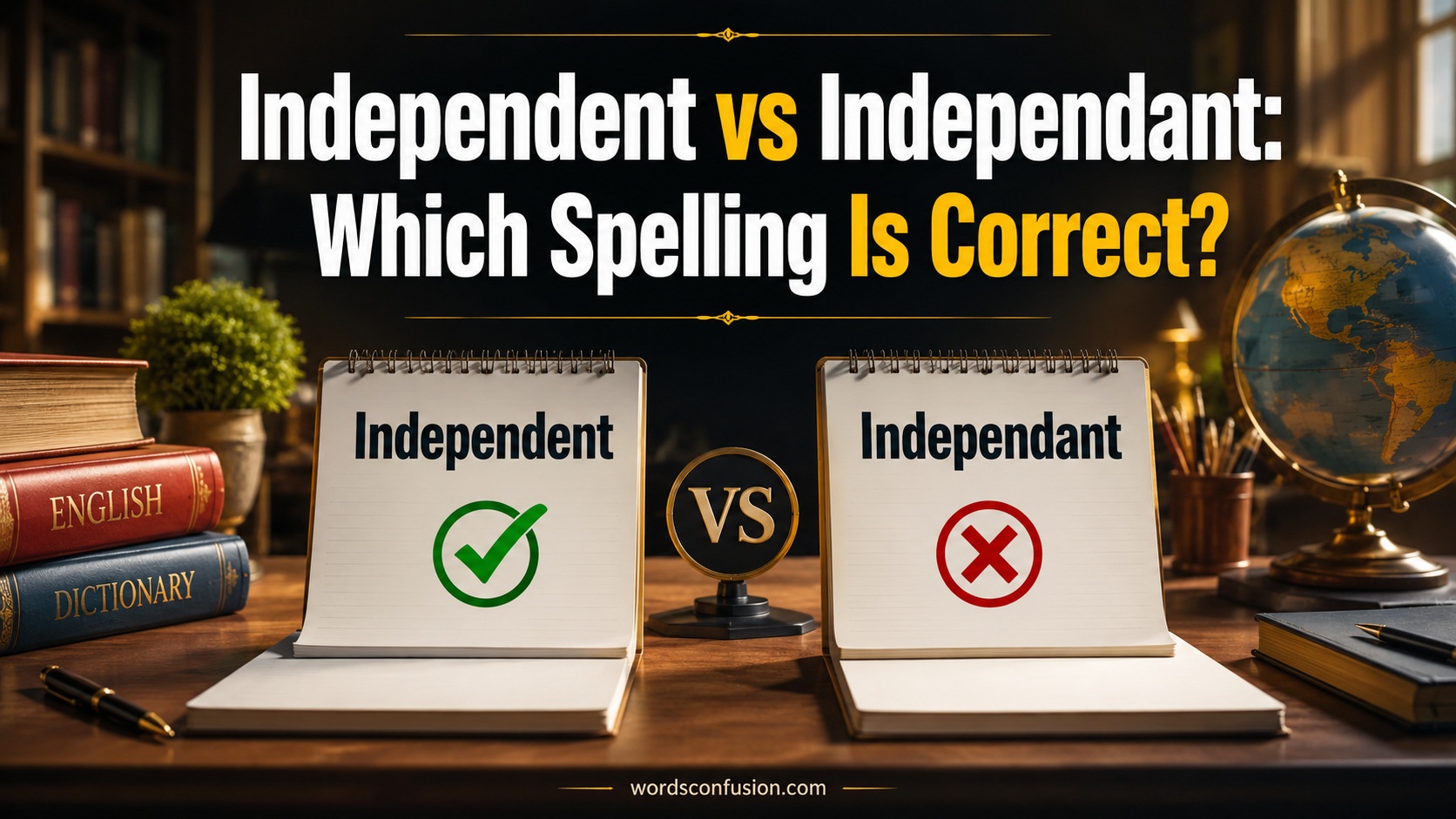
Choosing the correct spelling can make a big difference in how your writing looks. One small spelling mistake can weaken an email, assignment, resume, or blog post. A common example is Independent vs Independant. Many people type Independant because it sounds similar when spoken. However, only one spelling is accepted in English.
If you’ve ever wondered whether Independent or Independant is correct, you’re in the right place. This guide explains the correct spelling, its meaning, pronunciation, usage, common mistakes, memory tricks, and real-world examples. By the end, you’ll know exactly which version to use and why.
Quick Answer
Independent is the correct spelling in both US English and British English.
Independant is a misspelling. It doesn’t appear as a standard word in reputable English dictionaries and shouldn’t be used in academic, professional, or everyday writing.
| Word | Correct? | Meaning |
| Independent | Yes | Free from outside control or influence; self-reliant |
| Independant | No | Incorrect spelling of Independent |
Whenever you write, choose Independent.
Independent vs Independant: The Correct Spelling
Many English words end with -ent or -ant, which often causes confusion. Since both endings sound similar in everyday speech, it’s easy to replace one with the other.
That’s exactly why many writers accidentally type Independant instead of Independent.
The correct spelling is always Independent.
Why Independent Is Correct
The word Independent is recognized by every major English dictionary. It has been part of the English language for centuries and follows the traditional spelling inherited from Latin through French.
You should use Independent whenever you describe someone or something that isn’t controlled by another person, organization, or government.
Examples include:
- An independent business
- An independent country
- An independent researcher
- An independent student
- An independent journalist
The word works in formal writing, casual conversations, academic papers, and professional documents.
Why Independant Is Incorrect
Independant is simply a spelling mistake.
It isn’t recognized as a standard English word. Spell-checkers, grammar tools, dictionaries, and style guides all identify it as incorrect.
Using Independant can make your writing appear careless, especially in situations such as:
- Job applications
- School assignments
- Business reports
- Research papers
- Professional emails
- Website content
Whenever you see Independant, replace it with Independent.
Independent: Meaning and Definition
The word Independent describes a person, organization, country, or idea that isn’t controlled or influenced by someone else.
Depending on the context, it can also describe someone who supports themselves financially, thinks freely, or works without relying on others.
Dictionary Definition
As an adjective, Independent means:
Free from outside control, influence, or support.
As a noun, Independent refers to:
A person who isn’t affiliated with a political party or a business that operates without being owned by a larger company.
Although the exact wording varies slightly across dictionaries, the meaning remains consistent.
Pronunciation
The standard pronunciation is:
in-duh-PEN-duhnt
Phonetic spelling:
/ˌɪn.dɪˈpen.dənt/
Notice that the ending sounds like -dent, not -dant. Even though the pronunciation may seem similar in fast speech, the correct spelling always ends with -ent.
Part of Speech
Independent functions as more than one part of speech.
| Part of Speech | Example |
| Adjective | She is an independent thinker. |
| Noun | The candidate ran as an Independent in the election. |
Most commonly, you’ll see it used as an adjective.
Independant: Is It a Real Word?
Many people search for Independant because they assume both spellings exist. That’s understandable because English contains many words ending in -ant and -ent.
However, Independant isn’t a real English word.
It isn’t accepted in:
- US English
- British English
- Canadian English
- Australian English
You’ll only encounter it as a typo or spelling mistake.
Why People Misspell It
Several factors contribute to this common error.
The pronunciation sounds similar.
When people speak quickly, Independent may sound as though it ends with -ant instead of -ent.
English spelling isn’t always predictable.
Words ending in -ant and -ent often confuse learners because there isn’t a simple rule that applies to every word.
Examples include:
- Assistant
- Important
- Relevant
- Different
- Excellent
Some end with -ant, while others end with -ent.
Typing quickly increases mistakes.
Fast typing often leads to swapping letters without noticing. Since Independant closely resembles the correct word, many people overlook the error until a spell checker highlights it.
Common Typing and Pronunciation Mistakes
People also make other spelling mistakes with this word.
Some examples include:
- Independant
- Indepedent
- Indepandent
- Indepndent
- Indepenent
- Indepedently
- Independantly
Every one of these is incorrect.
The correct forms are:
- Independent
- Independently
- Independence
Independent vs Independant: Side-by-Side Comparison
The easiest way to remember the difference is to compare both spellings directly.
| Feature | Independent | Independant |
| Correct English spelling | Yes | No |
| Found in dictionaries | Yes | No |
| Accepted in US English | Yes | No |
| Accepted in UK English | Yes | No |
| Suitable for academic writing | Yes | No |
| Suitable for professional writing | Yes | No |
| Appears in official publications | Yes | No |
| Recommended by grammar checkers | Yes | No |
The comparison makes the answer simple.
There is only one correct spelling, and that’s Independent.
What Does Independent Mean?
The meaning of Independent changes slightly depending on the situation, yet the central idea remains the same. It always refers to freedom from control, influence, or reliance on others.
Whether you’re talking about a person, a country, a business, or a decision, the word suggests autonomy and self-sufficiency.
As an Adjective
Most often, Independent describes someone or something that can function without depending on another person or organization.
For example:
- An independent student completes assignments without constant supervision.
- An independent business operates without being owned by a larger corporation.
- An independent nation governs itself without foreign control.
- An independent researcher reaches conclusions based on evidence rather than outside pressure.
In each example, the subject acts freely and makes its own decisions.
As a Noun
In some contexts, Independent serves as a noun.
This usage appears most often in politics and business.
Examples include:
- She voted for an Independent in the local election.
- The newspaper is owned by an Independent, not a media conglomerate.
When capitalized in politics, Independent usually refers to a candidate or voter who doesn’t belong to a major political party.
Common Contexts Where It Appears
You’ll encounter Independent across many areas of daily life.
| Context | Example |
| Education | Independent learning develops critical thinking. |
| Business | She owns an independent bookstore. |
| Politics | The Independent candidate won the debate. |
| Science | The experiment used an independent variable. |
| Finance | He became financially independent at age 35. |
| Journalism | Independent media often cover local stories. |
The wide range of uses explains why this word appears frequently in books, news articles, schools, and workplaces.
How to Use Independent Correctly
Using Independent correctly is easier once you understand its meaning. In nearly every case, the word describes freedom, self-reliance, or the ability to act without outside control.
You can use it to describe people, organizations, countries, ideas, businesses, or even scientific concepts.
Below are the most common situations where Independent fits naturally.
In Everyday Conversation
In daily speech, Independent often describes someone’s personality, lifestyle, or ability to handle responsibilities alone.
Examples include:
- My daughter has become independent since starting college.
- You should encourage children to become more independent.
- He’s an independent thinker who doesn’t follow the crowd.
- Sarah enjoys traveling because she’s very independent.
- After years of saving money, they became financially independent.
Notice that the word emphasizes confidence and self-sufficiency rather than isolation.
In Academic Writing
Schools, colleges, and universities frequently use the word Independent in assignments and research papers.
Examples:
- Students completed an independent research project.
- The professor assigned independent reading before class.
- Independent learning improves critical thinking skills.
- The study measured the independent variable before analyzing the results.
- Every participant completed the assessment independently.
Academic writing values precision, so spelling Independent correctly is essential.
In Business and Professional Writing
Businesses also rely on this word in contracts, reports, resumes, and marketing materials.
Examples include:
- She works as an independent consultant.
- Our company remains independent despite rapid growth.
- The organization hired an independent auditor.
- An independent contractor completed the project.
- The review came from an independent expert.
A single spelling mistake such as Independant can make professional writing appear less polished. Always proofread before sending important documents.
Examples of Independent in Sentences
Reading examples helps you understand how native English speakers naturally use the word.
Everyday Examples
- Emma became independent after moving into her first apartment.
- My grandfather remained fiercely independent throughout his life.
- Independent thinking helps you make better decisions.
- Jake started an independent coffee shop downtown.
- Learning to cook made her more independent.
Workplace Examples
- The company hired an independent financial advisor.
- We requested an independent inspection before buying the property.
- The committee asked for an independent review of the report.
- She works as an independent graphic designer.
- An independent audit confirmed the company’s financial records.
Academic Examples
- Students completed an independent study during the semester.
- The experiment included one independent variable and two dependent variables.
- Researchers remained independent throughout the investigation.
- The university encourages independent learning.
- Every student submitted an independent research paper.
Common Words People Misspell Like Independent
English spelling can be challenging because many words don’t sound exactly like they look.
Here are several commonly misspelled words that confuse writers for similar reasons.
| Correct Spelling | Incorrect Spelling |
| Independent | Independant |
| Separate | Seperate |
| Government | Goverment |
| Discipline | Disipline |
| Accommodation | Accomodation |
| Existence | Existance |
| Embarrass | Embarass |
| Receive | Recieve |
| Calendar | Calender |
| Foreign | Forein |
A useful habit is to run your work through a spell checker before publishing or submitting it.
Read More: Happiness vs Happyness: Which Spelling Is Correct?
Why Do People Write “Independant”?
If Independant is incorrect, why do thousands of people search for it every month?
The answer lies in pronunciation, spelling patterns, and typing habits.
Pronunciation Confusion
The final syllable of Independent doesn’t strongly emphasize the letters e or a.
When spoken quickly, many people hear:
- Independent
- Independant
Both sound very similar.
As a result, writers often spell the word the way they hear it rather than the way dictionaries record it.
The “-ant” vs “-ent” Ending Pattern
English contains many words ending in both -ant and -ent.
For example:
| Ends in -ant | Ends in -ent |
| Assistant | Different |
| Important | Excellent |
| Relevant | Independent |
| Constant | Convenient |
| Elegant | Efficient |
Because both endings are common, there’s no universal spelling rule that works every time. The safest approach is to memorize the correct spelling of frequently used words.
Fast Typing and Autocorrect Mistakes
Typing quickly often leads to unnoticed errors.
Many people rely entirely on autocorrect. While modern spell checkers usually catch Independant, they aren’t perfect. If you’re writing on a platform without spell checking, the mistake can slip through.
Professional writers always proofread before publishing.
Memory Tricks to Remember the Correct Spelling
Simple memory tricks can help you avoid making the same mistake again.
Remember the Ending “-ent”
Focus on the last three letters:
Independent = ENT
Think of this phrase:
“Independent people enter life on their own.”
The word enter also begins with ent, making it easier to remember the correct ending.
Connect It With Related Words
Notice how related words share the same spelling pattern.
- Independence
- Independently
- Independent
Every member of the word family contains -ent.
If you accidentally write Independant, the related forms won’t match.
A Simple Mnemonic
Try this easy sentence:
Independent people depend on themselves.
The word depend appears inside Independent, making the spelling easier to visualize.
The more often you write the correct form, the more natural it becomes.
Independent Synonyms
Sometimes repeating the same word makes your writing feel monotonous. Using a synonym can improve variety while preserving your meaning.
Keep in mind that synonyms aren’t always interchangeable. Each carries a slightly different nuance.
Formal Synonyms
These alternatives work well in academic and professional writing.
- Autonomous
- Self-governing
- Self-sufficient
- Self-supporting
- Sovereign
- Unaffiliated
- Uncontrolled
- Standalone
Informal Alternatives
For casual writing or conversation, you can use:
- Self-reliant
- On your own
- Free
- Capable
- Resourceful
- Self-made
Words With Similar Meaning
| Word | Best Used For |
| Autonomous | Governments, systems, organizations |
| Self-reliant | Individuals |
| Sovereign | Countries |
| Standalone | Technology and products |
| Self-sufficient | Financial or practical independence |
| Free | General situations |
Choosing the right synonym depends on your audience and the context.
FAQs:
Is Independant ever correct?
No. Independant is never considered a correct spelling in standard English. It is a common misspelling of Independent and should not appear in academic papers, business documents, professional emails, or published content. Always use Independent instead.
How do you spell Independent correctly?
The correct spelling is Independent, ending with -ent. A simple way to remember it is that related words like independence and independently also use the -ent spelling.
Why do people spell Independent as Independant?
Most people make this mistake because the endings -ent and -ant sound very similar in spoken English. Fast typing, pronunciation, and unfamiliarity with the word’s spelling also contribute to the error.
Is Independent correct in both US and UK English?
Yes. Independent is the standard spelling in American English, British English, Canadian English, and Australian English. There are no regional spelling variations for this word.
What does Independent mean?
Independent means free from outside control, influence, or support. It can describe a person who is self-reliant, a country that governs itself, a business that operates on its own, or someone who thinks and acts without depending on others.
Conclusion:
The debate over Independent vs Independant has a simple answer. Independent is the only correct spelling accepted in English, while Independant is a spelling mistake that should always be avoided.
Whether you’re writing a school assignment, preparing a business report, sending a professional email, or publishing content online, using the correct spelling improves your credibility and helps your writing appear polished and professional.
Whenever you’re unsure, remember this simple rule: Independent always ends with “-ent.” You can also connect it with related words such as independence and independently, which share the same spelling pattern.

Andrew Wilson is an experienced language researcher and content writer specializing in WordsConfusion topics. He helps readers understand commonly confused English words, spelling differences, grammar rules, word meanings, and proper usage through clear explanations, practical examples, and easy-to-follow language guides. His goal is to make English learning simple, accurate, and accessible for students, writers, professionals, and everyday learners.