Choosing between look and see seems simple until you start speaking or writing English every day. Many learners use these two words interchangeably because both relate to vision. However, they don’t have the same meaning.
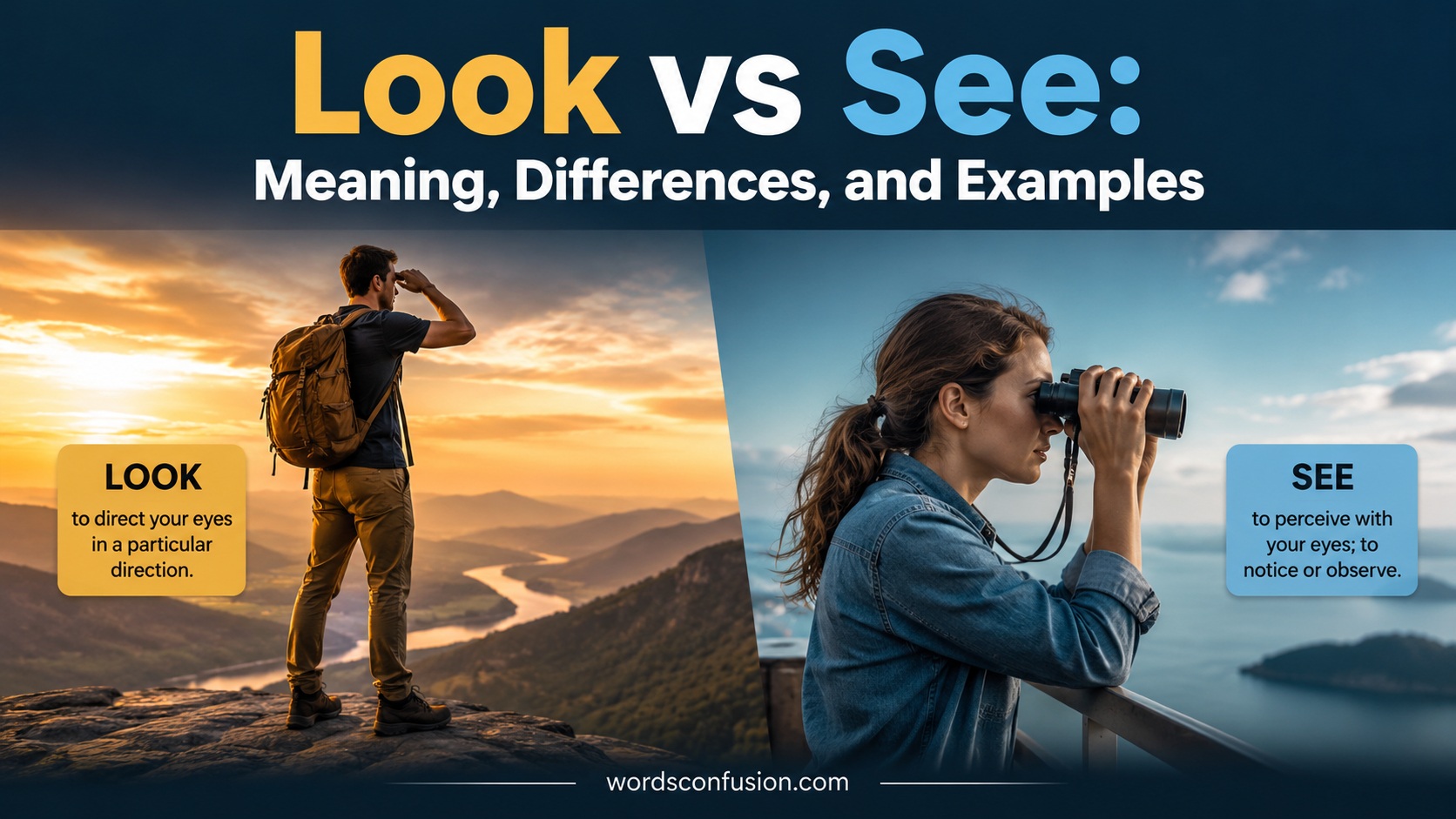
The key difference is intention. You look when you intentionally direct your eyes toward something. You see when your eyes naturally notice something, whether you planned to or not.
For example, if someone says, “Look at the sunset,” they’re asking you to focus your eyes on it. If you reply, “I can see it,” you’re saying the sunset is already visible to you.
Understanding this distinction will make your English sound more natural. It will also help you avoid one of the most common grammar mistakes made by English learners.
In this guide, you’ll learn the meaning of look vs see, their differences, grammar rules, examples, common expressions, and practical tips you can use in everyday conversations.
Quick Answer
The difference between look and see is simple:
- Look means to direct your eyes toward something on purpose.
- See means to notice something with your eyes, often without making a conscious effort.
| Word | Meaning | Requires Intention? | Example |
| Look | Direct your eyes toward something | Yes | Look at the stars. |
| See | Notice something with your eyes | Usually no | I can see the stars. |
Easy rule to remember:
Look = Action. See = Result.
What Does “Look” Mean?
The verb look means to intentionally turn your eyes toward someone or something. It requires a conscious action.
When someone tells you to look, they’re asking you to pay attention visually.
When to Use “Look”
Use look when you want someone to:
- Focus on an object
- Pay attention
- Examine something carefully
- Observe something intentionally
Examples
- Look at this picture.
- Please look outside.
- Look at the road before crossing.
- Look over your homework.
- Everyone looked at the teacher.
Notice that look usually needs the preposition at before the object.
Correct:
- Look at me.
- Look at the map.
Incorrect:
- Look the map.
Common Mistakes
Many learners forget to use at after look.
| Incorrect | Correct |
| Look the sky. | Look at the sky. |
| Look this photo. | Look at this photo. |
| Look me. | Look at me. |
What Does “See” Mean?
The verb see means to notice or become aware of something through your eyes.
Unlike look, seeing often happens naturally. You don’t always decide to see something. If an object is visible, your eyes can see it.
When to Use “See”
Use see when:
- Something is visible
- You notice an object
- You recognize someone
- You witness an event
- You understand something in certain expressions
Examples
- I can see the mountains.
- She saw a rainbow after the rain.
- Did you see my message?
- We saw dolphins during our trip.
- I see what you mean.
Unlike look, see normally does not require at.
Correct:
- I saw the movie.
- I can see the building.
Incorrect:
- I saw at the movie.
The Main Difference Between Look and See
The biggest difference is whether the action is intentional.
You look first. If everything goes well, you see.
Think about using binoculars. You intentionally look through them. Once focused, you see birds in the distance.
Comparison Table
| Feature | Look | See |
| Meaning | Direct your eyes intentionally | Notice something with your eyes |
| Requires effort | Yes | Usually no |
| Needs attention | Yes | Not always |
| Common grammar | Look at + object | See + object |
| Focus | Action | Result |
| Example | Look at the painting. | I can see the painting. |
Simple Analogy
Imagine using a flashlight.
- Turning the flashlight toward something is like looking.
- Actually noticing what’s there is like seeing.
This comparison makes the difference much easier to remember.
Look vs See in Grammar
Grammar is where many English learners become confused.
Fortunately, the rules are straightforward.
Why “Look” Usually Needs “At”
The verb look commonly appears with at because it describes directing your eyes toward a target.
Examples:
- Look at the clock.
- Look at those birds.
- Look at this document.
Without at, the sentence is often incomplete.
Why “See” Usually Doesn’t Need a Preposition
The verb see directly takes its object.
Examples:
- I see your car.
- We saw a deer.
- She can see the ocean.
Adding at after see is incorrect in standard English.
Common Grammar Patterns
| Pattern | Example |
| Look at + noun | Look at the painting. |
| Look + adjective | You look tired. |
| Look for + noun | I’m looking for my keys. |
| See + noun | I see a bird. |
| Can see + noun | We can see the moon. |
| See + clause | I see that you’re busy. |
Look vs See vs Watch
Many learners also confuse watch with look and see.
Although all three involve vision, each serves a different purpose.
| Word | Meaning | Best Used For | Example |
| Look | Direct your eyes | Intentional focus | Look at the painting. |
| See | Notice naturally | Visibility | I can see the painting. |
| Watch | Observe over time | Movement | Watch the football game. |
When to Use “Watch”
Use watch when something moves or changes over time.
Examples:
- Watch TV.
- Watch the children.
- Watch the game.
- Watch the traffic.
You don’t usually watch a mountain because it doesn’t move.
However, you can watch fireworks because they are constantly changing.
Common Expressions with “Look”
The word look appears in many everyday English expressions and phrasal verbs.
Look after
Meaning: Take care of someone.
Example:
- She looks after her younger brother.
Look for
Meaning: Try to find something.
Example:
- I’m looking for my wallet.
Look into
Meaning: Investigate.
Example:
- The company will look into the complaint.
Look forward to
Meaning: Feel excited about something in the future.
Example:
- We look forward to meeting you.
Look over
Meaning: Examine carefully.
Example:
- Please look over this report.
Look around
Meaning: Explore a place.
Example:
- We looked around the museum.
Look out
Meaning: Be careful.
Example:
- Look out! A bicycle is coming.
Look up
Meaning: Search for information.
Example:
- Look up the word in the dictionary.
Common Expressions with “See”
The verb see also appears in many common expressions.
See you later
A friendly way to say goodbye.
See for yourself
Check personally before believing something.
See through
Recognize the truth behind someone’s actions.
See to
Handle or take care of something.
See about
Consider arranging something.
See eye to eye
Completely agree.
See the point
Understand someone’s reasoning.
See the difference
Notice how two things differ.
Real-Life Examples of Look vs See
Understanding grammar becomes much easier when you see real situations.
At School
Teacher:
“Look at the board.”
Student:
“I can see the answer now.”
At Work
Manager:
“Please look at this report.”
Employee:
“I see a few mistakes.”
During Travel
Friend:
“Look at that waterfall!”
You:
“I’ve never seen anything so beautiful.”
At Home
Parent:
“Look at your room.”
Child:
“I don’t see what’s wrong.”
These examples show that look asks someone to focus while see describes what becomes visible.
Read More: Speak vs Talk: Meaning, Differences, and Correct Usage
Look vs See in Questions
Questions often reveal which verb fits naturally.
Use “Look” When Asking Someone to Focus
Examples:
- Will you look at this?
- Could you look for my phone?
- Can you look outside?
- Would you look at these photos?
Use “See” When Asking About Visibility or Awareness
Examples:
- Can you see the moon?
- Did you see the accident?
- Have you seen my glasses?
- Do you see what I mean?
Common Errors English Learners Make
Learning from mistakes helps you improve faster.
Using “See” Instead of “Look”
Incorrect:
- See at this picture.
Correct:
- Look at this picture.
Forgetting “At”
Incorrect:
- Look the teacher.
Correct:
- Look at the teacher.
Confusing “See” and “Watch”
Incorrect:
- I saw TV all evening.
Correct:
- I watched TV all evening.
Using “Watch” Instead of “See”
Incorrect:
- Watch the mountains from here.
Correct:
- See the mountains from here.
Incorrect vs Correct Examples
| Incorrect | Correct |
| See at me. | Look at me. |
| Look the bird. | Look at the bird. |
| I see TV every night. | I watch TV every night. |
| Look a movie tonight. | Watch a movie tonight. |
| I looked a rainbow. | I saw a rainbow. |
Memory Trick to Remember the Difference
A simple memory trick can help you remember these verbs forever.
Think of the sentence:
You LOOK first. Then you SEE.
Another easy formula is:
- Look = Choice
- See = Notice
- Watch = Follow movement
Visualize entering an art gallery.
First, you look at a painting.
Then, you see its colors and details.
Finally, you watch a documentary explaining its history.
That sequence mirrors how these verbs naturally work.
FAQs:
Is it “look” or “see” a movie?
You normally watch a movie because it involves continuous action over time. If you’re referring to the experience after it happened, you can say, “I saw that movie last week.”
What’s the difference between “look at” and “see”?
Look at means you intentionally direct your eyes toward something. See means something is visible or noticed by your eyes.
Can “look” and “see” be used interchangeably?
Not usually. Although both relate to vision, they describe different actions. Using the wrong one can make a sentence sound unnatural.
Why does “look” usually need “at”?
The preposition at identifies the object you’re directing your eyes toward. That’s why “look at the picture” is correct while “look the picture” is not.
What is the difference between “look,” “see,” and “watch”?
Look means intentionally directing your eyes, see means noticing something visually, and watch means observing something that moves or changes over a period of time.
Conclusion:
The difference between look vs see becomes much easier once you remember that look is the action while see is the result. You choose to look at something, but you see it when it becomes visible to your eyes. When movement continues over time, watch is usually the correct verb.
A simple rule can help you every time:
- Look = Direct your eyes intentionally.
- See = Notice something with your eyes.
- Watch = Observe movement over time.
Practice these verbs in everyday conversations, reading, and writing. Before long, choosing between look, see, and watch will feel natural, and your English will sound more fluent and accurate.

Andrew Wilson is an experienced language researcher and content writer specializing in WordsConfusion topics. He helps readers understand commonly confused English words, spelling differences, grammar rules, word meanings, and proper usage through clear explanations, practical examples, and easy-to-follow language guides. His goal is to make English learning simple, accurate, and accessible for students, writers, professionals, and everyday learners.