
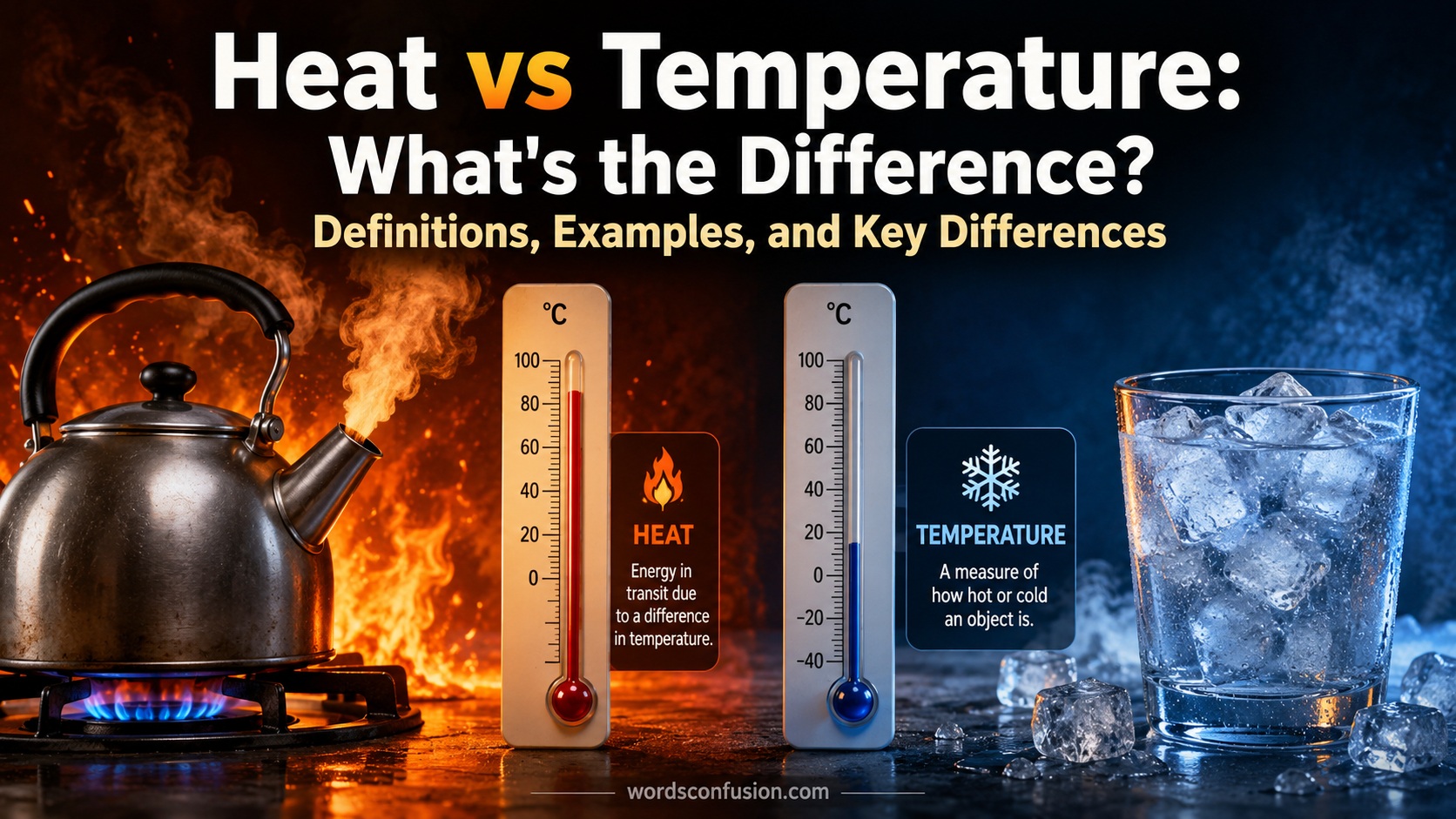
Many people use the words heat and temperature as if they mean the same thing. You have probably heard someone say, “The heat today is 95 degrees,” or “This cup has more temperature than that one.” These expressions sound normal in everyday conversation. However, they are scientifically incorrect.
Understanding the difference between heat vs temperature isn’t just important for passing a science exam. It helps you understand how cooking works, why ice melts, how refrigerators keep food cold, why metal feels colder than wood, and even how engines and air conditioners operate.
Here’s a simple example.
Imagine a small cup of boiling water and a large swimming pool on a warm summer day. The cup may have a temperature of 212°F (100°C), while the pool is only 86°F (30°C). Even though the cup has a much higher temperature, the swimming pool contains far more heat energy because it holds thousands of gallons of water.
That single example explains the biggest difference:
- Temperature tells you how hot or cold something is.
- Heat tells you how much thermal energy moves between objects because of a temperature difference.
Scientists carefully separate these two concepts because they describe different physical properties. Once you understand that distinction, topics like conduction, convection, radiation, specific heat capacity, and thermal equilibrium become much easier to grasp.
In this guide, you’ll learn exactly what heat and temperature mean, how they differ, why people confuse them, and how these concepts appear in everyday life. You’ll also discover practical examples, scientific facts, comparison tables, and memory tricks that make the topic easy to remember.
Heat vs Temperature: Quick Answer
Although people often use the terms interchangeably, heat and temperature describe two completely different scientific concepts.
- Heat is the transfer of thermal energy from one object to another because of a difference in temperature.
- Temperature is the measure of the average kinetic energy of particles within a substance.
Think of it this way:
Temperature measures how hot something is. Heat measures how much energy moves because one object is hotter than another.
Heat vs Temperature Comparison Table
| Feature | Heat | Temperature |
| Definition | Energy transferred due to temperature difference | Measure of average kinetic energy of particles |
| Scientific Meaning | Thermal energy in transit | Degree of hotness or coldness |
| SI Unit | Joule (J) | Kelvin (K) |
| Common Units | Joule, calorie | Celsius, Fahrenheit, Kelvin |
| Property Type | Extensive property | Intensive property |
| Depends on Mass | Yes | No |
| Can Flow | Yes | No |
| Measuring Instrument | Calorimeter | Thermometer |
| Symbol | Q | T |
| Direction | Always flows from hotter to colder objects | Does not flow |
| Example | Heat from a stove warms a pan | Water is 80°C |
The Easiest Way to Remember
Imagine two buckets filled with water.
One bucket contains 1 gallon of water at 176°F (80°C).
The other contains 100 gallons of water at the same 176°F (80°C).
Both have the same temperature because the water molecules move at the same average speed. However, the larger bucket contains much more thermal energy. That means it can transfer much more heat to another object.
This simple comparison highlights why heat depends on the amount of matter, while temperature does not.
What Is Heat?
Heat Is Energy in Transit
In physics, heat refers to the transfer of thermal energy between objects because they have different temperatures.
Notice one important phrase: energy in transit.
Heat is not stored inside an object. Instead, it describes energy moving from one place to another. Once that energy reaches the object, it becomes part of the object’s internal energy.
For example:
- A hot frying pan transfers heat to an egg.
- The Sun transfers heat to Earth through radiation.
- Your hands transfer heat to an ice cube, causing it to melt.
In every case, heat flows naturally from the warmer object to the cooler one until both reach the same temperature.
SI Unit of Heat
The International System of Units (SI) measures heat in joules (J).
One joule represents the amount of energy transferred when a force of one newton moves an object one meter.
Other units still appear in certain fields:
| Unit | Common Use |
| Joule (J) | Scientific calculations |
| Kilojoule (kJ) | Engineering and chemistry |
| Calorie (cal) | Older scientific work |
| Kilocalorie (kcal) | Food energy and nutrition |
| British Thermal Unit (BTU) | Heating and air conditioning |
A nutritional “Calorie” on food labels actually equals one kilocalorie (kcal), or 4,184 joules.
How Heat Flows
Heat always follows one simple rule:
It moves from a hotter object to a colder object.
It never moves the opposite way without external work.
For example:
- Ice cools a drink because heat leaves the drink and enters the ice.
- A hot pizza cools because heat transfers into the surrounding air.
- A warm hand melts snow because heat flows from your skin into the snow.
Scientists call this natural direction of energy transfer the Second Law of Thermodynamics.
Heat transfer continues until both objects reach thermal equilibrium, meaning they share the same temperature.
What Is Temperature?
Temperature measures how fast the particles inside a substance move on average. In scientific terms, it represents the average kinetic energy of atoms or molecules.
The faster the particles move, the higher the temperature. As particle motion slows down, the temperature decreases.
Unlike heat, temperature is not energy itself. Instead, it tells you the thermal state of an object.
Think of temperature as a speedometer in a car. A speedometer doesn’t create speed. It simply measures how fast the vehicle is moving. In the same way, temperature measures the average motion of particles rather than the total amount of thermal energy.
Temperature Measures Average Kinetic Energy
Every solid, liquid, and gas contains billions of tiny particles that constantly move.
- In solids, particles vibrate around fixed positions.
- In liquids, particles slide past one another.
- In gases, particles move freely and collide frequently.
When these particles gain energy, they move faster. Faster motion means a higher temperature. When they lose energy, their motion slows and the temperature drops.
For example:
- Water at 32°F (0°C) contains particles moving more slowly than water at 212°F (100°C).
- Steam has particles moving much faster than ice, which explains its much higher temperature.
SI Unit of Temperature
The official SI unit of temperature is the kelvin (K).
Scientists prefer kelvin because it starts at absolute zero, the lowest possible temperature.
Common temperature scales include:
| Scale | Symbol | Common Use |
| Celsius | °C | Most countries |
| Fahrenheit | °F | United States |
| Kelvin | K | Science and engineering |
Understanding Absolute Zero
Absolute zero is 0 K, which equals:
- −273.15°C
- −459.67°F
At this temperature, particle motion reaches its theoretical minimum. While atoms still exhibit quantum motion, no lower temperature exists according to classical thermodynamics.
Scientists have created temperatures only fractions of a degree above absolute zero in specialized laboratories, but reaching exactly 0 K remains impossible under current physical laws.
How Temperature Is Measured
Temperature is measured using a thermometer.
Different thermometers work in different ways.
Common types include:
- Mercury thermometers
- Alcohol thermometers
- Digital thermometers
- Infrared thermometers
- Thermocouples
- Resistance temperature detectors (RTDs)
Each measures temperature by detecting a physical change caused by heating or cooling.
For example, a mercury thermometer works because mercury expands as its temperature rises.
Temperature Is an Intensive Property
One of the most important characteristics of temperature is that it is an intensive property.
That means it does not depend on the amount of material.
Consider these examples:
- A teaspoon of boiling water has a temperature of 212°F (100°C).
- A bathtub full of boiling water also has a temperature of 212°F (100°C).
Even though one contains thousands of times more water, both have the same temperature because the average kinetic energy of their particles is identical.
This idea often surprises students because people naturally associate “more water” with “more heat.” While the larger container does contain more thermal energy, its temperature remains exactly the same.
Heat vs Temperature: Side-by-Side Comparison
Although heat and temperature are closely related, they describe different physical concepts. Understanding their differences makes many scientific ideas much easier to grasp.
| Feature | Heat | Temperature |
| Meaning | Energy transferred between objects | Measure of average particle motion |
| Scientific Symbol | Q | T |
| SI Unit | Joule (J) | Kelvin (K) |
| Nature | Energy | Physical measurement |
| Property Type | Extensive | Intensive |
| Depends on Mass | Yes | No |
| Depends on Material | Yes | No |
| Can Flow | Yes | No |
| Direction | Hot to cold | Does not move |
| Instrument | Calorimeter | Thermometer |
| Changes During Phase Change | Yes | May remain constant |
| Everyday Example | Heat from an oven cooks food | Oven is set to 375°F |
Key Differences at a Glance
| Heat | Temperature |
| Represents transferred energy | Represents average molecular motion |
| Depends on mass and material | Independent of quantity |
| Measured in joules | Measured in degrees or kelvin |
| Can increase or decrease internal energy | Indicates thermal condition |
| Always flows naturally | Never flows |
The Main Differences Between Heat and Temperature
Understanding a few fundamental differences will eliminate almost every misconception about these two terms.
Heat Is Energy. Temperature Is a Measurement.
This is the biggest distinction.
Heat is actual energy moving from one object to another.
Temperature simply tells you how energetic the particles inside an object are on average.
Imagine filling two balloons with air.
One balloon contains very little air heated to 212°F (100°C).
The other is much larger and contains ten times more air at 122°F (50°C).
The smaller balloon has the higher temperature.
The larger balloon may contain much more total thermal energy.
This shows why the two terms cannot replace one another.
Heat Can Move. Temperature Cannot.
People often say things like:
- “The temperature traveled through the wall.”
- “Cold entered the room.”
Neither statement is scientifically accurate.
Only heat moves.
Temperature simply changes because heat has entered or left an object.
For example:
- Heat leaves hot coffee and enters the surrounding air.
- As heat escapes, the coffee’s temperature gradually falls.
- The temperature itself does not travel anywhere.
This distinction explains many everyday events, including why food cools after sitting on a table.
Read More: Mass vs Weight: What’s the Difference? Definition, Formula, Units, and Examples
Heat Depends on the Amount of Matter
Heat is an extensive property, meaning it depends on how much material is present.
Consider these two pots:
- Pot A contains 1 gallon of boiling water.
- Pot B contains 20 gallons of boiling water.
Both are at 212°F (100°C).
Pot B stores much more internal thermal energy simply because it contains much more water.
Heating that larger pot required far more energy.
Temperature Does Not Depend on Quantity
Temperature behaves differently.
Whether you measure:
- one drop of water,
- one cup,
- one bucket,
- or an entire swimming pool,
the temperature remains identical if the average particle motion is the same.
That’s why a tiny cup of coffee can be just as hot as a giant coffee urn.
Different Units
Heat and temperature even use different measurement units.
Heat
- Joule (J)
- Kilojoule (kJ)
- Calorie (cal)
- Kilocalorie (kcal)
- BTU
Temperature
- Celsius (°C)
- Fahrenheit (°F)
- Kelvin (K)
Mixing these units is like confusing miles with speed. One measures distance while the other measures velocity. Both relate to travel, but they describe different things.
Heat Causes Temperature Changes
Adding heat often increases temperature.
Removing heat usually lowers temperature.
However, there are important exceptions.
During melting and boiling, heat continues entering a substance without raising its temperature.
Instead, the added energy breaks molecular bonds and changes the substance’s physical state.
This phenomenon is known as latent heat, and it explains why boiling water remains at 212°F (100°C) until all the liquid becomes steam.
Understanding this concept is essential in physics, chemistry, engineering, and even cooking.
A Simple Everyday Analogy
Imagine a classroom.
- Temperature is like the average excitement level of the students.
- Heat is like the energy entering the room when dozens of excited students rush inside.
The excitement level describes the current condition.
The arriving students represent energy being transferred.
Although the analogy isn’t perfect, it helps illustrate why scientists carefully distinguish between heat and temperature.
FAQs:
Is heat the same as temperature?
No. Heat and temperature are not the same thing, even though people often use the terms interchangeably.
- Heat is the transfer of thermal energy from a hotter object to a cooler one.
- Temperature measures the average kinetic energy of the particles in a substance.
For example, a large bathtub of warm water may contain far more heat than a small cup of boiling water, even though the cup has a much higher temperature.
Can an object have more heat but a lower temperature?
Yes. This is one of the easiest ways to understand the difference between heat and temperature.
Imagine:
- A swimming pool at 86°F (30°C)
- A cup of coffee at 176°F (80°C)
The coffee has the higher temperature because its molecules move faster. However, the swimming pool contains a much larger amount of water, so it stores far more thermal energy. In other words, it has more heat content.
This example shows why mass plays an important role in heat but not in temperature.
Why does the temperature stay the same while water boils?
At normal atmospheric pressure, water boils at 212°F (100°C).
Once boiling begins, additional heat does not increase the water’s temperature. Instead, the added energy breaks the attractive forces between water molecules and converts the liquid into steam.
Scientists call this energy latent heat of vaporization.
The temperature remains constant until all the liquid has changed into a gas.
Why does metal feel colder than wood if both are in the same room?
This common experience often confuses people.
If a metal spoon and a wooden spoon sit in the same room for several hours, they will have the same temperature.
Metal feels colder because it is a much better thermal conductor than wood. It transfers heat away from your hand much faster, causing your skin to cool quickly. Your brain interprets that rapid heat loss as a colder sensation.
Wood is a poor conductor, so it removes heat more slowly and feels warmer even though its temperature is identical.
What are the SI units of heat and temperature?
The International System of Units (SI) uses different units for each quantity.
| Quantity | SI Unit | Symbol |
| Heat | Joule | J |
| Temperature | Kelvin | K |
Outside scientific settings, people commonly measure temperature in degrees Celsius (°C) or degrees Fahrenheit (°F). Heat may also be expressed in calories, kilocalories, or British Thermal Units (BTUs), depending on the application.
Conclusion:
Understanding the difference between heat vs temperature is fundamental to physics, chemistry, engineering, and everyday life. Although the terms are closely related, they describe different concepts.
Heat is the transfer of thermal energy that occurs because two objects have different temperatures. It always flows naturally from a warmer object to a cooler one until both reach thermal equilibrium.
Temperature, on the other hand, measures the average kinetic energy of particles within a substance. It tells you how hot or cold an object is, but it doesn’t indicate how much total thermal energy the object contains.

Andrew Wilson is an experienced language researcher and content writer specializing in WordsConfusion topics. He helps readers understand commonly confused English words, spelling differences, grammar rules, word meanings, and proper usage through clear explanations, practical examples, and easy-to-follow language guides. His goal is to make English learning simple, accurate, and accessible for students, writers, professionals, and everyday learners.