
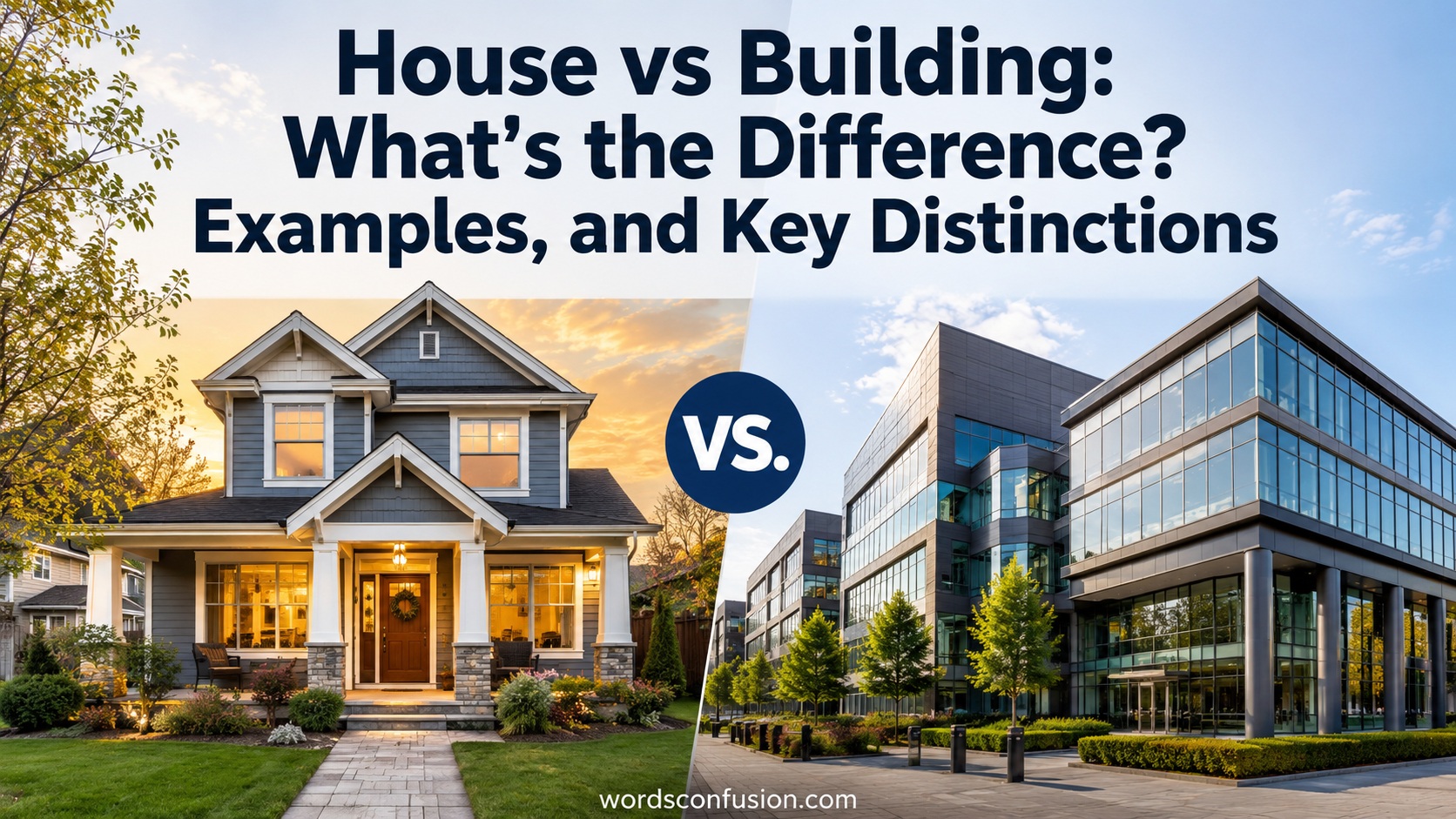
When people use the words house and building, they often assume they mean the same thing. After all, a house is a structure with walls, a roof, doors, and windows. Doesn’t that make it just another building?
Not exactly.
Although every house is technically a building, not every building is a house. The distinction lies in the structure’s purpose, design, and how people use it. A house exists primarily as a place where people live, while a building is a much broader term that includes everything from homes and apartment complexes to offices, hospitals, schools, factories, and shopping malls.
Understanding the difference isn’t just useful for English learners. It also matters in architecture, construction, real estate, legal documents, and everyday conversations. Choosing the correct word helps you communicate more accurately and avoid common mistakes.
In this guide, you’ll learn exactly what makes a house different from a building, discover practical examples, compare their characteristics, and see how native English speakers use each term in real life.
House vs Building at a Glance
The quickest way to understand the difference is to compare both terms side by side.
| Feature | House | Building |
| Definition | A structure designed primarily for people to live in | Any permanent structure built for residential, commercial, industrial, or public use |
| Primary Purpose | Residential living | Multiple purposes depending on its function |
| Occupants | Individuals or families | People, businesses, organizations, equipment, or storage |
| Residential Use | Always | Sometimes |
| Commercial Use | Rare | Very common |
| Number of Units | Usually one dwelling | One or many units |
| Ownership | Individuals, families, or investors | Individuals, companies, governments, or organizations |
| Examples | Cottage, bungalow, townhouse, villa | Office tower, school, hospital, apartment building, warehouse |
The key takeaway is simple:
Every house is a building, but only some buildings are houses.
What Is a House?
A house is a permanent structure built primarily as a residence. It provides people with a safe, private place to live, sleep, cook, relax, and carry out everyday activities.
Unlike other structures, a house focuses on comfortable living. Every part of its design supports daily life, whether it’s the bedrooms, kitchen, bathrooms, or living room.
In everyday English, people often say:
- “I’m buying a house.”
- “Their house has four bedrooms.”
- “She just moved into a new house.”
In each example, the speaker refers specifically to someone’s place of residence rather than a general structure.
Definition of a House
A house is a residential building intended for one family or multiple occupants living together as a household.
The word comes from Old English and has always referred to a dwelling where people make their home.
Although architectural styles differ around the world, the main purpose remains the same: providing shelter and a place to live.
Main Characteristics of a House
Several features distinguish a house from other buildings.
- Designed for residential use
- Contains living spaces
- Includes bedrooms and bathrooms
- Has a kitchen for preparing meals
- Offers privacy for occupants
- Usually includes utilities such as electricity, water, heating, and plumbing
- May include outdoor areas like a yard, garage, or garden
Many modern houses also include:
- Home offices
- Laundry rooms
- Storage spaces
- Basements
- Attics
- Smart home technology
- Energy-efficient systems
These features support comfortable everyday living rather than commercial or industrial activities.
Common Types of Houses
Houses come in many shapes and sizes. Each type meets different lifestyle and space requirements.
| House Type | Description |
| Detached House | A standalone home with no shared walls |
| Semi-Detached House | Shares one wall with another house |
| Townhouse | Shares walls with neighboring homes in a row |
| Cottage | A small, cozy house often found in rural areas |
| Bungalow | A single-story house with an efficient layout |
| Duplex | One building divided into two separate homes |
| Villa | A spacious, upscale residence with private outdoor space |
| Farmhouse | Built on agricultural land for farming families |
| Cabin | A simple house typically located in forests or mountains |
| Tiny House | A compact home designed to maximize limited space |
Although these homes look different, they all serve the same basic purpose: housing people.
What Makes a House Unique?
A house differs from many other buildings because it centers on everyday living.
For example, imagine walking into a typical house.
You’ll probably see:
- A living room for relaxing
- Bedrooms for sleeping
- A kitchen for cooking
- Bathrooms
- Dining space
- Personal belongings
- Family photos
- Furniture designed for comfort
Now imagine walking into a warehouse.
You might find shelves, machinery, forklifts, or storage containers instead.
Both structures qualify as buildings. Only one qualifies as a house.
What Is a Building?
A building is any permanent structure with walls and a roof that serves a specific purpose.
Unlike the word house, which refers only to residential living, building covers a huge range of structures.
Buildings exist to support many different activities, including:
- Living
- Working
- Manufacturing
- Learning
- Shopping
- Healthcare
- Entertainment
- Transportation
- Religious worship
- Government services
Because the definition is so broad, millions of different buildings exist around the world.
Definition of a Building
A building is a constructed structure designed to enclose space for people, animals, equipment, businesses, or activities.
Buildings may be small or enormous.
A tiny roadside information center is a building.
A 100-story skyscraper is also a building.
Their purposes differ dramatically, but both fit the general definition.
Main Characteristics of a Building
Buildings usually share several common characteristics.
- Permanent construction
- Walls and roof
- Foundation
- Interior space
- Designed for a particular function
- Built according to engineering and safety standards
Some buildings serve only one purpose.
Others combine several functions under one roof.
For example, a mixed-use building may contain:
- Retail stores on the first floor
- Offices on the middle floors
- Apartments on the upper floors
This flexibility makes the term building much broader than house.
Common Types of Buildings
The world contains many categories of buildings.
| Building Type | Primary Purpose |
| Apartment Building | Residential housing |
| Office Building | Business operations |
| Hospital | Healthcare services |
| School | Education |
| University | Higher education |
| Hotel | Temporary accommodation |
| Shopping Mall | Retail |
| Warehouse | Storage |
| Factory | Manufacturing |
| Library | Public learning |
| Airport Terminal | Transportation |
| Stadium | Sports and entertainment |
| Museum | Cultural preservation |
| Courthouse | Legal proceedings |
| Government Office | Public administration |
Notice that only a few of these buildings exist primarily for people to live in.
The rest support entirely different activities.
Buildings Can Have Many Occupants
Unlike most houses, buildings often accommodate hundreds or even thousands of people simultaneously.
For example:
| Building | Typical Occupancy |
| Single-family house | 2–6 people |
| Apartment building | Hundreds of residents |
| Office tower | Thousands of employees |
| Shopping mall | Thousands of visitors daily |
| Hospital | Patients, visitors, and medical staff |
| Stadium | Tens of thousands of spectators |
This illustrates another important distinction.
Houses generally serve one household.
Buildings often serve entire communities.
Key Differences Between a House and a Building
Although people sometimes use these words interchangeably, they represent different concepts.
The following comparison highlights the most important differences.
| Aspect | House | Building |
| Meaning | A residential structure | Any constructed structure |
| Scope | Specific term | Broad term |
| Purpose | Living | Living, working, learning, shopping, manufacturing, and more |
| Residential Use | Always | May or may not be residential |
| Commercial Use | Rare | Very common |
| Number of Occupants | Usually one household | One person to thousands |
| Interior Design | Residential rooms | Depends on function |
| Facilities | Kitchen, bedrooms, bathrooms | Varies according to purpose |
| Ownership | Individuals or families | Individuals, companies, governments, institutions |
| Examples | Villa, cottage, bungalow | School, office, hotel, apartment building |
The easiest way to remember the difference is this analogy:
Imagine the word fruit.
An apple is a fruit.
However, not every fruit is an apple.
The relationship between house and building works exactly the same way.
- Building is the broad category.
- House is one specific type within that category.
Whenever you see a house, you can confidently call it a building. The reverse isn’t always true. An office tower, shopping mall, warehouse, or hospital qualifies as a building, yet none of them is a house because they were designed for purposes other than everyday residential living.
Is Every House a Building?
Yes. Every house is a building. This is one of the simplest rules to remember, yet many people still get confused because they use the two words interchangeably.
A house meets every requirement of a building. It has a foundation, walls, a roof, and an enclosed interior. Engineers, architects, and local governments all classify houses as buildings because they are permanent structures constructed according to building codes.
However, a house has one defining feature that sets it apart from many other buildings: it is designed primarily for people to live in.
Think of it this way:
- Every house is a building.
- Every bungalow is a house.
- Every villa is a house.
- Every cottage is a house.
Since all of these are residential structures, they also fall under the broader category of buildings.
Why This Distinction Matters
The difference isn’t just a matter of vocabulary. It affects several industries, including:
- Architecture, where professionals classify structures based on their intended use.
- Construction, where building codes vary depending on whether a structure is residential or commercial.
- Real estate, where property listings distinguish houses from other building types.
- Insurance, where coverage often depends on the type of building.
- Urban planning, where zoning laws separate residential buildings from commercial and industrial ones.
For example, a city may approve construction for a residential building but reject plans for an industrial building in the same neighborhood. Although both are buildings, they serve completely different purposes.
Real-World Example
Imagine a suburban neighborhood with 150 detached homes.
Each home is a house.
Collectively, all 150 houses are also buildings because each one is a permanent structure.
Now picture the nearby elementary school.
The school is clearly a building, but no one would call it a house because people don’t live there as their primary residence.
Can a Building Be a House?
Sometimes, yes.
A building becomes a house when it is designed and used as a residence for people.
This means some buildings are houses, while others are not.
Consider these examples.
| Structure | Building | House |
| Detached family home | Yes | Yes |
| Cottage | Yes | Yes |
| Villa | Yes | Yes |
| Cabin | Yes | Yes |
| Office building | Yes | No |
| Shopping mall | Yes | No |
| Hospital | Yes | No |
| School | Yes | No |
| Warehouse | Yes | No |
| Factory | Yes | No |
The table makes one thing clear.
The word building describes the physical structure.
The word house describes both the structure and its residential purpose.
What About Apartment Buildings?
Apartment buildings often create confusion.
The entire structure is called an apartment building because it contains multiple residential units.
However, the individual apartments are homes or apartments, not houses.
For example:
- Correct: “She lives in an apartment building.”
- Correct: “She lives in an apartment.”
- Less natural: “She lives in a house.”
Unless the apartment occupies an entire detached structure, native English speakers usually avoid calling it a house.
Real-World Examples of House vs Building
The easiest way to understand the difference is by looking at everyday structures.
| Structure | House or Building? | Explanation |
| Family home | Both | A residential building occupied by one family |
| Cottage | Both | Built for residential living |
| Villa | Both | A luxury residential building |
| Duplex | Both | One building containing two homes |
| Apartment complex | Building | Contains many apartments rather than one house |
| Office tower | Building | Designed for businesses |
| School | Building | Used for education |
| Hospital | Building | Provides medical care |
| Hotel | Building | Offers temporary accommodation |
| Warehouse | Building | Stores goods and equipment |
| Shopping mall | Building | Houses retail businesses |
| Factory | Building | Used for manufacturing |
| Airport terminal | Building | Supports transportation |
| Museum | Building | Displays historical or cultural collections |
Notice that the purpose determines whether something qualifies as a house.
Simply having walls and a roof isn’t enough.
Read More: Search vs Research: What’s the Difference? Definitions, and Examples
House vs Building in Everyday English
Native English speakers rarely confuse these words because they naturally choose the one that fits the situation.
Here are some common examples.
When People Say “House”
People usually use house when discussing where someone lives.
Examples include:
- “They’re buying a new house next month.”
- “My grandparents built this house in 1982.”
- “The house has a beautiful backyard.”
- “Our house needs a new roof.”
Each sentence focuses on someone’s residence.
When People Say “Building”
People use building when referring to almost any physical structure.
Examples include:
- “That office building opened last year.”
- “The tallest building downtown has 60 floors.”
- “Firefighters evacuated the building.”
- “The university added a new science building.”
Notice that these examples don’t describe private homes.
Instead, they refer to structures designed for business, education, or public use.
Context Changes the Meaning
Sometimes both words can describe the same structure.
For example:
“The building was constructed in 1955.”
This sentence discusses the physical structure.
Now compare it with:
“The house has been in the family for three generations.”
This sentence focuses on the place where people live.
The difference is subtle but important.
House vs Building in Architecture and Construction
Architects and engineers classify structures according to their function rather than their appearance.
A house belongs to the broader category of residential buildings.
Other building classifications include:
| Building Category | Examples |
| Residential | Houses, apartments, condominiums |
| Commercial | Offices, retail stores, restaurants |
| Industrial | Factories, warehouses, power plants |
| Institutional | Schools, hospitals, libraries |
| Agricultural | Barns, silos, greenhouses |
| Government | Courthouses, city halls, police stations |
| Recreational | Stadiums, theaters, sports arenas |
Each category follows different design standards and building regulations.
For instance, a hospital requires emergency exits, specialized ventilation systems, backup power supplies, and accessibility features that most houses don’t need.
Likewise, a warehouse prioritizes storage capacity over residential comfort.
These functional differences explain why professionals prefer the broader term building during planning and construction.
House vs Building in Real Estate
The distinction between a house and a building also plays an important role in real estate.
When agents advertise properties, they choose terminology carefully because each word sets different expectations.
Houses
Listings for houses usually emphasize features such as:
- Number of bedrooms
- Bathrooms
- Kitchen size
- Backyard
- Garage
- Family-friendly neighborhoods
- Privacy
- Lot size
Example:
Four-bedroom detached house with a landscaped backyard and two-car garage.
Buildings
Commercial property listings focus on different characteristics.
These may include:
- Office space
- Retail units
- Floor area
- Parking capacity
- Elevator access
- Zoning regulations
- Rental income
- Accessibility
Example:
Six-story office building with retail space on the ground floor and underground parking.
Investors also use different valuation methods.
A house is often valued based on comparable home sales in the neighborhood.
A commercial building may be valued based on rental income, occupancy rates, and future investment potential.
Understanding this distinction helps buyers, sellers, and investors communicate more accurately.
FAQs:
What is the main difference between a house and a building?
The main difference is their purpose and scope. A building is any permanent structure built for residential, commercial, industrial, institutional, or public use. A house is a specific type of building designed primarily for people to live in. In simple terms, every house is a building, but many buildings are not houses.
Is a house considered a building?
Yes. A house is classified as a residential building because it has a permanent structure with walls, a roof, and a foundation. Architects, builders, and legal authorities all recognize a house as a type of building.
Can a building be used as a house?
Yes, but only if it is designed or converted for residential living. Detached homes, cottages, villas, and cabins are all buildings that function as houses. Office buildings, factories, schools, and shopping malls are buildings, but they are not houses because they serve different purposes.
What is the difference between a house and a home?
A house is the physical structure where people live, while a home is a place that provides comfort, security, and a sense of belonging. A house becomes a home through the people, memories, and experiences associated with it.
Why do people confuse house and building?
People often confuse these terms because a house is physically a building. However, building is a broad category that includes many different structures, while house refers only to residential dwellings. Understanding the intended use of a structure helps you choose the correct word.
Conclusion:
Understanding the difference between house vs building is easier once you recognize that the two words describe different levels of specificity.
A building is the broader term. It refers to any permanent structure constructed for a particular purpose, whether that purpose is living, working, learning, shopping, manufacturing, or providing public services.
A house, on the other hand, is a specific type of building created for residential living. It provides a private space where individuals or families can sleep, cook, relax, and build their daily lives.
This distinction matters in everyday conversations, real estate, architecture, construction, and legal contexts. Using the correct term not only improves your vocabulary but also helps you communicate with greater precision.

Andrew Wilson is an experienced language researcher and content writer specializing in WordsConfusion topics. He helps readers understand commonly confused English words, spelling differences, grammar rules, word meanings, and proper usage through clear explanations, practical examples, and easy-to-follow language guides. His goal is to make English learning simple, accurate, and accessible for students, writers, professionals, and everyday learners.