
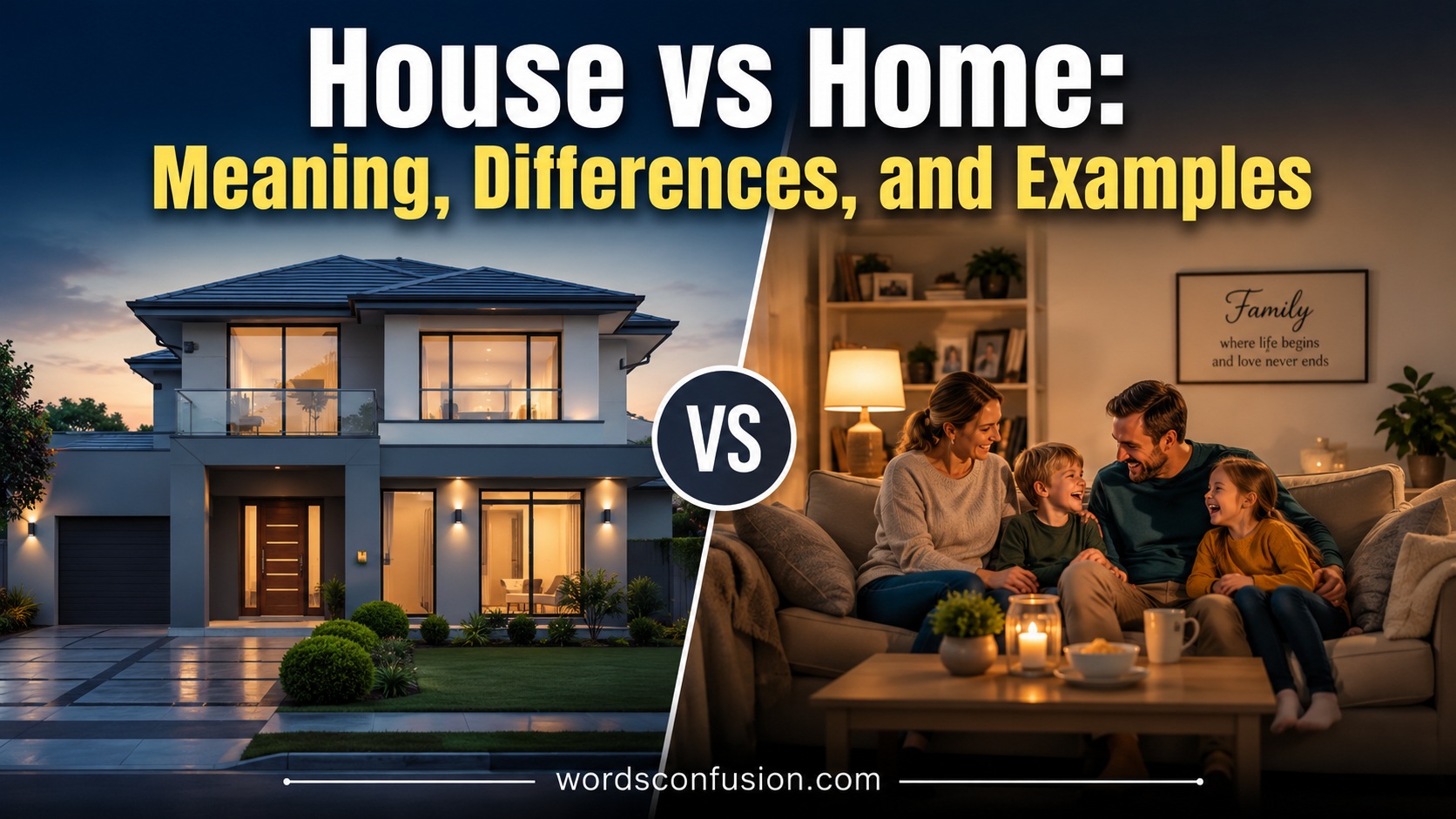
Many English learners assume that house and home mean the same thing. While they are closely related, they are not interchangeable in every situation. A house is a physical building where people live, while a home is a place where someone feels comfortable, safe, and emotionally connected. In other words, every home can be a house, apartment, or another type of residence, but not every house becomes a home.
Understanding the difference between house vs home helps you choose the right word in conversations, writing, exams, and professional communication. For example, a real estate agent usually sells a house, but a family creates a home through memories, relationships, and everyday life.
This guide explains the meanings, differences, examples, common mistakes, collocations, idioms, and practical usage of both words in simple language. By the end, you’ll know exactly when to use house and when home is the better choice.
Quick Answer
The main difference between house and home is simple:
- A house is a physical building where people live.
- A home is a place where someone feels love, comfort, belonging, and security.
For example:
- We bought a new house last month.
- It finally feels like home.
A house can be empty, rented, or for sale. A home is about the people, memories, and feelings connected to a place rather than the building itself.
What Is a House?
Definition of House
A house is a building designed for people to live in. It usually includes rooms such as bedrooms, bathrooms, a kitchen, and a living room. The word refers to the physical structure, not the emotional connection people have with it.
Whether someone owns it or rents it doesn’t change the meaning. If it is a residential building, it is a house.
Key Features of a House
- It is a physical building.
- It provides shelter.
- It has walls, doors, windows, and a roof.
- It can be bought, sold, rented, or renovated.
- It does not automatically have emotional value.
Examples of “House” in Sentences
- They built a beautiful house near the lake.
- The old house needs a new roof.
- We painted our house last summer.
- Every house on the street has a large garden.
- The fire damaged several houses.
What Is a Home?
Definition of Home
A home is the place where a person feels they belong. It may be a house, apartment, cottage, mobile home, or any other living space. Unlike house, home focuses on comfort, relationships, memories, and emotional attachment.
A home is more than bricks and concrete. It represents the people and experiences that make a place meaningful.
Key Features of a Home
- It provides emotional comfort.
- It creates a sense of belonging.
- It is associated with family and memories.
- It can be any type of residence.
- It reflects personal identity and lifestyle.
Examples of “Home” in Sentences
- After traveling for weeks, she was happy to return home.
- This apartment feels like home.
- Home is where people feel accepted.
- Nothing compares to being home after a long day.
- They turned an old cabin into a warm home.
House vs Home: The Key Difference
Although these words are related, they describe different ideas.
| Feature | House | Home |
| Meaning | A physical building | A place of comfort and belonging |
| Focus | Structure | Feelings and relationships |
| Purpose | Shelter | Emotional connection |
| Ownership | Can be owned or rented | Can also be owned or rented |
| Emotional Value | Not required | Essential |
| Physical Building | Yes | Not necessarily |
| Used in Real Estate | Very common | Less common |
| Examples | Buy a house | Go home |
The easiest way to remember the difference is this:
A house is built with materials. A home is built with memories.
House vs Home in Simple Words
Think of it this way.
Imagine two identical houses standing side by side.
One is empty because nobody lives there.
The other is filled with family photos, laughter, celebrations, and everyday life.
Both are houses.
Only one truly feels like home.
This simple example explains why English has two different words.
When to Use “House”
Use house whenever you are talking about the building itself.
Common Situations
- Buying or selling property
- Construction projects
- Home inspections
- Renovations
- Real estate listings
- Insurance documents
- Property taxes
Example Sentences
- We bought a new house downtown.
- Their house has four bedrooms.
- The house needs fresh paint.
- They sold their old house quickly.
- Every house on the block looks different.
Common Collocations
- House prices
- House market
- House keys
- House renovation
- House inspection
- House payment
- House insurance
- Housewarming party
When to Use “Home”
Use home whenever the focus is on people, comfort, family, or where someone belongs.
Common Situations
- Talking about family
- Returning after work
- Expressing emotions
- Describing comfort
- Speaking about memories
- Daily conversations
Example Sentences
- Welcome home.
- I stayed home today.
- This place feels like home.
- She misses home while studying abroad.
- Home is my favorite place.
Common Collocations
- Home address
- Home cooking
- Home office
- Home country
- Home life
- Home sweet home
- Home environment
- Home improvement
House vs Home in Real-Life Examples
Real-life situations make the difference much easier to understand.
Buying Real Estate
A real estate agent sells houses, not homes. The listing describes square footage, bedrooms, bathrooms, and location because buyers are purchasing a building.
Example:
“We bought a three-bedroom house in Texas.”
Family and Relationships
Once people move in, celebrate birthdays, decorate rooms, and build memories, that same building becomes a home.
Example:
“Our children grew up in this home.”
Moving to a New Place
During the first few weeks, you may live in a new house. Over time, as you become familiar with the neighborhood and create routines, it starts feeling like home.
Legal and Official Documents
Legal documents usually use the word residence, property, or house because they refer to physical locations rather than emotions.
For example:
- House insurance
- House deed
- Residential property
- House inspection report
House vs Home in American and British English
Both American English and British English use house and home in almost the same way.
There are no significant differences in meaning.
However, some expressions are more common in certain regions.
American English
- Homeowner
- Home loan
- Home improvement
- Open house
British English
- Council house
- Home counties
- Housing estate
Despite these regional expressions, the core meanings remain the same.
House vs Home in Idioms and Everyday Expressions
English contains many expressions that use these words naturally.
Common Idioms with “House”
| Idiom | Meaning |
| Get your house in order | Organize your life |
| On the house | Free of charge |
| Bring the house down | Receive huge applause |
| House of cards | A weak or unstable situation |
Common Idioms with “Home”
| Idiom | Meaning |
| Home sweet home | Happiness of returning home |
| Home away from home | A place that feels comfortable |
| Hit home | Affect someone deeply |
| Make yourself at home | Feel comfortable |
Learning these expressions helps you sound more natural in English.
Read More: Job vs Work: Meaning, Differences, and Examples
House vs Home in Literature and Popular Culture
Many writers deliberately choose home instead of house because it carries emotional weight.
For example, novels often describe characters searching for a home, not simply a house. The word suggests identity, belonging, safety, and emotional healing.
One well-known saying captures the idea perfectly:
“Home is where the heart is.”
This quote reminds readers that love and connection matter more than the building itself.
Movies and songs also use home to express comfort, family, hope, and personal identity.
Common Mistakes People Make
Many English learners confuse these words because some languages use only one word for both meanings.
Using “House” Instead of “Home”
Incorrect:
- I can’t wait to go to my house after work.
Natural:
- I can’t wait to go home after work.
Using “Home” Instead of “House”
Incorrect:
- They built a new home with five bedrooms.
This sentence isn’t technically wrong because people often market new properties as “homes.” However, if you are discussing construction, architecture, or real estate, house is usually more precise.
Better:
- They built a new house with five bedrooms.
How to Avoid These Mistakes
Ask yourself one question.
Am I talking about the building or the feeling?
- Building = House
- Feeling = Home
That simple question solves most confusion.
Memory Trick to Remember the Difference
Here’s an easy trick you can remember.
House = Hardware
Both refer to something physical.
Home = Heart
Both relate to feelings, comfort, and belonging.
This memory trick makes choosing the correct word much easier.
Practice Sentences
Choose the correct word.
- We just bought a new ______.
- I can’t wait to go ______ after work.
- Their ______ has a beautiful swimming pool.
- My grandparents’ farm has always felt like ______.
- The old ______ needs a new roof.
Answer Key
- House
- Home
- House
- Home
- House
Synonyms and Related Words
| House | Home |
| Residence | Dwelling |
| Property | Residence |
| Building | Household |
| Cottage | Family home |
| Bungalow | Living place |
| Villa | Place of belonging |
Remember that these words are related, but they may not always work as exact substitutes.
FAQs:
Is every house a home?
No. A house is simply a building. It becomes a home when people create emotional connections, memories, and a sense of belonging.
Can an apartment be called a home?
Yes. A home can be any place where someone feels comfortable and connected, including an apartment, condo, cabin, or mobile home.
Why do people say “go home” instead of “go to my house”?
English speakers use go home because they are referring to the place where they belong rather than emphasizing the building.
Is “home” always an emotional word?
Most of the time, yes. Although home can also describe a physical residence, it almost always carries a sense of comfort, familiarity, or personal connection.
Which word should I use in formal writing?
Use house when discussing buildings, construction, architecture, or real estate. Use home when discussing families, communities, living experiences, or emotional attachment.
Conclusion:
Understanding house vs home is easier once you focus on the purpose of each word. A house refers to the physical structure where people live. It is something you can buy, sell, rent, build, or renovate. A home, on the other hand, represents comfort, security, relationships, and belonging. It reflects the emotional bond people create with a place.
Whenever you’re unsure which word to choose, ask yourself one simple question: Are you describing the building or the feeling? If you’re talking about the structure, use house. If you’re talking about comfort, family, or emotional connection, use home. Mastering this distinction will make your English sound more natural, accurate, and confident in both everyday conversations and formal writing.

Andrew Wilson is an experienced language researcher and content writer specializing in WordsConfusion topics. He helps readers understand commonly confused English words, spelling differences, grammar rules, word meanings, and proper usage through clear explanations, practical examples, and easy-to-follow language guides. His goal is to make English learning simple, accurate, and accessible for students, writers, professionals, and everyday learners.