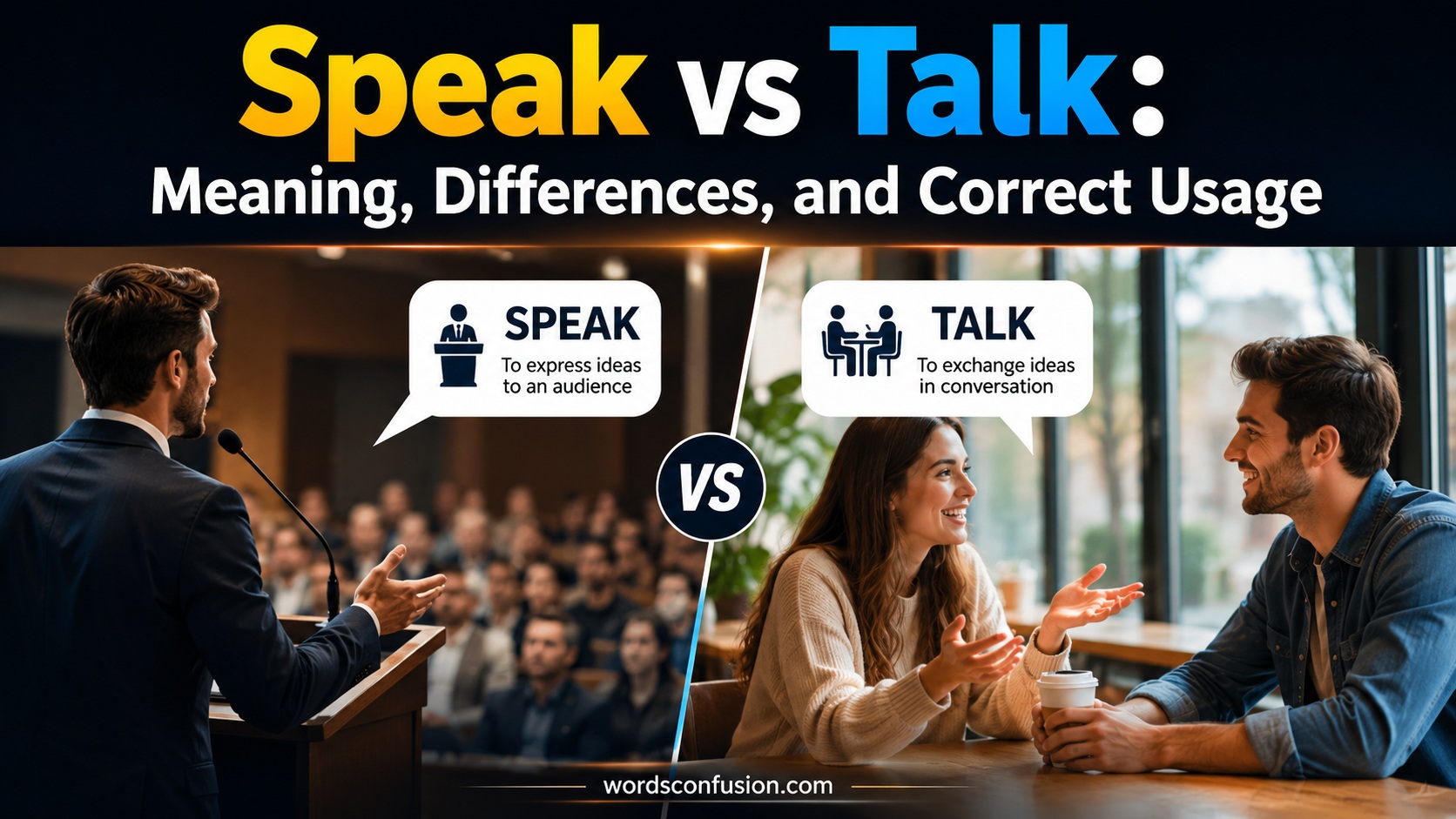
Many English learners assume speak and talk mean exactly the same thing. While both verbs describe communication, they are not always interchangeable. The difference often depends on the situation, the level of formality, the purpose of the conversation, and the relationship between the people involved.
For example, you would naturally say, “I need to speak with the manager,” instead of “I need to talk with the manager” in a formal setting. On the other hand, “Let’s talk after dinner” sounds much more natural than “Let’s speak after dinner” when chatting with friends.
Understanding the difference between speak vs talk will help you sound more fluent, choose the right word in different situations, and avoid common mistakes made by English learners.
Quick Answer
The main difference between speak and talk is formality and communication style.
- Speak is usually more formal and often focuses on the act of saying words or using a language.
- Talk is generally less formal and emphasizes a conversation or exchange of ideas between people.
For example:
- She speaks three languages.
- Can we talk about your project?
- The CEO spoke at the conference.
- My friends talked for hours.
Although both words can sometimes replace each other, choosing the correct one makes your English sound much more natural.
Speak vs Talk at a Glance
| Feature | Speak | Talk |
| Meaning | To say words or use a language | To have a conversation |
| Formality | More formal | More informal |
| Communication | Can be one-way | Usually two-way |
| Common Situations | Speeches, presentations, interviews | Conversations, discussions, chats |
| Language Ability | Yes | Rarely |
| Public Speaking | Common | Less common |
| Everyday Conversation | Sometimes | Very common |
| Example | She spoke confidently. | We talked all evening. |
What Does “Speak” Mean?
Definition
Speak means to produce spoken words, communicate verbally, or use a particular language. It often refers to the act of expressing ideas rather than having a full conversation.
It is commonly used in formal, professional, and academic situations.
When to Use “Speak”
Use speak when referring to:
- Speaking a language
- Giving a speech
- Addressing an audience
- Speaking politely
- Formal communication
- Telephone conversations in formal contexts
Examples:
- She speaks English and Spanish.
- The professor spoke about climate change.
- May I speak with the manager?
- Please speak clearly.
Common Examples
- He speaks very softly.
- They spoke honestly during the meeting.
- She spoke with confidence.
- The lawyer spoke on behalf of the client.
- Our teacher speaks slowly.
What Does “Talk” Mean?
Definition
Talk means to have a conversation or exchange thoughts, ideas, or feelings with another person.
Unlike speak, talk almost always suggests interaction between two or more people.
When to Use “Talk”
Use talk when discussing:
- Casual conversations
- Friendly discussions
- Family conversations
- Everyday communication
- Sharing opinions
- Long discussions
Examples:
- We talked for hours.
- Let’s talk tomorrow.
- They talked about their vacation.
- Can we talk privately?
Common Examples
- I talked with my brother.
- We talked about sports.
- They talked during lunch.
- She talked too loudly.
- We need to talk.
Speak vs Talk: The Main Difference
Although both words describe verbal communication, they are used differently depending on the context.
| Situation | Speak | Talk |
| Formal meetings | Yes | Sometimes |
| Friendly conversation | Less common | Yes |
| Giving speeches | Yes | No |
| Speaking a language | Yes | No |
| Two-way discussion | Sometimes | Yes |
| Casual chat | Rarely | Yes |
Formal vs Informal Communication
One of the biggest differences is formality.
Speak sounds more professional.
Examples:
- I’d like to speak with the director.
- The ambassador spoke at the ceremony.
Talk sounds relaxed and conversational.
Examples:
- Let’s talk later.
- We talked after work.
One-Way vs Two-Way Communication
Speak may involve one person addressing many people.
Examples:
- The president spoke to the nation.
- The teacher spoke for twenty minutes.
Talk usually involves interaction.
Examples:
- We talked about our future.
- They talked until midnight.
Purpose of Communication
Use speak when emphasizing the act of communicating.
Use talk when emphasizing the conversation itself.
Compare these examples:
- She spoke confidently during the interview.
- She talked with the interviewer after the interview.
Tone and Context
Context changes which word sounds natural.
Formal:
- Speak with your supervisor.
Informal:
- Talk with your friends.
Choosing the right word makes your English sound more natural to native speakers.
Speak vs Talk in Different Situations
Everyday Conversations
In daily life, talk is much more common.
Examples:
- Let’s talk after class.
- We talked all evening.
Business and Professional Communication
Professional settings often favor speak.
Examples:
- I’d like to speak with the HR manager.
- The CEO spoke during the conference.
Public Speaking
Whenever someone addresses an audience, speak is the correct choice.
Examples:
- She spoke at the graduation ceremony.
- He spoke for thirty minutes.
Using talk here sounds less natural unless referring to an informal presentation.
Phone Calls
Both words are possible.
Formal:
- May I speak to Mr. Johnson?
Casual:
- Can I talk to Sarah?
Language Ability
Only speak is normally used when discussing languages.
Correct:
- She speaks French.
- He speaks Arabic.
Incorrect:
- She talks French.
Serious Discussions
Both verbs work, although they emphasize different ideas.
- We need to talk about your grades.
- I’d like to speak with you regarding your performance.
The first sounds personal.
The second sounds professional.
Casual Chats
Use talk.
Examples:
- We talked over coffee.
- They talked after dinner.
- We talked all night.
Common Phrases with “Speak”
These expressions appear frequently in spoken and written English.
| Phrase | Meaning |
| Speak clearly | Pronounce words well |
| Speak English | Use the English language |
| Speak your mind | Express your opinion honestly |
| Speak highly of | Praise someone |
| Speak publicly | Address an audience |
| Speak softly | Use a quiet voice |
| Speak up | Talk louder |
Example Sentences
- Please speak clearly.
- Always speak your mind respectfully.
- Everyone speaks highly of her work.
- He spoke publicly about education.
Common Phrases with “Talk”
These expressions are common in everyday English.
| Phrase | Meaning |
| Talk about | Discuss something |
| Talk to | Communicate with someone |
| Talk with | Have a conversation |
| Small talk | Casual conversation |
| Talk through | Solve by discussing |
| Talk back | Reply disrespectfully |
| Talk someone into | Persuade someone |
Example Sentences
- Let’s talk about your plans.
- We talked through every problem.
- She talked him into applying.
- They enjoyed small talk before dinner.
Speak vs Talk in Grammar
Verb Forms
| Base Form | Past Tense | Past Participle | Present Participle |
| Speak | Spoke | Spoken | Speaking |
| Talk | Talked | Talked | Talking |
Transitive and Intransitive Uses
Both verbs usually work without a direct object.
Examples:
- She spoke.
- They talked.
They can also take prepositional phrases.
Examples:
- Speak to the audience.
- Talk with your parents.
Common Sentence Patterns
Speak
- Speak to someone
- Speak with someone
- Speak about something
- Speak on a topic
Talk
- Talk to someone
- Talk with someone
- Talk about something
- Talk over an issue
Speak To vs Speak With
Difference in Meaning
Both expressions are correct.
Speak to often suggests one person giving information.
Speak with emphasizes a conversation between two people.
Examples:
- I need to speak to the receptionist.
- I’d like to speak with you about the proposal.
In modern American English, both are widely accepted.
When Each Sounds More Natural
Use speak to for instructions or announcements.
Use speak with for collaborative discussions.
Talk To vs Talk With
Difference in Meaning
The difference is small.
Talk to can sometimes imply one-way communication.
Talk with sounds slightly more cooperative.
Examples:
- I talked to my doctor.
- I talked with my classmates.
Most native speakers use them interchangeably.
Regional Preferences
American English uses both forms regularly.
British English also accepts both, although personal preference often determines which one speakers choose.
Read More: House vs Home: Meaning, Differences, and Examples
Can “Speak” and “Talk” Be Used Interchangeably?
Sometimes.
Examples:
- I need to speak with you.
- I need to talk with you.
Both are correct.
However, they are not always interchangeable.
Correct:
- She speaks Japanese.
- He spoke at the conference.
Incorrect:
- She talks Japanese.
- He talked at the conference. (unless referring to an informal presentation)
Common Mistakes to Avoid
- Saying talk English instead of speak English
- Using talk for formal speeches
- Using speak when describing casual conversations between friends
Speak vs Talk in American and British English
Both American and British English recognize the same basic distinction.
American English tends to use talk more often in casual situations.
British English follows similar patterns, although formal writing may favor speak slightly more often.
Examples from both varieties include:
- Speak to the manager.
- Talk to your neighbor.
- Speak clearly.
- Talk about your ideas.
The meanings remain consistent across both dialects.
Real-Life Example Sentences
Examples Using “Speak”
- She speaks four languages fluently.
- The principal spoke during the ceremony.
- Please speak louder.
- I spoke with my lawyer yesterday.
- He spoke honestly about the problem.
Examples Using “Talk”
- We talked until midnight.
- Can we talk after class?
- They talked about their future.
- I talked with my grandmother yesterday.
- Let’s talk over lunch.
Common Mistakes English Learners Make
Many learners confuse these two verbs because both translate into the same word in many languages.
Here are some of the most common errors.
| Incorrect | Correct |
| I talk English. | I speak English. |
| He talked at the conference. | He spoke at the conference. |
| We spoke for hours about movies. | We talked for hours about movies. |
| Talk clearly. | Speak clearly. |
| They talked a speech. | They gave a speech. |
Tips to Remember
- Speak = formal communication or language ability.
- Talk = conversation and discussion.
- Speak often focuses on the speaker.
- Talk focuses on interaction.
Memory Trick to Remember the Difference
A simple way to remember speak vs talk is this:
- Speak starts with “S,” which can remind you of “Speech” and “Serious.”
- Talk starts with “T,” which can remind you of “Two people talking together.”
This isn’t a grammar rule, but it works as a quick memory aid.
FAQs:
Is it better to say speak or talk?
Neither is better. Choose speak for formal situations or language ability, and use talk for casual conversations.
What is the difference between speak and talk?
Speak focuses on the act of speaking or using a language, while talk emphasizes a conversation or exchange of ideas.
Can I say speak with instead of talk with?
Yes. Both expressions are grammatically correct, although speak with usually sounds slightly more formal.
Do native English speakers use talk more than speak?
Yes. In everyday conversations, native speakers generally use talk more often because it sounds natural and informal.
Can speak and talk always replace each other?
No. They overlap in many situations, but only speak is correct when discussing languages or formal speeches.
Is speak more formal than talk?
Yes. Speak usually sounds more formal, while talk feels relaxed and conversational.
Conclusion:
Understanding the difference between speak vs talk is easier once you focus on the context rather than the dictionary definition. Although both verbs involve verbal communication, speak generally fits formal situations, public speaking, and language ability. Talk, on the other hand, works best for everyday conversations, discussions, and friendly exchanges.
If you’re unsure which word to use, ask yourself one simple question: Is this a formal act of communication or a casual conversation? If it’s formal, choose speak. If it’s an informal discussion, talk will usually sound more natural.

Andrew Wilson is an experienced language researcher and content writer specializing in WordsConfusion topics. He helps readers understand commonly confused English words, spelling differences, grammar rules, word meanings, and proper usage through clear explanations, practical examples, and easy-to-follow language guides. His goal is to make English learning simple, accurate, and accessible for students, writers, professionals, and everyday learners.