
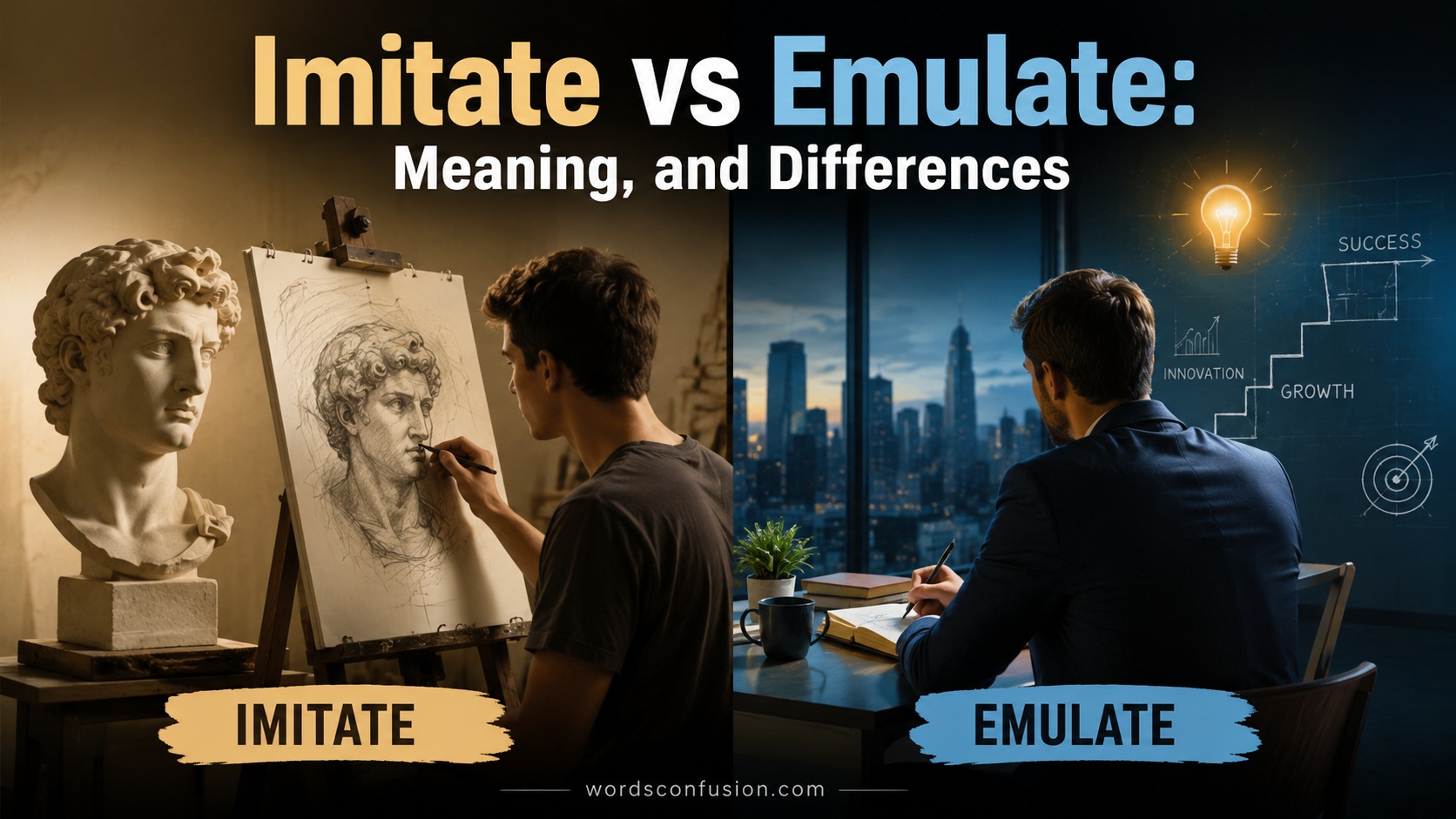
Imitate vs emulate can confuse even experienced English speakers because both words involve copying or following someone or something. However, they don’t mean exactly the same thing.
If you imitate someone, you copy their actions, voice, appearance, behavior, or style. If you emulate someone, you usually admire their qualities or achievements and try to reach the same level—or even surpass it.
Think of it this way: imitation copies the performance while emulation pursues the standard behind the performance.
For example, a child might imitate a famous athlete’s movements. A young athlete might emulate that athlete’s discipline, training habits, and success.
That small difference matters. Choosing the wrong word can make your sentence sound unclear or change its intended meaning.
Quick Answer: Imitate vs Emulate
Imitate means to copy someone or something. It can involve copying a voice, action, appearance, behavior, style, or technique.
Emulate means to try to match or surpass someone or something that serves as a model. It often involves admiration, ambition, or the desire to achieve a similar result.
| Word | Meaning | Main Focus | Example |
| Imitate | To copy or reproduce | Actions, sounds, appearance, behavior, or style | “The comedian imitated the actor’s voice.” |
| Emulate | To try to equal or surpass | Qualities, achievements, methods, or performance | “She hopes to emulate her mentor’s success.” |
The easiest rule to remember
Imitate the action. Emulate the achievement.
This rule won’t cover every technical use of the words. However, it works remarkably well in everyday English.
What Does Imitate Mean?
Imitate means to copy or reproduce the behavior, appearance, sound, actions, style, or manner of someone or something.
When you imitate something, you focus on reproducing what you observe. The goal might involve learning, entertainment, mockery, admiration, or even deception.
Examples of imitate in everyday English
- “The child imitated his father’s walk.”
- “The parrot imitated the sound of a telephone.”
- “The comedian imitated the politician’s voice.”
- “The student imitated the artist’s technique.”
- “The robot imitates the movement of a human arm.”
In each example, the subject copies something observable.
A child doesn’t necessarily want to become like the father. The parrot doesn’t admire the telephone. The comedian may not even respect the politician. Imitation simply describes the act of copying.
Imitate can describe learning
Imitation often plays an important role in learning.
A beginner watches an expert perform a skill. Then the beginner tries to reproduce the same movement. This process can involve imitation.
For example:
A new guitarist may imitate the hand position of an experienced musician.
The guitarist copies the technique to learn it. Later, the guitarist may develop an individual style.
This distinction shows that imitation isn’t automatically negative. In fact, many skills begin with careful observation and imitation.
Imitate can describe speech and sounds
People often use imitate when someone copies a voice, accent, sound, or speaking style.
Examples include:
- “The actor imitated a British accent.”
- “The comedian imitated the singer’s voice.”
- “The child imitated the sound of a siren.”
- “The bird imitated human speech.”
Here, imitate works better than emulate because the focus rests on reproducing a sound or manner of speaking.
Imitate can have a negative meaning
Context determines the tone.
Consider these examples:
- “The student imitated the teacher’s pronunciation to practice.”
- “The student imitated the teacher to make fun of him.”
The same verb appears in both sentences. The surrounding context changes the meaning.
Imitate can describe:
- Learning
- Practice
- Entertainment
- Mimicry
- Mockery
- Copying
- Counterfeiting
For example, an imitation product attempts to look like an original product. In that context, imitation may suggest that the copy lacks the authenticity or quality of the original.
What Does Emulate Mean?
Emulate means to try to equal or surpass someone or something that serves as a model.
Unlike simple imitation, emulation often involves ambition. You don’t merely copy what someone does. You try to reach a similar level of excellence, success, quality, or performance.
Examples of emulate in everyday English
- “She hopes to emulate her mother’s courage.”
- “The young athlete wants to emulate the champion.”
- “The company tried to emulate its competitor’s success.”
- “He emulates his mentor’s leadership style.”
- “The team hopes to emulate last year’s performance.”
In these examples, the focus goes beyond copying a visible action.
A young athlete might not copy every movement of a champion. Instead, the athlete may try to develop the champion’s discipline, focus, training habits, and competitive success.
That is emulation.
Emulate often involves admiration
In ordinary usage, people generally emulate someone they respect or admire.
For example:
“The young scientist hopes to emulate her mentor.”
This sentence suggests more than copying the mentor’s gestures. It suggests that the young scientist wants to achieve a similar level of knowledge, influence, or professional success.
The word often carries an aspirational quality.
You imitate what you see. You emulate what you admire.
That isn’t an absolute rule. However, it provides a useful distinction in most everyday situations.
Imitate vs Emulate: The Main Difference
The clearest difference between imitate and emulate involves the purpose behind the action.
Imitate means “copy”
When you imitate something, you reproduce it in some way.
“The actor imitated the comedian’s voice.”
The actor copies the sound or speaking style.
Emulate means “strive to match or surpass”
When you emulate someone, you try to achieve a similar standard.
“The young actor hopes to emulate the comedian’s career.”
The young actor wants to achieve a similar level of success.
The difference in one table
| Question | Imitate | Emulate |
| Does it involve copying? | Usually | Sometimes, but not necessarily |
| Does admiration matter? | No | Often |
| Does it focus on behavior or appearance? | Frequently | Sometimes |
| Does it involve ambition? | Not necessarily | Usually |
| Can it mean matching success? | Rarely | Yes |
| Can it mean surpassing a model? | No | Yes |
Imagine watching a professional basketball player.
If you copy the player’s jump shot, you imitate the player.
If you study the player’s discipline, practice routine, mindset, and career achievements because you want to reach a similar level, you emulate the player.
The first action copies a technique. The second pursues excellence.
Imitate vs Emulate Examples
The best way to understand the difference is to place the words side by side.
| Situation | Imitate | Emulate |
| Voice | “He imitated her accent.” | “He emulated her confidence as a speaker.” |
| Sports | “The child imitated the athlete’s movements.” | “The athlete emulated the champion’s discipline.” |
| School | “The student imitated the teacher’s handwriting.” | “The student emulated the teacher’s dedication.” |
| Business | “The company imitated the competitor’s logo.” | “The company emulated the competitor’s business strategy.” |
| Leadership | “He imitated his manager’s gestures.” | “He emulated his manager’s leadership skills.” |
| Writing | “The writer imitated the author’s style.” | “The writer emulated the author’s creativity.” |
| Technology | “The robot imitated human movement.” | “The software emulated an older computer system.” |
Notice the pattern.
Imitate often describes something you can observe directly. Emulate often describes a quality, achievement, strategy, or function that you want to reproduce or reach.
Imitate vs Emulate in Education and Learning
Education provides one of the clearest examples of the difference.
A student may imitate a teacher’s method. The student may copy the teacher’s note-taking style, pronunciation, handwriting, or problem-solving steps.
However, the student may emulate the teacher’s patience, knowledge, discipline, and dedication to students.
Example
“The student imitated the teacher’s method of solving the equation.”
The student copied the process.
“The student emulated the teacher’s dedication to mathematics.”
The student tried to develop a similar quality.
This distinction reveals an important learning principle: imitation often starts the learning process while emulation can shape long-term ambition.
A beginner might first imitate an expert. With time, that beginner may begin to emulate the expert’s deeper habits and standards.
Imitate vs Emulate in Business
Businesses use both words in different ways.
A company might imitate a competitor by copying a product feature, advertisement, website design, or packaging style.
However, a company might emulate a successful competitor by studying the principles behind its success.
For example:
A company may imitate a competitor’s loyalty program.
That means it creates something similar.
A company may emulate the competitor’s customer-service standards.
That means it tries to achieve a similar level of performance.
Imitation versus emulation in business strategy
| Business action | Best word |
| Copying a logo design | Imitate |
| Copying a marketing slogan | Imitate |
| Following a successful business model | Emulate |
| Adopting strong leadership practices | Emulate |
| Reproducing a product’s appearance | Imitate |
| Trying to match a company’s success | Emulate |
A useful business lesson emerges here: imitation copies the surface while emulation often studies the engine underneath.
Imitate vs Emulate in Sports
Sports make the difference especially easy to see.
A young soccer player might imitate a professional player’s famous dribbling technique. The player watches the movement and tries to reproduce it.
However, the young athlete might emulate the professional’s:
- Work ethic
- Discipline
- Training habits
- Mental toughness
- Competitive mindset
- Long-term commitment
Example
“The young runner imitated the champion’s starting technique.”
The runner copied a physical action.
“The young runner emulated the champion’s dedication.”
The runner tried to develop a similar quality.
This distinction matters because copying a technique alone doesn’t guarantee success. Emulation goes deeper.
Read More: Fewer vs. Less: Meaning, Difference, and Rules
Imitate vs Emulate in Technology
Technology adds an important specialized meaning to emulate.
What does emulate mean in technology?
In computing, one system emulates another when it reproduces the original system’s functions closely enough to behave like it.
For example, software can emulate:
- An older gaming console
- A computer processor
- A hardware environment
- An operating system
- Another device’s functions
A video game emulator, for example, allows modern hardware to reproduce the behavior of an older gaming system.
How imitate differs from emulate in technology
Imitate generally means copying behavior or appearance.
Emulate often means reproducing functionality.
Compare these examples:
“The robot imitates the movement of a human hand.”
The robot copies the movement.
“The software emulates an older computer system.”
The software reproduces the system’s functions.
The second sentence describes a deeper technical relationship. The software doesn’t merely look like the older computer. It attempts to behave like it in meaningful ways.
Imitate vs Emulate: Synonyms
The words have several related synonyms. However, these alternatives don’t always carry exactly the same meaning.
Synonyms for imitate
Depending on context, you might use:
- Copy
- Mimic
- Mirror
- Reproduce
- Replicate
- Echo
- Model
- Parrot
- Simulate
For example:
- “The child copied his brother.”
- “The comedian mimicked the politician.”
- “The machine replicated the process.”
Each word creates a slightly different shade of meaning.
Synonyms for emulate
Common alternatives include:
- Aspire to
- Follow
- Model
- Match
- Equal
- Surpass
- Rival
For example:
“She hopes to emulate her mentor.”
You could also say:
“She aspires to reach her mentor’s level.”
The meaning remains similar. However, emulate neatly combines the ideas of admiration, imitation, and ambition.
Imitate vs Mimic vs Simulate vs Emulate
These four words often appear in the same discussions.
| Word | Main Meaning | Example |
| Imitate | Copy someone or something | “The child imitated the dancer.” |
| Mimic | Copy behavior, speech, or appearance closely | “The comedian mimicked the actor.” |
| Simulate | Reproduce the behavior of a real situation or system | “The program simulates flight conditions.” |
| Emulate | Try to match or surpass a model or reproduce system functions | “She emulates her mentor’s success.” |
Imitate vs mimic
Mimic often emphasizes close copying.
A person may mimic someone’s accent, facial expressions, or gestures.
Imitate has a broader meaning and can include copying techniques, styles, systems, or behaviors.
Imitate vs simulate
Simulate often involves creating a model of something real.
A flight simulator doesn’t simply imitate an airplane’s appearance. It simulates the conditions and responses involved in flying.
Emulate vs mimic
Mimic focuses on reproduction.
Emulate often focuses on reaching a similar standard or reproducing functionality.
That difference makes emulate more aspirational in everyday language.
FAQs:
Is imitate the same as emulate?
No. The words overlap but they aren’t identical. Imitate usually means to copy someone or something. Emulate often means to try to match or surpass an admired person, achievement, quality, or standard.
Is it better to say imitate or emulate?
Neither word is automatically better. The correct choice depends on your meaning. Use imitate for direct copying. Use emulate when you mean pursuing similar qualities, achievements, or performance.
Can you emulate a person?
Yes. You can emulate someone’s qualities, methods, behavior, achievements, or standards.
For example:
“She emulates her grandmother’s resilience.”
This means she tries to develop similar resilience.
Can you imitate a person?
Yes. You can imitate someone’s:
- Voice
- Accent
- Gestures
- Mannerisms
- Appearance
- Actions
- Style
For example:
“The actor imitated the politician’s mannerisms.”
Is emulate always positive?
In ordinary English, emulate usually has a positive or aspirational tone. However, its technical use can simply mean reproducing the behavior or functions of another system.
What is the difference between imitate and emulate in technology?
Imitate generally means copying behavior or appearance. Emulate often means reproducing the functions of another system.
For example, software can emulate an older gaming console.
What is the correct spelling: imitate or immitate?
Imitate is correct.
Immitate is a misspelling.
Conclusion:
The difference between imitate and emulate becomes much easier once you focus on the purpose behind the action. Imitate means to copy. You might imitate someone’s voice, movement, appearance, behavior, or style.
Emulate usually means to follow an admired model and try to reach a similar level of quality, success, or achievement. In technology, it can also mean reproducing another system’s functions.

Andrew Wilson is an experienced language researcher and content writer specializing in WordsConfusion topics. He helps readers understand commonly confused English words, spelling differences, grammar rules, word meanings, and proper usage through clear explanations, practical examples, and easy-to-follow language guides. His goal is to make English learning simple, accurate, and accessible for students, writers, professionals, and everyday learners.