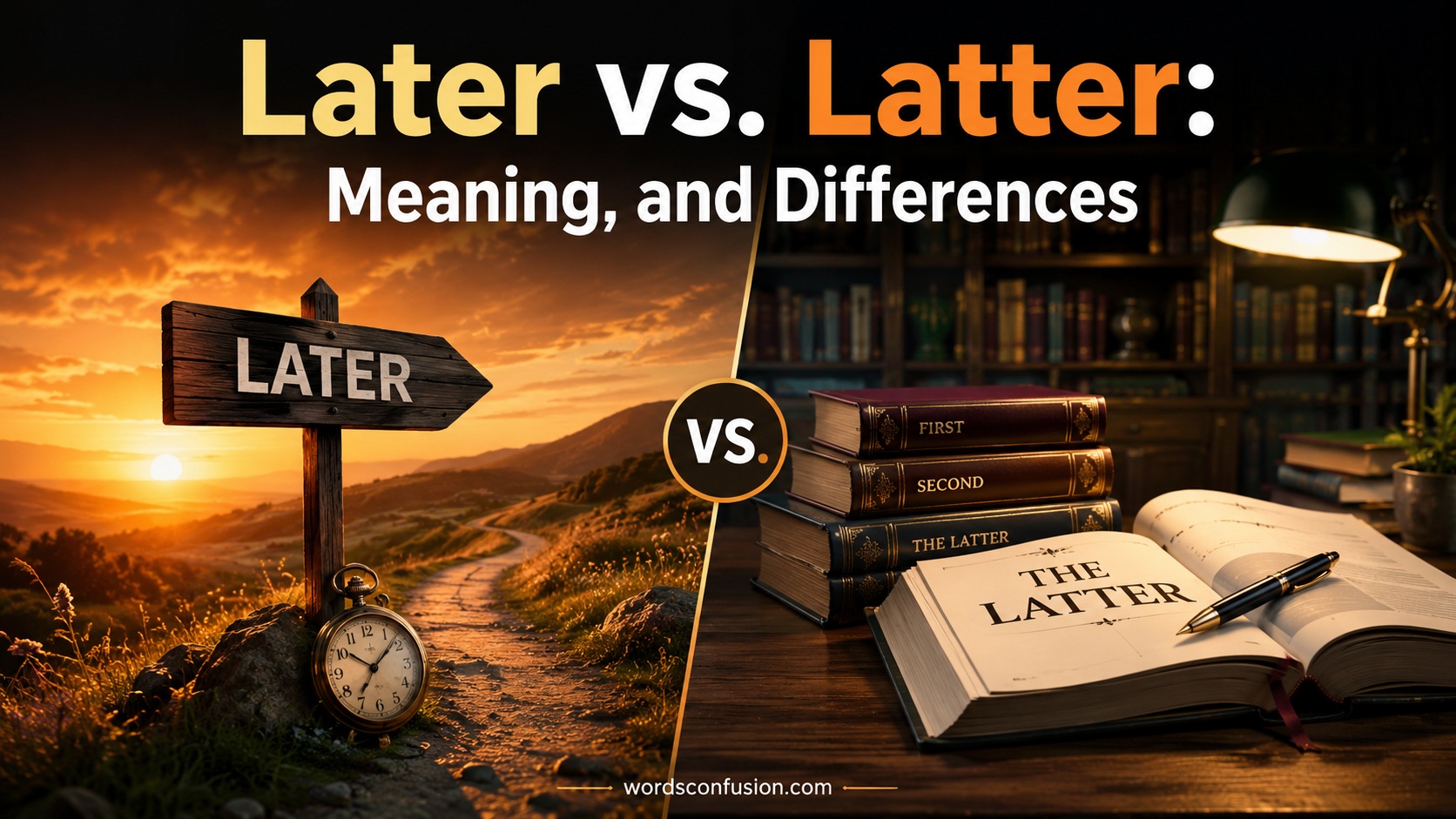
Later vs. latter is a classic word pair that confuses many English learners and even native speakers. The two words look almost identical, sound similar, and share several letters. However, they don’t mean the same thing.
The simplest distinction is this: later relates to time, while latter refers to the second of two people or things already mentioned.
For example:
- I’ll call you later. → This sentence refers to time.
- Between tea and coffee, I prefer the latter. → This sentence refers to the second of two choices.
One small letter can change the meaning entirely. Use the wrong word and your sentence may sound awkward or even mean something completely different. Fortunately, once you understand the basic pattern, later vs. latter becomes much easier to remember.
Quick Answer: Later vs. Latter
Later means at a time after now or after another time.
I’ll finish my homework later.
Latter means the second of two people or things previously mentioned.
Between summer and winter, I prefer the latter.
The easiest way to remember the difference
| Word | Meaning | Simple Question |
| Later | At a subsequent time | When? |
| Latter | The second of two things | Which one of two? |
Later = time.
Latter = the second of two.
If you’re talking about something happening afterward, choose later. If you’re choosing between two previously mentioned things and mean the second one, choose latter.
What Does “Later” Mean?
Later refers to a time that comes after another time. That time could be in the future or after a specific event in the past.
Consider this sentence:
I’ll call you later.
The speaker doesn’t identify the exact time. The call will simply happen after now.
Likewise:
She arrived later than expected.
Here, later means after the expected time.
The word can describe time in several ways. It can refer to something happening after the present moment, after another event, or at a subsequent stage in a process.
Later as an adverb
As an adverb, later modifies a verb and explains when something happens.
Examples:
- I’ll speak to you later.
- We can discuss the issue later.
- He arrived later than his friends.
- She called me later that evening.
- The truth emerged later.
In each example, later answers the question “When?”
That’s the key. When a word describes a point in time that comes afterward, later usually fits.
Later can refer to the future
You can use later to talk about a future time without giving a precise schedule.
I’ll clean my room later.
This doesn’t necessarily mean tonight or tomorrow. The exact time depends on the context.
You can also add a specific period:
- later today
- later this evening
- later this week
- later this year
- years later
For example:
Years later, she returned to the village where she had grown up.
Here, later describes a time after an earlier event.
Later can refer to the past
A common misconception says later only refers to the future. That’s not true.
You can use later to describe something that happened after a previous event in the past.
He moved to New York in 2010. Three years later, he started his own business.
The business started after the move. Therefore, later correctly describes the sequence of events.
Other examples include:
- Later that day, the weather improved.
- Several months later, the company launched a new product.
- She learned the truth years later.
Later as a comparative form
Later can also compare two points in time.
She arrived later than I did.
This means she arrived after me.
Compare:
- He arrived early.
- She arrived later.
The word later shows that one event happened after another.
What Does “Latter” Mean?
Latter refers to the second of two people, things, ideas, or choices that you have already mentioned.
For example:
The company considered quality and price. The latter became the deciding factor.
The sentence mentions two things:
- Quality
- Price
The latter refers to price, the second item.
This is the central meaning of latter.
Latter refers to the second of two
The word works best when you mention two items in a sentence or nearby context.
Between cats and dogs, I prefer the latter.
The two choices are:
- cats
- dogs
The second choice is dogs. Therefore, latter refers to dogs.
Another example:
The manager discussed training and education. The latter received more attention.
The second item, education, is the latter.
Latter can refer to people
Although many examples involve objects or ideas, latter can also refer to people.
Sarah and Emily applied for the position. The latter was selected.
The sentence mentions Sarah first and Emily second.
Therefore:
- Sarah = the former
- Emily = the latter
This usage often appears in formal, academic, professional, and analytical writing.
Latter traditionally refers to two items
The safest rule is simple: use latter when referring to the second of two.
For example:
The two main options are renting and buying. The latter requires a larger initial investment.
Here, latter clearly refers to buying.
When a sentence contains three or more items, latter can create confusion.
For example:
The three options were renting, buying, and building. I chose the latter.
What does latter mean here? Some readers may interpret it as the last item, building. However, the traditional use of latter refers specifically to the second of two items.
For clarity, write:
The three options were renting, buying, and building. I chose the last option.
Even better:
The three options were renting, buying, and building. I chose building.
Clear writing doesn’t make readers solve a puzzle.
Later vs. Latter: The Main Difference
The difference between later and latter comes down to time versus position.
| Word | Core Meaning | Example |
| Later | At a time afterward | I’ll call you later. |
| Latter | The second of two mentioned items | I prefer the latter. |
Use “later” when talking about time
We can finish the project later.
The sentence answers:
When can we finish it?
Answer: later.
Other examples:
- I’ll see you later.
- The train arrived later than expected.
- Later that night, the lights went out.
- The problem appeared later in the process.
Use “latter” when referring to the second of two
The course covers grammar and vocabulary. The latter section contains more exercises.
The sentence answers:
Which of the two?
Answer: vocabulary.
Other examples:
- Between coffee and tea, I prefer the latter.
- John and Mark attended the meeting. The latter spoke first.
- The report examines cost and efficiency. The latter is the main concern.
Later vs. Latter Examples
Examples using “later”
- I’ll send the document later.
- She arrived later than expected.
- The company expanded later in the decade.
- We discovered the mistake later.
- Later developments changed the original plan.
- He called me later that evening.
In all these examples, later has a connection to time.
Examples using “latter”
- Between honesty and popularity, I choose the latter.
- The book discusses grammar and vocabulary. The latter section contains practical examples.
- John and David applied for the job. The latter had more experience.
- The two plans differ in cost and flexibility. The latter is more attractive to students.
In every example, latter points back to the second of two previously mentioned items.
Former vs. Latter: First vs. Second
Former and latter often appear as a pair.
- Former = the first of two
- Latter = the second of two
Consider this sentence:
The company considered speed and reliability. The former was cheaper to improve, while the latter mattered more to customers.
Here:
- speed = former
- reliability = latter
This relationship makes the words easier to understand.
| Word | Meaning | Example |
| Former | First of two | Between tea and coffee, I prefer the former. |
| Latter | Second of two | Between tea and coffee, I prefer the latter. |
A simple example
Sarah and Lisa joined the debate. The former spoke first, while the latter presented the final argument.
Sarah appears first, so she is the former.
Lisa appears second, so she is the latter.
Think of the two words as a pair of bookends. Former points to the first item. Latter points to the second.
Common Mistakes With Later and Latter
Mistake 1: Using “latter” to mean “later”
Incorrect:
I’ll call you latter.
Correct:
I’ll call you later.
The sentence refers to a future time. Therefore, later is correct.
Mistake 2: Using “later” for the second choice
Incorrect:
Between tea and coffee, I prefer the later.
Correct:
Between tea and coffee, I prefer the latter.
The sentence doesn’t discuss time. It identifies the second choice.
Mistake 3: Using “latter” for three or more items
Consider:
The three choices were red, blue, and green. I chose the latter.
The sentence may seem understandable. However, it doesn’t follow the clearest traditional usage of latter.
Better:
The three choices were red, blue, and green. I chose the last one.
Best:
The three choices were red, blue, and green. I chose green.
When readers have to pause and decode your meaning, the sentence needs improvement.
Mistake 4: Confusing “latter” with “latest”
These words have completely different meanings.
Latter means the second of two.
Between the two reports, I prefer the latter.
Latest means the most recent.
Have you read the latest report?
Compare them:
| Word | Meaning | Example |
| Latter | Second of two | I prefer the latter. |
| Latest | Most recent | This is the latest report. |
The similarity in spelling causes many mistakes. Don’t let the extra s in latest fool you.
Read More: Imitate vs Emulate: Meaning, and Differences
Later vs. Latter vs. Latest vs. Last
These words often appear in the same conversations. Their meanings overlap slightly in some contexts. However, each one has a distinct job.
| Word | Meaning | Example |
| Later | At a subsequent time | I’ll finish it later. |
| Latter | Second of two | I prefer the latter. |
| Latest | Most recent | This is the latest update. |
| Last | Final in a sequence | She was the last person to leave. |
| Former | First of two | I prefer the former. |
| Earlier | Before a particular time | He arrived earlier. |
Compare these sentences
I’ll read the report later.
The action will happen at a future time.
The report compares two strategies. The latter is more affordable.
The sentence refers to the second strategy.
Have you read the latest report?
The sentence refers to the most recent report.
She read the last chapter.
The sentence refers to the final chapter.
Each word points in a different direction.
Is “Latter” More Formal Than “Later”?
In everyday conversation, later appears constantly.
You might say:
I’ll see you later.
However, latter often appears more frequently in formal or structured writing.
For example:
The study examined cost and efficiency. The latter proved more important to long-term success.
You could also write:
The study examined cost and efficiency. Efficiency proved more important to long-term success.
The second version often sounds more direct.
Clarity should come first
Latter can make writing concise. However, it can also force readers to look backward to remember the two nouns you mentioned.
Compare:
The organization considered speed and accuracy. The latter became the priority.
This is perfectly clear because only two items appear.
Now compare:
The organization examined speed, accuracy, cost, reliability, and accessibility. The latter became the priority.
What does latter refer to? The sentence becomes muddy.
A strong writer doesn’t choose a formal word merely because it sounds sophisticated. The best word is the one that delivers the meaning quickly and accurately.
FAQs:
What is the difference between “later” and “latter”?
Later refers to time or something that happens afterward. Latter refers to the second of two people or things previously mentioned.
I’ll call you later.
Between tea and coffee, I prefer the latter.
Is “latter” the same as “later”?
No. The words have different meanings.
Later = afterward or at a subsequent time.
Latter = the second of two mentioned items.
They aren’t interchangeable.
Is “See you latter” correct?
No. The correct expression is:
See you later.
The sentence refers to a future time. Therefore, later is the correct word.
Can “latter” refer to three things?
Traditional usage recommends using latter for the second of two things. When three or more items appear, use second, last, final, or the specific noun to avoid ambiguity.
What is the difference between “former” and “latter”?
Former refers to the first of two items. Latter refers to the second.
Between apples and oranges, I prefer the former.
Here, former means apples.
Between apples and oranges, I prefer the latter.
Here, latter means oranges.
What is the difference between “latter” and “latest”?
Latter means the second of two. Latest means the most recent.
I chose the latter of the two options.
This is the latest version of the software.
Is “latter” commonly used in everyday speech?
It appears more often in formal writing than casual conversation. In everyday speech, people often say the second one instead.
For example:
Between pizza and burgers, I prefer the second one.
This sounds more conversational than:
Between pizza and burgers, I prefer the latter.
Both are grammatically correct.
Conclusion:
The difference between later and latter becomes simple once you focus on the meaning behind each word. Later deals with time. It means something happens afterward or at a subsequent point.
I’ll finish the project later.
Latter deals with order. It identifies the second of two people or things previously mentioned.
Between quality and price, I prefer the latter.
The fastest memory trick is:
Later = when. Latter = which of two.
When you keep that distinction in mind, these similar-looking words stop being a grammatical stumbling block. Use later for time, latter for the second of two, and former for the first of two. When three or more items enter the picture, choose a clearer word such as last, final, or the specific noun.
Later is about time. Latter is about the second choice.

Andrew Wilson is an experienced language researcher and content writer specializing in WordsConfusion topics. He helps readers understand commonly confused English words, spelling differences, grammar rules, word meanings, and proper usage through clear explanations, practical examples, and easy-to-follow language guides. His goal is to make English learning simple, accurate, and accessible for students, writers, professionals, and everyday learners.