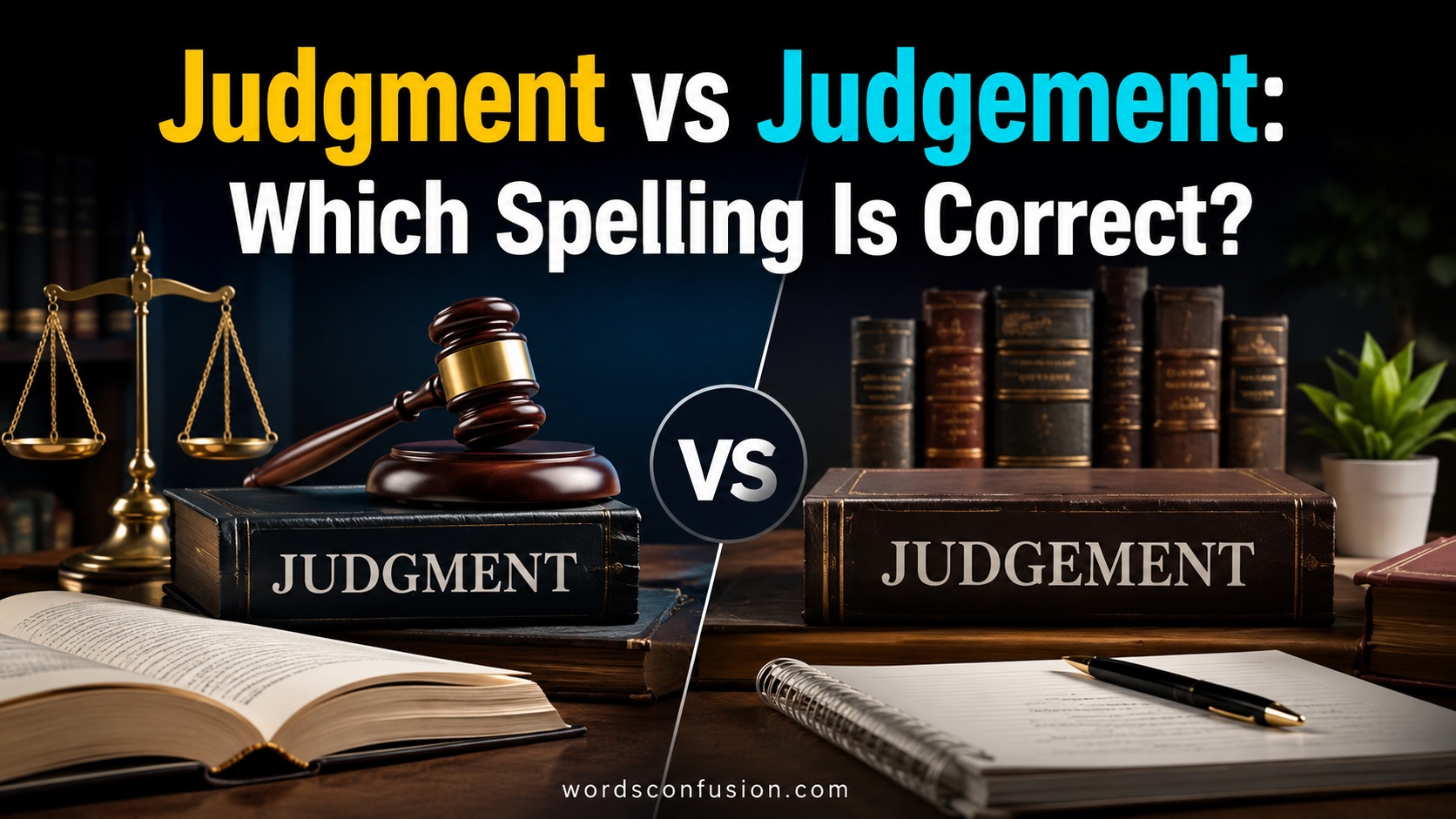
Choosing between Judgment and Judgement can be confusing because both spellings appear in books, newspapers, dictionaries, and legal documents. If you’ve ever wondered which version is correct, you’re not alone. Many English learners, students, writers, and even native speakers ask the same question.
The good news is that this isn’t a case where one spelling is always wrong. Instead, the correct choice depends on the type of English you’re writing and, in some cases, the style guide you’re following.
In American English, judgment is the standard spelling and appears in nearly every major dictionary and style guide. In British English, both judgment and judgement are accepted, although judgement remains more common in general British writing. The meaning, pronunciation, and grammatical function stay exactly the same regardless of which spelling you choose.
This guide explains the difference between Judgment vs Judgement, shows when each spelling is appropriate, explores their historical background, compares dictionary recommendations, and shares practical examples to help you choose the correct spelling every time.
Quick Answer
If you’re writing in US English, use judgment. It is the preferred spelling in American dictionaries, academic writing, business communication, and major style guides such as APA, AP Style, and Chicago.
If you’re writing in UK English, you can use either judgment or judgement. However, judgement is still more common in everyday British writing, while judgment often appears in legal contexts and publications that follow Oxford style.
Here’s the short answer:
| English Variety | Recommended Spelling |
| American English | Judgment |
| British English | Judgement or Judgment |
| Canadian English | Usually Judgment |
| Australian English | Often Judgement |
| Legal English | Usually Judgment |
The key point is simple: both words have the same meaning. The only real difference is regional spelling preference.
Judgment vs Judgement at a Glance
Understanding the distinction becomes much easier when you compare both spellings side by side.
| Feature | Judgment | Judgement |
| Meaning | Decision, opinion, or legal ruling | Same meaning |
| Pronunciation | Same | Same |
| Part of Speech | Noun | Noun |
| American English | Standard spelling | Rare |
| British English | Accepted | Common |
| Legal Documents | Frequently used | Less common in legal writing |
| Academic Writing (US) | Preferred | Usually avoided |
Quick Facts
- Both spellings mean exactly the same thing.
- Pronunciation never changes.
- The difference is regional rather than grammatical.
- Judgment is the dominant spelling in American English.
- Judgement remains popular in many British publications.
What Does “Judgment” Mean?
Judgment is a noun that refers to the ability to make careful decisions or to the decision itself. Depending on the context, it can also describe a formal ruling made by a court.
The word comes from the verb judge, which means to evaluate, decide, or form an opinion.
Definition
Judgment commonly means:
- The ability to make wise decisions
- An opinion formed after careful thought
- A legal decision issued by a court
- An assessment or evaluation
- A conclusion reached after considering evidence
Examples
- You showed excellent judgment during the emergency.
- The judge announced the final judgment yesterday.
- Good judgment comes from experience.
- She trusted her own judgment instead of following the crowd.
- The company’s leadership exercised sound judgment during the financial crisis.
In everyday conversation, judgment often refers to wisdom or decision-making ability.
For example:
“Parents hope their children develop good judgment as they grow older.”
Here, the word doesn’t refer to a courtroom. Instead, it describes someone’s ability to make sensible choices.
Origin of the Word
The word traces its roots to the Latin judicare, meaning to judge or decide. It later entered Old French before becoming part of Middle English.
For centuries, English writers used several spellings, including:
- Judgement
- Judgment
- Judgement
As dictionaries became standardized, American English gradually settled on judgment, while British English continued accepting both forms.
Why the Spelling Looks Unusual
Many English learners wonder why judgment drops the extra e found in judge.
Normally, English keeps the silent e when adding a suffix. However, judgment became an established exception through centuries of usage.
It may seem unusual at first, yet it follows a long-standing spelling convention rather than a modern simplification.
What Does “Judgement” Mean?
Judgement has exactly the same meaning as judgment.
There is no difference in definition, pronunciation, or grammatical function.
The only distinction is spelling preference.
Definition
Judgement can refer to:
- Careful decision-making
- Personal opinion
- Critical evaluation
- Legal ruling
- Moral assessment
Examples
- His judgement impressed the hiring committee.
- The court delivered its judgement on Friday.
- Good judgement often develops through experience.
- Her judgement proved accurate.
Every one of these sentences could also be written with judgment without changing the meaning.
Why Some Dictionaries Include Both Spellings
Modern dictionaries recognize that English has multiple standard varieties.
American dictionaries usually list judgment as the preferred spelling and mention judgement as a variant.
British dictionaries often list both spellings because British writers commonly use either one depending on publisher preference.
This approach reflects actual language use instead of forcing a single global standard.
Where “Judgement” Is Common
You’ll frequently see judgement in:
- British newspapers
- UK blogs
- Australian publications
- New Zealand websites
- Commonwealth English writing
Although judgment also appears in these regions, judgement remains familiar to many readers outside North America.
Judgment vs Judgement: What’s the Difference?
At first glance, these two words seem different. In reality, the distinction is surprisingly small.
The difference between Judgment vs Judgement comes down to regional spelling conventions, not meaning.
| Comparison | Judgment | Judgement |
| Meaning | Same | Same |
| Pronunciation | Same | Same |
| Grammar | Noun | Noun |
| American Usage | Preferred | Rare |
| British Usage | Accepted | Common |
The Difference Is Spelling, Not Meaning
Many spelling pairs in English have different meanings.
For example:
- Affect vs Effect
- Accept vs Except
- Principal vs Principle
However, Judgment vs Judgement does not belong in that category.
No matter which spelling you choose, the word still means:
- Decision
- Opinion
- Evaluation
- Verdict
- Assessment
There is absolutely no change in meaning.
Regional Usage Explained
Language naturally evolves in different countries.
American English favors simpler spellings in many words.
Examples include:
| American English | British English |
| Color | Colour |
| Honor | Honour |
| Labor | Labour |
| Center | Centre |
| Judgment | Judgement |
Neither version is inherently better.
Each simply reflects the spelling standards of a particular English-speaking region.
Why Both Spellings Continue to Exist
Unlike many spelling differences, judgment and judgement have existed together for hundreds of years.
Publishing traditions, dictionary preferences, and educational systems all helped preserve both versions.
As a result:
- American schools teach judgment.
- British schools often accept both.
- International organizations choose the spelling that matches their editorial style.
- Professional writers stay consistent throughout a document.
Consistency matters more than choosing one spelling over the other. If you’re writing in US English, use judgment throughout your document. If you’re writing for a British audience, choose either judgement or judgment based on the publication’s style guide and stick with it.
Is Judgment or Judgement Correct?
The simplest answer is that both spellings are correct, but they aren’t used equally around the world. Your audience and the type of English you’re writing determine which spelling you should choose.
If you’re writing for readers in the United States, judgment is the correct and expected spelling. If you’re writing for readers in the United Kingdom, both spellings are acceptable, although judgement appears more often in general British writing.
Choosing the correct spelling shows attention to detail and keeps your writing consistent.
In American English
American English almost always uses judgment.
You’ll find this spelling in:
- Newspapers
- Universities
- Government publications
- Business documents
- Books
- Professional emails
- Academic journals
Major American style guides also recommend judgment.
Examples include:
- The court entered its final judgment.
- Use your best judgment before making a decision.
- Her judgment helped the team avoid a costly mistake.
If you’re writing for an American audience, there is little reason to use judgement.
In British English
British English is more flexible.
Most British dictionaries recognize both spellings. However, judgement remains common in everyday writing, while judgment frequently appears in legal contexts and publications that follow Oxford spelling.
Examples include:
- His judgement was respected by everyone in the company.
- The judge delivered the final judgment after reviewing the evidence.
Because both spellings are accepted, always follow your employer’s, publisher’s, or school’s style guide.
In Canadian English
Canadian English often follows a blend of American and British conventions.
Although you’ll occasionally see judgement, many Canadian publishers prefer judgment, especially in business, education, and legal writing.
The safest choice for Canadian audiences is usually judgment unless a specific style guide recommends otherwise.
In Australian and New Zealand English
Australian and New Zealand English generally favor judgement in everyday writing.
However, legal documents may still use judgment, depending on the court and official publication.
As with British English, consistency matters more than choosing one version over another.
In Legal Writing
Legal English deserves special attention because it doesn’t always follow everyday spelling preferences.
Many courts use judgment as the official spelling regardless of country.
For example:
- Court judgment
- Default judgment
- Summary judgment
- Final judgment
These phrases have become standard legal terminology.
If you’re preparing legal documents, always follow the terminology used by the relevant court or jurisdiction.
Why Is “Judgment” Preferred in US English?
Many people assume judgment is a modern simplification. The real story is more interesting.
The spelling developed over centuries and became standardized through American dictionaries, publishing practices, and educational systems.
Historical Development
English spelling wasn’t always standardized.
Several hundred years ago, writers often used multiple spellings of the same word.
Historical documents include variations such as:
- Judgment
- Judgement
- Judgement
As dictionaries became more influential, spelling gradually became more consistent.
American publishers eventually settled on judgment as the standard form.
Influence of American Dictionary Standards
American dictionaries played a major role in establishing spelling consistency.
Today, leading dictionaries list judgment as the preferred spelling.
These references influence:
- Schools
- Universities
- Newspapers
- Publishers
- Businesses
As a result, millions of Americans learn only one standard spelling throughout their education.
Style Guide Recommendations
Professional writers rely on style guides to maintain consistency.
Here is how major American style guides treat the word.
| Style Guide | Recommended Spelling |
| AP Style | Judgment |
| Chicago Manual of Style | Judgment |
| APA Style | Judgment |
| MLA Style | Judgment |
If you’re writing academic papers, professional reports, or online articles in the United States, judgment is the safest choice.
Read More: Independent vs Independant: Which Spelling Is Correct?
Why Do Many British Writers Prefer “Judgement”?
British English often preserves traditional spellings that American English has simplified over time.
That is one reason judgement remains familiar throughout the UK.
Traditional British Spelling
British spelling tends to retain historical forms.
Examples include:
| American English | British English |
| Color | Colour |
| Honor | Honour |
| Favorite | Favourite |
| Judgment | Judgement |
These spelling differences don’t change pronunciation or meaning.
Instead, they reflect the independent evolution of English in different countries.
Modern UK Usage
Modern British publications vary.
Some newspapers prefer judgement.
Others use judgment because it aligns with Oxford spelling.
This explains why you may encounter both spellings while reading British books or news articles.
Dictionary Preferences
Most British dictionaries include both spellings.
Some list judgement first because of its popularity in general British English.
Others emphasize that judgment is common in legal writing.
Neither spelling is considered incorrect.
Judgment vs Judgement in Major Dictionaries
The world’s leading dictionaries recognize these spellings differently.
Here’s a quick comparison.
| Dictionary | Judgment | Judgement |
| Merriam-Webster | Preferred | Variant |
| Oxford English Dictionary | Accepted | Accepted |
| Cambridge Dictionary | Accepted | Accepted |
| Collins Dictionary | Accepted | Accepted |
| Dictionary.com | Preferred | Variant |
What This Means for Writers
Dictionaries don’t disagree about the meaning.
Instead, they describe how real people use the language.
American dictionaries emphasize judgment because it dominates American writing.
British dictionaries include both spellings because both appear regularly in British English.
This is an excellent reminder that English is a global language with multiple accepted standards.
Judgment vs Judgement in Popular Style Guides
Style guides help organizations maintain consistent writing.
Rather than asking which spelling is “right,” professional editors ask which spelling matches the publication’s style.
| Style Guide | Preferred Spelling |
| AP Style | Judgment |
| Chicago Manual of Style | Judgment |
| APA Publication Manual | Judgment |
| MLA Handbook | Judgment |
| Oxford Style | Judgment or Judgement depending on editorial preference |
Why Style Guides Matter
Imagine reading a report where one page says judgment and the next says judgement.
Even though both are correct, the inconsistency looks unprofessional.
Good editors make sure one spelling appears throughout an entire document.
That small detail improves readability and builds trust with readers.
FAQs:
Is judgment or judgement correct?
Both spellings are correct. Judgment is the standard spelling in American English, while judgement is commonly used in British English. The meaning and pronunciation are identical, so the correct choice depends on the variety of English you’re using.
Why is judgment spelled without the extra “e”?
Although the base word is judge, the spelling judgment became the standard form in American English through historical usage and dictionary standardization. It is now the preferred spelling in American schools, businesses, legal writing, and major style guides.
Is judgement considered wrong?
No. Judgement is not incorrect. It is an accepted spelling in British English and other Commonwealth countries. However, if you’re writing for an American audience, you should use judgment instead.
Which spelling should students and professional writers use?
Use the spelling that matches your audience or your institution’s style guide.
- US schools, colleges, and businesses: Use judgment.
- UK schools and publishers: Either spelling may be acceptable, though judgement is more common in general writing.
- Academic papers: Always follow your instructor’s or publisher’s preferred style guide and remain consistent throughout the document.
Does the spelling change the meaning of the word?
No. Judgment and judgement have exactly the same meaning. Both refer to a decision, opinion, evaluation, or a court’s ruling. The only difference is regional spelling preference.
Conclusion:
The debate over Judgment vs Judgement isn’t about right versus wrong. It’s about choosing the spelling that fits your audience and staying consistent throughout your writing.
If you’re writing in American English, judgment is the clear choice. It is the standard spelling recommended by major dictionaries, universities, publishers, and style guides such as APA, AP Style, MLA, and The Chicago Manual of Style.
If you’re writing in British English, both spellings are accepted. Judgement remains common in everyday British usage, while judgment also appears frequently, particularly in legal and Oxford-style writing.

Andrew Wilson is an experienced language researcher and content writer specializing in WordsConfusion topics. He helps readers understand commonly confused English words, spelling differences, grammar rules, word meanings, and proper usage through clear explanations, practical examples, and easy-to-follow language guides. His goal is to make English learning simple, accurate, and accessible for students, writers, professionals, and everyday learners.