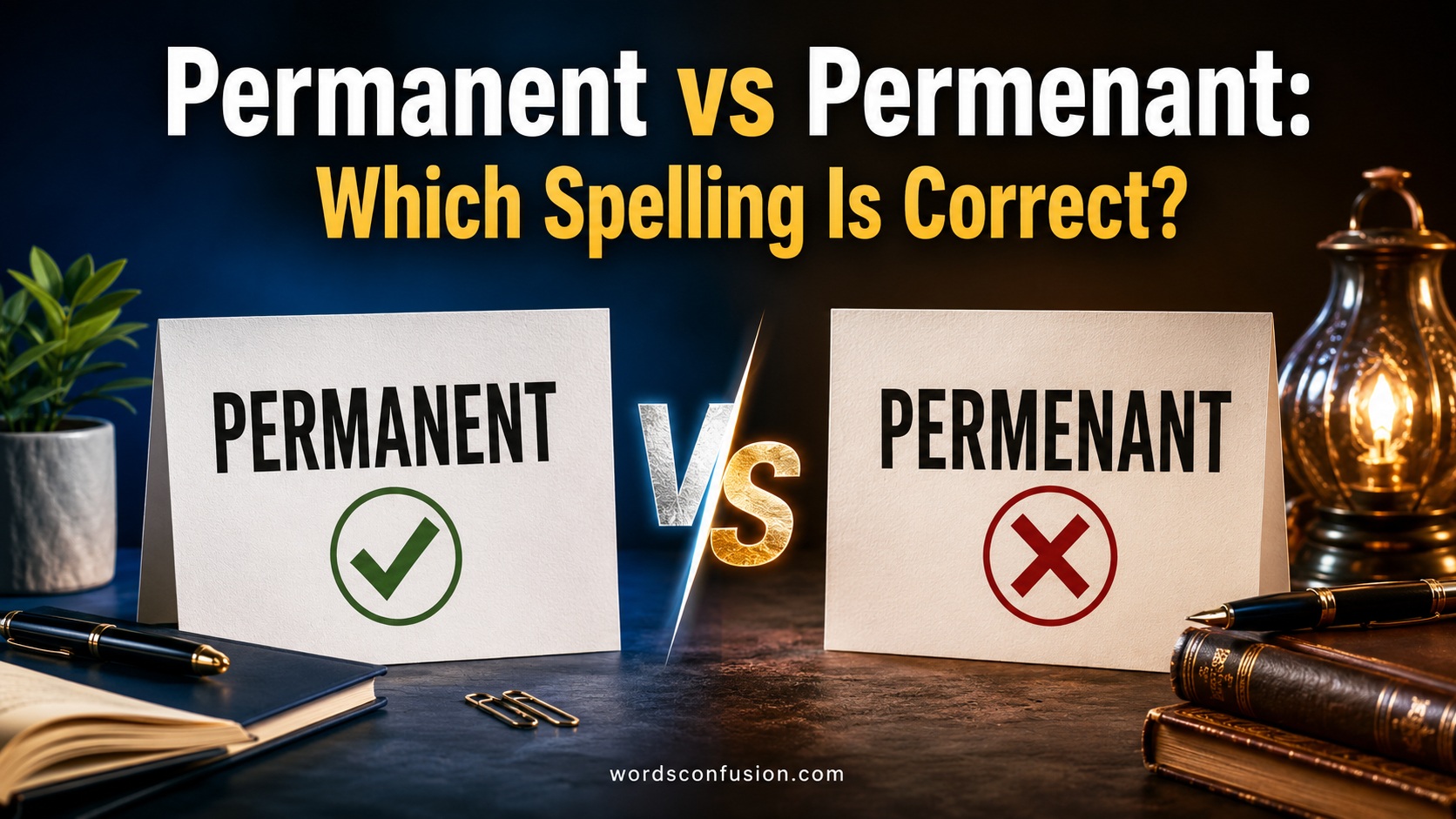
If you’ve ever paused while writing the word permanent, you’re not alone. The spelling often causes confusion because the word contains several unstressed vowel sounds. As a result, many people write permenant instead of permanent.
The correct spelling is permanent.
Permenant is a common spelling mistake, not a standard English word. The correct form contains “man” in the middle:
PER + MAN + ENT = PERMANENT
The word permanent describes something that lasts for a long time, continues indefinitely, or isn’t intended to end or change soon. You might use it to describe a job, home, change, address, resident status, solution, record, or physical effect.
This guide explains the difference between permanent vs permenant, the correct spelling, pronunciation, meaning, word forms, common mistakes, useful examples, and easy ways to remember the correct form.
Quick Answer: Permanent or Permenant?
Permanent is the correct spelling.
Permenant is incorrect.
| Spelling | Correct? | Meaning |
| Permanent | Yes | Lasting for a long time or intended to continue indefinitely |
| Permenant | No | Common misspelling of permanent |
Correct: She accepted a permanent position at the company.
Incorrect: She accepted a permenant position at the company.
The easiest way to remember the spelling is to break it into three parts:
PER + MAN + ENT = PERMANENT
The middle of the word is MAN, not MEN.
Permanent vs Permenant: Which Spelling Is Correct?
When comparing permanent vs permenant, only one spelling follows standard English spelling conventions: permanent.
The correct word contains the letter sequence:
P-E-R-M-A-N-E-N-T
The incorrect form changes the internal vowel pattern:
P-E-R-M-E-N-A-N-T
That small change creates a spelling error. Although readers usually understand what permenant means, it shouldn’t appear in polished writing.
You should use permanent in:
- Emails
- Resumes
- Cover letters
- School assignments
- Academic writing
- Business documents
- Websites
- Legal documents
- Professional reports
- Social media posts
A single spelling mistake might not change the meaning of a sentence. However, repeated errors can make your writing look careless. The good news is that permanent becomes easy to spell once you remember its internal structure.
Permanent Is the Correct Spelling
Permanent is a standard English adjective. It describes something that lasts or is intended to last indefinitely.
For example:
- The company offered her a permanent position.
- The damage may be permanent.
- They moved into a permanent home.
- The new policy created a permanent change.
The word can also function as a noun in certain contexts. For example, a permanent can refer to a hairstyle created through a chemical treatment.
Permenant Is a Misspelling
Permenant isn’t the accepted standard spelling of the word.
People usually make this mistake because they remember the general sound of permanent rather than the exact letters. English pronunciation often reduces unstressed vowels, so the spelling doesn’t always match what you hear.
That’s why saying the word slowly can help:
PER-MAN-ENT
The spelling becomes much easier to remember when you focus on the middle:
PER-MAN-ENT
Not:
PER-MEN-ANT
What Does Permanent Mean?
Permanent means lasting for a long time or intended to continue without a planned end.
The word often contrasts with temporary, although permanent doesn’t always mean something will literally last forever. In everyday English, it usually means that something is designed or expected to remain for an indefinite period.
For example, a permanent job may continue indefinitely. That doesn’t mean the person can never leave the job. A permanent address may remain someone’s main address for a long period. That doesn’t mean the person can never move.
Context matters.
Core Meanings of Permanent
The word permanent commonly carries these meanings:
- Lasting for an indefinite period
- Not temporary
- Intended to remain
- Difficult or impossible to reverse
- Continuing without a planned ending
Consider these examples:
The temporary office will close next month.
The company plans to move into a permanent office.
The first office exists for a limited period. The second office is intended to serve as a long-term location.
Permanent Does Not Always Mean Forever
This distinction matters.
Many people treat permanent and forever as exact synonyms. They aren’t always interchangeable.
For example:
She found a permanent job.
This means the job isn’t designed as a short-term position. It doesn’t guarantee that she will keep it for the rest of her life.
Similarly:
The government established a permanent committee.
The committee may continue indefinitely. However, a future decision could still dissolve it.
So, permanent usually means lasting or intended to last indefinitely, while forever often suggests endless duration.
Permanent Examples in Sentences
The best way to understand permanent is to see how people use it in real sentences.
Examples About Employment
- After six months as an intern, Maria received a permanent position.
- The company is hiring permanent employees for its expanding department.
- He left his temporary contract and accepted a permanent role.
- The position began as seasonal work but eventually became permanent.
Examples About Homes and Addresses
- The family finally found a permanent home.
- Please provide your permanent address on the application.
- They lived in temporary housing before moving into a permanent residence.
Examples About Changes
- The renovation made a permanent difference to the building.
- The policy created a permanent change in the organization.
- The treatment may cause permanent changes to the material.
Examples About Damage
- The accident caused permanent damage to the vehicle.
- Doctors warned that the injury could cause permanent complications.
- The fire left permanent marks on the wall.
Examples About Records
- The decision became part of the company’s permanent record.
- The school keeps a permanent record of academic results.
These examples show that permanent works across many different situations. Its basic meaning remains the same: something is expected to stay rather than disappear quickly.
How to Pronounce Permanent
In American English, permanent is commonly pronounced approximately as:
PUR-muh-nuhnt
A common pronunciation guide is:
/ˈpɝː.mə.nənt/
The middle syllables often sound softer than the spelling suggests. That pronunciation explains why some people struggle to remember the exact letters.
When you say permanent naturally, the vowel sounds in the middle aren’t strongly stressed. Because of that, you may hear something closer to:
PUR-muh-nuhnt
rather than a clearly separated:
PER-MA-NENT
This difference between pronunciation and spelling causes many English spelling mistakes.
Pronunciation vs Spelling
| Word | Common Pronunciation | Correct Written Form |
| Permanent | PUR-muh-nuhnt | Permanent |
| Permenant | Usually intended to sound like permanent | Incorrect spelling |
The key lesson is simple: don’t rely entirely on sound when spelling permanent. Remember the written pattern instead.
Why Do People Spell Permanent as Permenant?
The error permenant doesn’t appear randomly. Several factors make the mistake understandable.
The Unstressed Vowels Sound Similar
English contains many words where unstressed vowels become less distinct in ordinary speech.
For example, when people say permanent quickly, the middle vowel sounds may not stand out clearly. A writer who spells primarily by sound might choose the wrong vowel.
That’s why the word can feel confusing even to people who use English every day.
The Word Contains Several Vowels
The correct spelling has this pattern:
P E R M A N E N T
The vowels appear in a sequence that isn’t always easy to recall:
E – A – E
When people write the word from memory, they may rearrange the vowels and create:
E – E – A
That produces permenant.
Similar Words Create Mental Interference
English contains many words with related-looking letter patterns:
- management
- permanent
- permanence
- permanently
- permanent resident
Because these words share similar sounds and endings, the brain may accidentally blend spelling patterns.
The solution isn’t to memorize every word as a completely separate object. Instead, learn the word family.
Permanent → Permanently → Permanence
Once you know the base spelling, the related forms become much easier.
The Best Memory Trick for Permanent
The most useful spelling trick is:
PER + MAN + ENT
Look at the middle:
PER-MAN-ENT
The word contains MAN.
That gives you a quick mental checkpoint:
Permanent has MAN in the middle.
Correct Spelling
PER-MAN-ENT
Incorrect Spelling
PER-MEN-ANT
The incorrect version changes both the middle vowel and the ending pattern.
Another helpful approach involves the final three letters:
ENT
The word ends in -ent, not -ant.
So remember two key points:
- The middle contains MAN.
- The word ends with ENT.
Put them together:
PER + MAN + ENT = PERMANENT
Permanent vs Permenant: Side-by-Side Comparison
| Feature | Permanent | Permenant |
| Standard English spelling | Yes | No |
| Correct dictionary word | Yes | No as the standard spelling |
| Meaning | Lasting or not temporary | No standard meaning |
| Common usage | Professional and everyday writing | Spelling error |
| Example | The change is permanent. | Incorrect |
| Memory pattern | PER-MAN-ENT | Incorrect pattern |
The difference is only a few letters. However, only permanent should appear in formal and standard English writing.
Permanent vs Temporary
The clearest opposite of permanent is temporary.
A temporary situation has a limited duration. A permanent situation is intended to continue indefinitely.
| Permanent | Temporary |
| Long-term | Short-term |
| Intended to remain | Intended to end |
| Not planned as a brief arrangement | Planned for a limited period |
| May be difficult to reverse | Often easier to change or remove |
Employment Example
The company offered him a permanent position.
This suggests an ongoing role without a fixed end date.
The company offered him a temporary position.
This suggests the role exists for a defined or limited period.
Housing Example
The family lives in permanent housing.
The housing serves as their long-term home.
The family lives in temporary housing.
The arrangement is intended to last only until a more lasting solution becomes available.
Solutions Example
The engineers found a permanent solution to the leak.
The solution is designed to fix the problem for the long term.
The engineers found a temporary solution to the leak.
The fix works for now but may require a more lasting repair later.
Read More: Occasion vs Ocassion: Which Spelling Is Correct?
Permanent as an Adjective
The most common use of permanent is as an adjective.
An adjective describes a noun. Therefore, permanent tells you that something has a lasting or continuing quality.
Examples include:
- Permanent job
- Permanent home
- Permanent address
- Permanent resident
- Permanent record
- Permanent solution
- Permanent change
- Permanent damage
- Permanent marker
Consider this sentence:
The museum installed a permanent exhibit.
The word permanent describes the exhibit. It tells you that the exhibit isn’t intended as a short-term display.
Another example:
The company made a permanent change to its operating policy.
Here, permanent describes the change.
Permanent as a Noun
Although permanent most often functions as an adjective, it can also act as a noun in specific situations.
The best-known example involves hair treatment.
A permanent, often called a perm, is a chemical treatment that changes the structure of hair to create curls or waves.
For example:
She decided to get a permanent at the salon.
In everyday modern English, perm is often more common than permanent in this meaning.
The noun use has a different meaning from the adjective:
- Adjective: They found a permanent solution.
- Noun: She got a permanent at the salon.
The spelling remains permanent in both cases.
Common Collocations With Permanent
A collocation is a combination of words that commonly appear together. Learning these combinations helps you use permanent naturally.
Permanent Position
A permanent position is an ongoing job rather than a short-term or temporary role.
After completing the probation period, she received a permanent position.
Permanent Resident
A permanent resident is a person who has been granted a long-term legal right to live in a country under that country’s immigration system.
He became a permanent resident after completing the required process.
The exact legal meaning of this term varies by country. However, the central idea involves long-term residency rather than a short visit or temporary stay.
Permanent Address
A permanent address usually refers to the address considered a person’s primary or long-term residence.
The application asks for both your current address and permanent address.
Permanent Record
A permanent record refers to information intended to remain documented for a long period.
The school maintained a permanent record of the student’s academic history.
Permanent Damage
Permanent damage describes harm that won’t naturally disappear or fully reverse.
The accident caused permanent damage to the structure.
Permanent Solution
A permanent solution aims to solve a problem for the long term.
The technician replaced the damaged component instead of applying another temporary fix.
Permanent Marker
A permanent marker contains ink designed to resist ordinary removal from many surfaces.
Write your name on the box with a permanent marker.
Permanent, Permanently, and Permanence
These words belong to the same word family. Understanding their roles prevents another common group of mistakes.
| Word | Part of Speech | Meaning | Example |
| Permanent | Adjective / noun | Lasting or intended to last | The change is permanent. |
| Permanently | Adverb | In a lasting or indefinite way | The store permanently closed. |
| Permanence | Noun | The quality of lasting | The monument represents permanence. |
Permanent
Use permanent to describe a noun.
They need a permanent solution.
Here, permanent describes solution.
Permanently
Use permanently to describe an action, condition, or change.
The business permanently closed.
The adverb permanently tells you how the business closed.
Permanence
Use permanence when discussing the quality or state of lasting.
The stone structure gives the town a sense of permanence.
The noun permanence names an idea rather than directly describing a specific object.
FAQs:
Is “permanent” or “permenant” the correct spelling?
Permanent is the correct spelling. Permenant is a misspelling.
The correct word is spelled:
P-E-R-M-A-N-E-N-T
For example:
The company offered her a permanent position.
What does the word “permanent” mean?
Permanent describes something that lasts for a long time or is intended to continue indefinitely.
For example:
- A permanent job is intended to continue without a fixed end date.
- A permanent home is intended as a long-term residence.
- Permanent damage describes damage expected to remain.
The word doesn’t always mean something will last literally forever. Instead, it usually contrasts with temporary.
Why is “permenant” a common spelling mistake?
People often write permenant because the middle vowel sounds in permanent become less clear during natural speech.
When pronounced quickly, permanent sounds roughly like PUR-muh-nuhnt. Because the vowel sounds aren’t strongly stressed, writers may remember the wrong letter sequence.
A useful memory trick is:
PER + MAN + ENT = PERMANENT
The word contains MAN in the middle.
What is the difference between permanent and temporary?
Permanent means lasting or intended to continue indefinitely. Temporary means lasting for a limited period.
For example:
She found a permanent job after working several temporary positions.
A permanent position has no planned short-term ending. A temporary position usually exists for a specific period or purpose.
What are the related forms of permanent?
The main related forms are:
- Permanent — adjective: The change is permanent.
- Permanently — adverb: The store permanently closed.
- Permanence — noun: The structure represents permanence.
- Impermanent — adjective: The arrangement is impermanent.
Learning these related forms makes it easier to use the word correctly in different sentences.
Conclusion:
When comparing permanent vs permenant, the answer is straightforward: permanent is the correct spelling, while permenant is a common spelling error.
The correct spelling is:
PER-MAN-ENT
The word permanent describes something that lasts for a long time or is intended to remain indefinitely. It can describe a permanent job, permanent home, permanent address, permanent change, permanent solution, or permanent damage.

Andrew Wilson is an experienced language researcher and content writer specializing in WordsConfusion topics. He helps readers understand commonly confused English words, spelling differences, grammar rules, word meanings, and proper usage through clear explanations, practical examples, and easy-to-follow language guides. His goal is to make English learning simple, accurate, and accessible for students, writers, professionals, and everyday learners.