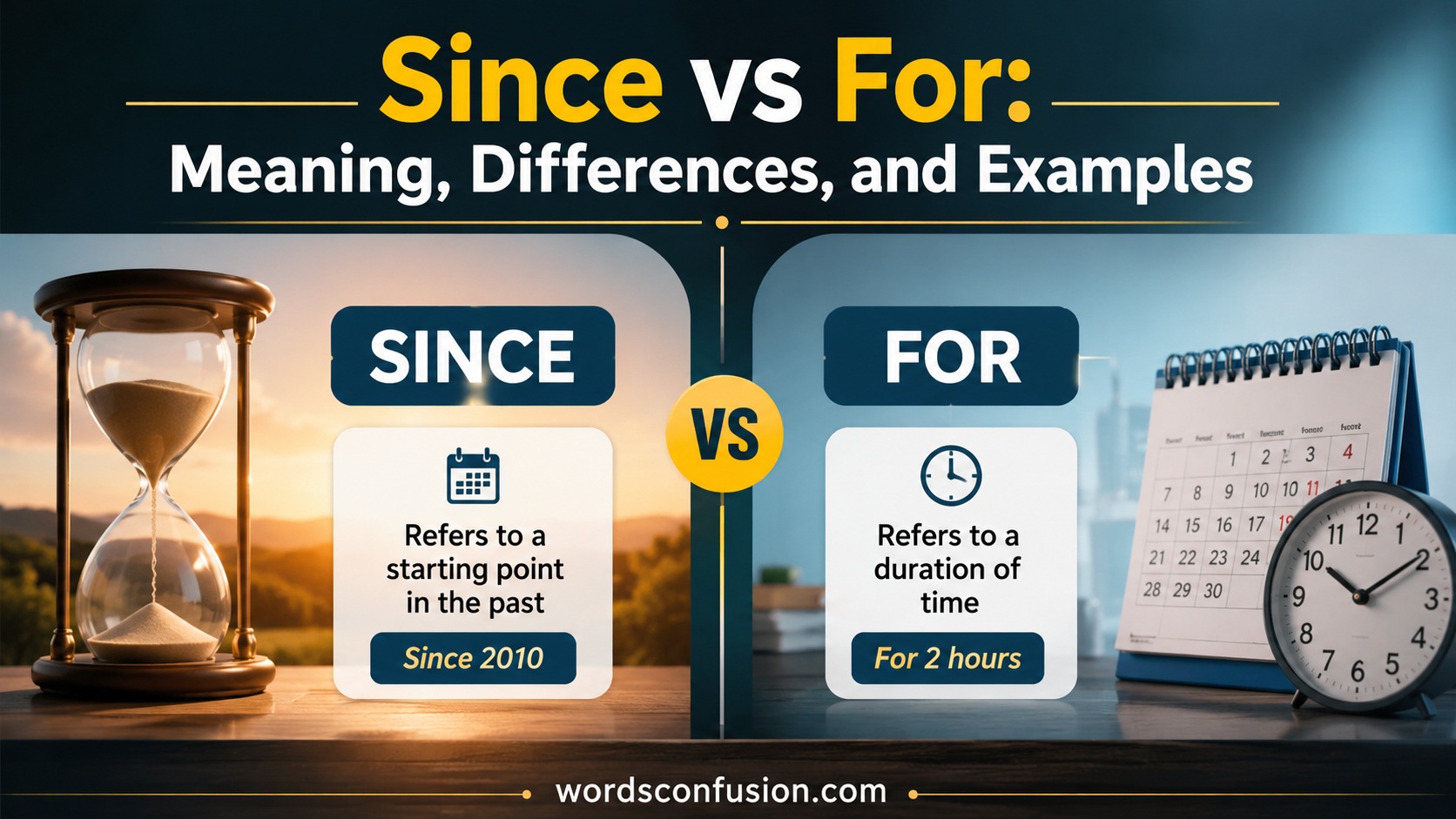
Learning the difference between since vs for can instantly improve your English grammar. These two small words often confuse learners because both relate to time. However, they don’t mean the same thing. Choosing the wrong one can change the meaning of your sentence or make it grammatically incorrect.
The good news is that the rule is simple once you understand it. Since points to the moment something started. For tells you how long something has continued. That’s the key difference.
In this guide, you’ll learn when to use since and for, how they work with different verb tenses, common mistakes to avoid, memory tricks, examples, practice exercises, and answers to frequently asked questions.
Quick Answer
Use since when you mention the starting point of an action or event.
- Since Monday
- Since 2022
- Since breakfast
- Since 9:00 AM
Use for when you mention the duration of time.
- For two hours
- For five years
- For several weeks
- For a long time
Simple rule to remember:
Since = Starting Point
For = Length of Time
| Correct Usage | Example |
| Since + starting point | I have lived here since 2020. |
| For + duration | I have lived here for four years. |
Since vs For: What’s the Difference?
Although both words describe time, they answer different questions.
- Since answers “When did it start?”
- For answers “How long?”
Think of it this way.
Imagine you started reading a book at 7:00 PM. It is now 9:00 PM.
You could say:
- I have been reading since 7:00 PM.
- I have been reading for two hours.
Both sentences describe the same situation. The first focuses on the beginning. The second focuses on the duration.
What Does “Since” Mean?
Since identifies the exact point when something began and continues until another time, usually the present.
Examples:
- She has worked here since January.
- We’ve been friends since childhood.
- They’ve lived in New York since 2018.
What Does “For” Mean?
For expresses the amount of time that something lasts.
Examples:
- She has worked here for eight months.
- We’ve been friends for twenty years.
- They’ve lived in New York for six years.
Since vs For Comparison Table
| Feature | Since | For |
| Meaning | Starting point | Duration |
| Answers | When did it start? | How long? |
| Used with | Dates, years, times, events | Hours, days, months, years |
| Focus | Beginning | Length |
| Example | Since Monday | For three days |
When to Use Since
You use since whenever you mention the exact point when an action began.
Use Since With a Starting Point
A starting point can be:
- A date
- A day
- A month
- A year
- A season
- A holiday
- A specific time
- An event
Examples include:
- Since Monday
- Since June
- Since 2015
- Since sunrise
- Since lunchtime
- Since graduation
- Since Christmas
- Since 8:30 AM
Examples of Since in Sentences
- I have lived here since 2019.
- She has studied English since high school.
- We’ve known each other since childhood.
- They have been waiting since noon.
- He has worked remotely since March.
- It has been raining since early morning.
- My brother has played football since he was six years old.
Common Time Expressions Used With Since
| Time Expression | Example |
| Since yesterday | I’ve felt better since yesterday. |
| Since Monday | She’s worked since Monday. |
| Since 2010 | They’ve lived here since 2010. |
| Since breakfast | I haven’t eaten since breakfast. |
| Since last week | We’ve been busy since last week. |
| Since childhood | He’s loved music since childhood. |
When to Use For
Use for whenever you mention the length of time.
The exact starting point isn’t important. The duration is.
Use For With a Duration
Common durations include:
- Minutes
- Hours
- Days
- Weeks
- Months
- Years
- Centuries
- A while
- A long time
Examples of For in Sentences
- I waited for thirty minutes.
- She has lived here for five years.
- We’ve been talking for hours.
- The museum remained closed for two weeks.
- They stayed abroad for six months.
- He exercised for forty-five minutes.
- We’ve owned this house for a decade.
Common Time Expressions Used With For
| Time Expression | Example |
| For ten minutes | Wait for ten minutes. |
| For an hour | She studied for an hour. |
| For three weeks | We’ve been travelling for three weeks. |
| For six months | He worked there for six months. |
| For five years | They’ve been married for five years. |
| For a lifetime | She loved painting for a lifetime. |
Since vs For in Different Verb Tenses
Although these words appear in many tenses, they are most common with perfect tenses because those tenses connect the past with another point in time.
Since vs For in the Present Perfect
The present perfect describes actions that began in the past and continue today.
Examples using since:
- I have lived here since 2021.
- She has worked remotely since January.
Examples using for:
- I have lived here for three years.
- She has worked remotely for six months.
Since vs For in the Present Perfect Continuous
This tense emphasizes an ongoing activity.
Examples:
- He has been studying since 8:00 AM.
- He has been studying for five hours.
- They have been travelling since last Monday.
- They have been travelling for two weeks.
Since vs For in the Past Perfect
The past perfect refers to an action completed before another past event.
Examples:
- She had lived there since 2016 before moving away.
- They had waited for two hours before the train arrived.
Since vs For in the Past Perfect Continuous
Examples:
- He had been working since sunrise.
- He had been working for twelve hours.
Since vs For in the Future Perfect
Examples:
- By next July, I will have worked here for ten years.
- By the end of next month, she will have lived here since 2020.
Since vs For Side-by-Side Examples
| Since | For |
| I have lived here since 2018. | I have lived here for seven years. |
| She has worked here since April. | She has worked here for four months. |
| We’ve known him since college. | We’ve known him for twenty years. |
| It has rained since midnight. | It has rained for six hours. |
| They’ve been waiting since noon. | They’ve been waiting for three hours. |
Common Mistakes and How to Fix Them
Even advanced English learners sometimes confuse since and for. Most mistakes happen because people mix up a starting point with a duration.
Mistake: Using Since With a Duration
Incorrect:
- I have lived here since five years.
Correct:
- I have lived here for five years.
The phrase five years is a duration, not a starting point.
Mistake: Using For With a Starting Point
Incorrect:
- She has worked here for 2021.
Correct:
- She has worked here since 2021.
A year represents the moment something began.
Mistake: Mixing Them in Present Perfect Sentences
Incorrect:
- We’ve known each other since ten years.
Correct:
- We’ve known each other for ten years.
Mistake: Forgetting That Since Has Another Meaning
Many learners only think about time.
However, since can also mean because.
Examples:
- Since it was raining, we stayed home.
- Since you already finished, you can leave early.
The meaning depends on the sentence.
Since as a Conjunction
Besides showing time, since can introduce a reason.
Compare these examples.
Time
- I’ve lived here since 2018.
Reason
- Since the weather improved, we went hiking.
The first sentence answers when.
The second sentence answers why.
Understanding the context makes it easy to tell the difference.
Read More: Sensible vs Sensitive: Meaning, Differences, and Usage
Since vs For Memory Trick
A simple memory trick can help you remember the rule forever.
Think of these two words:
Since = Start
Both begin with the letter S.
For = Full Length
Think of for as measuring the entire period.
Another way to remember it is to picture a race.
The starting line represents since.
The distance between the start and finish represents for.
Real-Life Examples
Here are examples you might hear every day.
At work:
- I’ve worked here since last summer.
- I’ve worked here for three years.
At school:
- She’s studied Spanish since seventh grade.
- She’s studied Spanish for six years.
At home:
- We’ve lived in this neighborhood since 2020.
- We’ve lived in this neighborhood for five years.
While traveling:
- They’ve been in Italy since Monday.
- They’ve been in Italy for ten days.
Practice Exercises
Fill in the Blank
Choose since or for.
- I have lived here _____ 2017.
- She has waited _____ two hours.
- We’ve known each other _____ childhood.
- They’ve been travelling _____ three weeks.
- He has worked here _____ January.
- It has been snowing _____ this morning.
- We’ve owned this car _____ five years.
- She has studied French _____ college.
Choose the Correct Word
- I have lived here since / for 2021.
- He has waited since / for an hour.
- We’ve been friends since / for high school.
- They’ve travelled since / for six months.
- She has worked here since / for last Monday.
Answer Key
Fill in the Blank
- Since
- For
- Since
- For
- Since
- Since
- For
- Since
Choose the Correct Word
- Since
- For
- Since
- For
- Since
FAQs:
Is it “since two hours” or “for two hours”?
The correct expression is for two hours because two hours describes a duration.
Can since mean because?
Yes. Since can introduce a reason.
Example:
- Since everyone agreed, the meeting ended early.
Can I use for with dates?
No. Dates represent starting points, so use since instead.
Correct:
- Since July 5
- Since 2023
Why are since and for common with the present perfect?
The present perfect connects the past with the present. Since marks the beginning while for measures the duration.
Can both words appear in the same sentence?
Yes.
Example:
- I have lived here since 2020 for almost five years.
Is since always followed by a specific point in time?
When referring to time, yes. However, since can also introduce a reason instead of a time expression.
Conclusion:
Understanding since vs for becomes much easier once you focus on one question. Are you talking about when something started or how long it has lasted?
If you’re mentioning a specific starting point such as Monday, 2022, or 9:00 AM, choose since. If you’re talking about a period like two hours, five months, or ten years, choose for.
Practice these patterns in everyday conversations and writing. Before long, you’ll choose the correct word naturally and speak with greater confidence.

Andrew Wilson is an experienced language researcher and content writer specializing in WordsConfusion topics. He helps readers understand commonly confused English words, spelling differences, grammar rules, word meanings, and proper usage through clear explanations, practical examples, and easy-to-follow language guides. His goal is to make English learning simple, accurate, and accessible for students, writers, professionals, and everyday learners.