
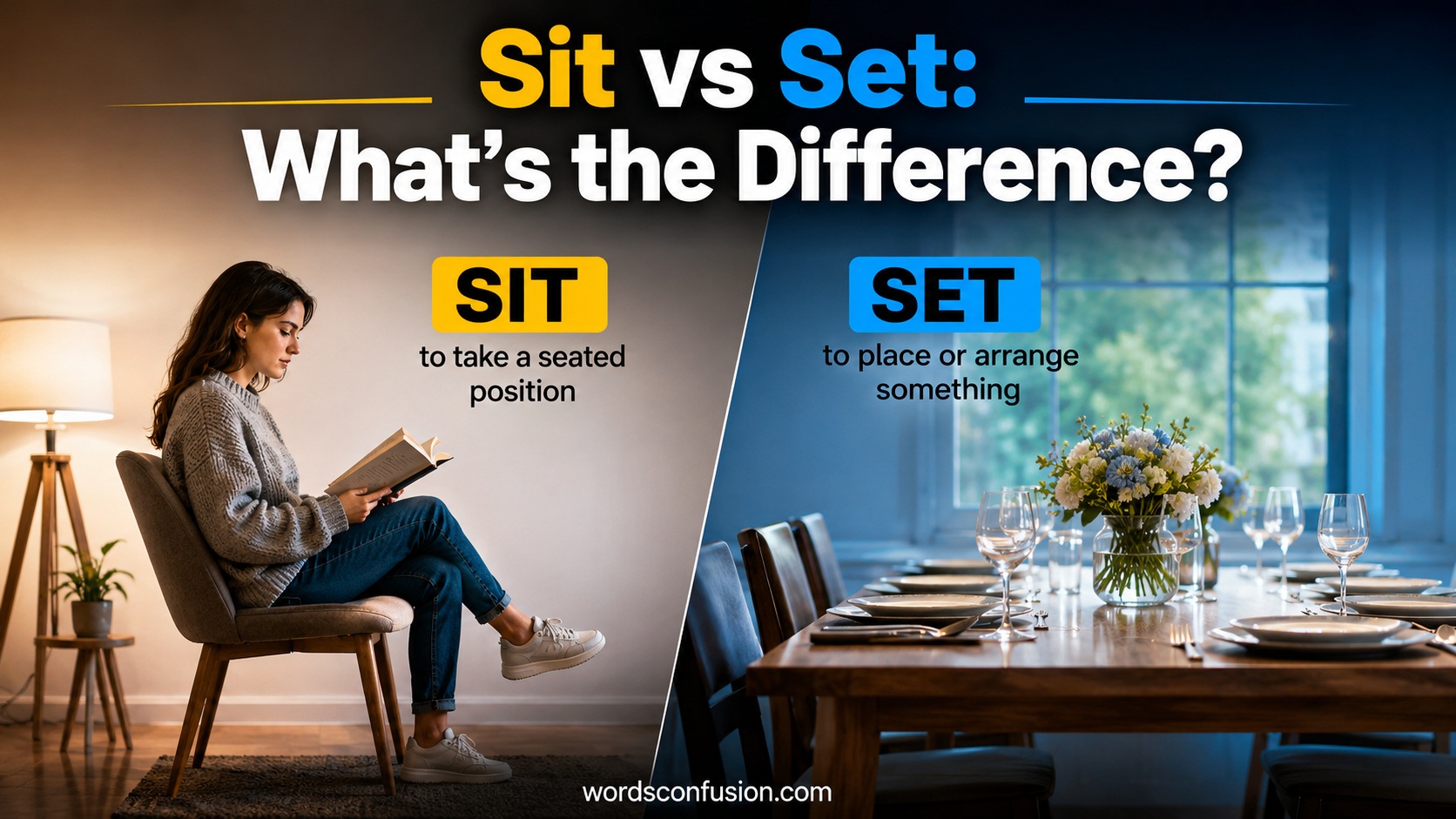
Choosing between sit and set can feel confusing because both words relate to position or placement. However, they follow different grammar rules and serve different purposes in a sentence. If you understand one simple rule, you’ll rarely confuse them again.
The biggest difference is that sit usually describes someone or something resting in a seated position, while set means placing something somewhere. One verb acts on its own, and the other requires an object.
In this guide, you’ll learn the meanings of sit vs set, their grammar rules, verb forms, examples, common mistakes, memory tricks, and practice exercises. By the end, you’ll know exactly when to use each word in everyday conversations and formal writing.
Quick Answer
The easiest way to remember sit vs set is this:
- Sit = to be in a seated position.
- Set = to place something somewhere.
| Word | Meaning | Requires an Object? | Example |
| Sit | To rest in a seated position | No | Please sit here. |
| Set | To place something somewhere | Yes | Please set the book on the table. |
Simple Rule:
- If someone or something sits by itself, use sit.
- If someone places something, use set.
For example:
- Correct: Sit on the chair.
- Correct: Set the chair beside the window.
Why People Confuse Sit and Set
Many English learners struggle with sit vs set because the words look alike and often appear in similar situations.
Here are the most common reasons for the confusion:
- Both involve position or location.
- They sound somewhat similar.
- Their past forms (sat and set) don’t resemble each other.
- Some regional dialects use sit where Standard American English prefers set.
Consider these examples:
- “Please sit beside me.”
- “Please set your backpack beside me.”
The location is the same. The action is different.
One describes your position.
The other describes placing an object.
That’s the key distinction.
What Does “Sit” Mean?
Definition of Sit
Sit means to rest in a seated position or to remain positioned somewhere without being moved.
Unlike set, sit usually doesn’t affect another object.
Sit Is an Intransitive Verb
An intransitive verb does not take a direct object.
Examples:
- I sit near the window.
- The children sat quietly.
- The dog is sitting outside.
- Please sit down.
Notice that nothing is being placed.
Common Uses of Sit
You can use sit when talking about:
- Sitting on a chair
- Sitting on the floor
- Remaining in one place
- Being located somewhere
- Remaining unused
Examples:
- The students sat silently during the presentation.
- The old cabin sits on a hill.
- Your package has been sitting at the post office for two days.
- The coffee sat untouched all morning.
What Does “Set” Mean?
Definition of Set
Set means to place or put something in a particular position.
Unlike sit, set almost always needs an object.
Set Is a Transitive Verb
A transitive verb acts on someone or something.
Examples:
- Set the dishes on the table.
- She set the vase on the shelf.
- He set his phone beside the laptop.
Ask yourself:
What was set?
You’ll always find an object.
Common Uses of Set
You use set for many everyday actions.
Examples include:
- Set the table.
- Set an alarm.
- Set a reminder.
- Set goals.
- Set the thermostat.
- Set a price.
- Set a record.
- Set a deadline.
Example sentences:
- She set the groceries on the counter.
- Please set your drink here.
- They set strict rules for the competition.
- He set the meeting for Monday morning.
Sit vs Set: The Main Difference
The difference becomes clear when you compare them side by side.
| Feature | Sit | Set |
| Meaning | Rest in a seated position | Put or place something |
| Verb Type | Intransitive | Transitive |
| Needs an Object | No | Yes |
| Action | Becoming seated | Placing an object |
| Example | The cat sits on the sofa. | She set the cat carrier on the floor. |
A quick comparison:
- I sat on the bench.
- I set my bag on the bench.
One sentence describes where I am.
The other describes where I placed something.
The Grammar Rule You Should Never Forget
If you remember only one rule, make it this one.
Sit Does Not Take a Direct Object
Correct:
- Sit here.
- Sit beside me.
- They sat quietly.
- We sat near the lake.
Incorrect:
- Sit the keys on the table.
- Sit the dishes here.
Set Takes a Direct Object
Correct:
- Set the keys on the table.
- Set the dishes here.
- Set the notebook beside the computer.
The easiest test is simple.
Ask yourself:
“What is being placed?”
If you can answer that question, use set.
If nothing is being placed, use sit.
Verb Forms of Sit and Set
The verb forms often confuse learners because they are very different.
| Verb | Base Form | Past Tense | Past Participle | Present Participle |
| Sit | Sit | Sat | Sat | Sitting |
| Set | Set | Set | Set | Setting |
Examples:
Sit
- I sit near the front.
- Yesterday I sat there.
- I have sat in this seat before.
- She is sitting outside.
Set
- I set the books down.
- Yesterday I set the books down.
- I have set the books down.
- She is setting the table.
Sit vs Set in Different Tenses
Understanding verb tenses helps you use both words naturally.
Present Tense
- I sit by the window every morning.
- She sets the table before dinner.
Past Tense
- We sat together during the concert.
- He set the suitcase near the door.
Future Tense
- They will sit in the front row.
- I will set the chairs before everyone arrives.
Present Perfect
- I have sat in that classroom before.
- She has set ambitious goals this year.
Side-by-Side Sentence Comparisons
Seeing both words together makes the difference much easier to understand.
| Sit | Set |
| Sit beside me. | Set your bag beside me. |
| The children sat quietly. | She set the books on the shelf. |
| We sat under the tree. | He set the ladder against the wall. |
| The dog sat by the door. | They set the food on the table. |
| She sat near the fireplace. | I set my keys on the counter. |
Notice the pattern.
Every set sentence includes an object.
Every sit sentence does not.
Common Mistakes and How to Avoid Them
Many learners repeat the same mistakes.
Here’s how to fix them.
| Incorrect | Correct | Why |
| Sit the box here. | Set the box here. | You are placing an object. |
| Set down for a minute. | Sit down for a minute. | A person becomes seated. |
| Sit the dishes on the counter. | Set the dishes on the counter. | Standard American English uses set. |
| Sit your phone here. | Set your phone here. | The phone is being placed. |
A Common Regional Exception
In some parts of the United States and other English-speaking regions, people say:
“Sit the baby in the chair.”
While this appears in regional speech, Standard American English generally prefers:
“Set the baby in the chair.”
If you’re writing professionally or taking an English exam, set is the safer choice.
Regional Differences in English
Language changes from place to place.
That’s true for sit and set as well.
Standard American English
Most grammar guides recommend:
- Sit yourself down.
- Set the package on the porch.
British English
British English follows the same core distinction.
You will still see:
- Sit on the sofa.
- Set the tray on the table.
Regional Dialects
Some regional dialects use sit as a transitive verb.
For example:
- Sit the groceries over there.
Although native speakers may understand it, formal writing generally prefers set.
Everyday Expressions Using Sit
Many common English expressions use sit.
| Expression | Meaning |
| Sit tight | Wait patiently |
| Sit still | Don’t move |
| Sit back and relax | Stop worrying and enjoy |
| Sit quietly | Remain silent |
| Sit down | Take a seat |
Example:
- Sit tight while the technician fixes the problem.
Read More: Since vs For: Meaning, Differences, and Examples
Everyday Expressions Using Set
Set appears in dozens of common expressions.
| Expression | Meaning |
| Set the table | Prepare for a meal |
| Set an example | Demonstrate good behavior |
| Set aside | Reserve something |
| Set up | Arrange or install |
| Set off | Begin a journey or trigger something |
| Set the record straight | Correct misinformation |
| Set in stone | Impossible to change |
Examples:
- Let’s set up the projector.
- She set an excellent example for the team.
- We set aside time every weekend for family.
Sit vs Set Memory Trick
Here’s an easy trick that works every time.
Think about the letter P.
Set = Place.
Both begin with a letter that reminds you an object is involved.
Now think about yourself.
You sit.
You don’t place yourself in normal grammar. You simply sit.
Another easy question is:
Can you point to the thing being placed?
- Yes → Use set.
- No → Use sit.
This simple habit quickly becomes automatic.
Practice Quiz
Fill in the Blank
Choose sit or set.
- Please _____ beside me.
- _____ the groceries on the counter.
- The children _____ quietly during class.
- She _____ the flowers on the windowsill.
- We _____ together every Friday.
- He _____ the alarm before bed.
- The cat _____ near the fireplace.
- Please _____ your backpack over there.
- They _____ in the front row.
- I _____ the dishes on the table.
Choose the Correct Word
- Sit the notebook here.
- Set the notebook here.
- Sit beside your brother.
- Set beside your brother.
- She sat quietly.
- She set quietly.
Answer Key
- Sit
- Set
- Sat
- Set
- Sit
- Set
- Sat
- Set
- Sit
- Set
Correct choices:
- Set the notebook here.
- Sit beside your brother.
- She sat quietly.
FAQs:
Is it “sit the baby down” or “set the baby down”?
In Standard American English, set the baby down is the preferred form because you’re placing someone in a seated position. Some regional dialects use sit the baby down, but it isn’t the standard choice for formal writing.
Why is “set” the same in the present and past tense?
Set is an irregular verb. Its base form, past tense, and past participle are all set.
Can “sit” ever take an object?
In some regional dialects, yes. However, Standard American English treats sit as an intransitive verb in most situations.
Is “set” always followed by an object?
Almost always. Since set means to place something, it normally requires an object.
What’s the easiest way to remember the difference?
Remember this simple rule:
- Sit = Be seated.
- Set = Place something.
Which word is more common in everyday English?
Both are extremely common. Sit often describes people or animals, while set appears frequently in household tasks, workplaces, schools, and daily conversations.
Conclusion:
Understanding sit vs set doesn’t have to be difficult. The key is knowing what each verb does in a sentence. Sit describes someone or something resting in a seated position, while set means placing an object in a specific location. Once you recognize whether an action involves a direct object, choosing the correct word becomes much easier.
A simple way to remember the difference is this: you sit, but you set something down. For example, you sit on a chair, but you set your backpack on the chair. This one rule will help you avoid one of the most common grammar mistakes in English.
As you read, write, and speak English, pay attention to how these verbs are used in real-life situations. With regular practice, using sit and set correctly will become second nature, making your communication clearer, more accurate, and more confident.

Andrew Wilson is an experienced language researcher and content writer specializing in WordsConfusion topics. He helps readers understand commonly confused English words, spelling differences, grammar rules, word meanings, and proper usage through clear explanations, practical examples, and easy-to-follow language guides. His goal is to make English learning simple, accurate, and accessible for students, writers, professionals, and everyday learners.