Have you ever wondered whether you should say, “I’ll take the documents to the office” or “I’ll bring the documents to the office”? You’re not alone. Many English learners and even native speakers occasionally mix up take vs bring because both words involve moving something from one place to another.
The good news is that the difference isn’t difficult. It all comes down to direction and point of view. Once you understand that simple rule, you’ll know exactly which word to use in everyday conversations, emails, and professional writing.
This guide explains the meaning of take vs bring, grammar rules, common mistakes, examples, comparison tables, memory tricks, and practice exercises so you can use both words confidently.
Quick Answer
The difference between take and bring depends on the direction of movement.
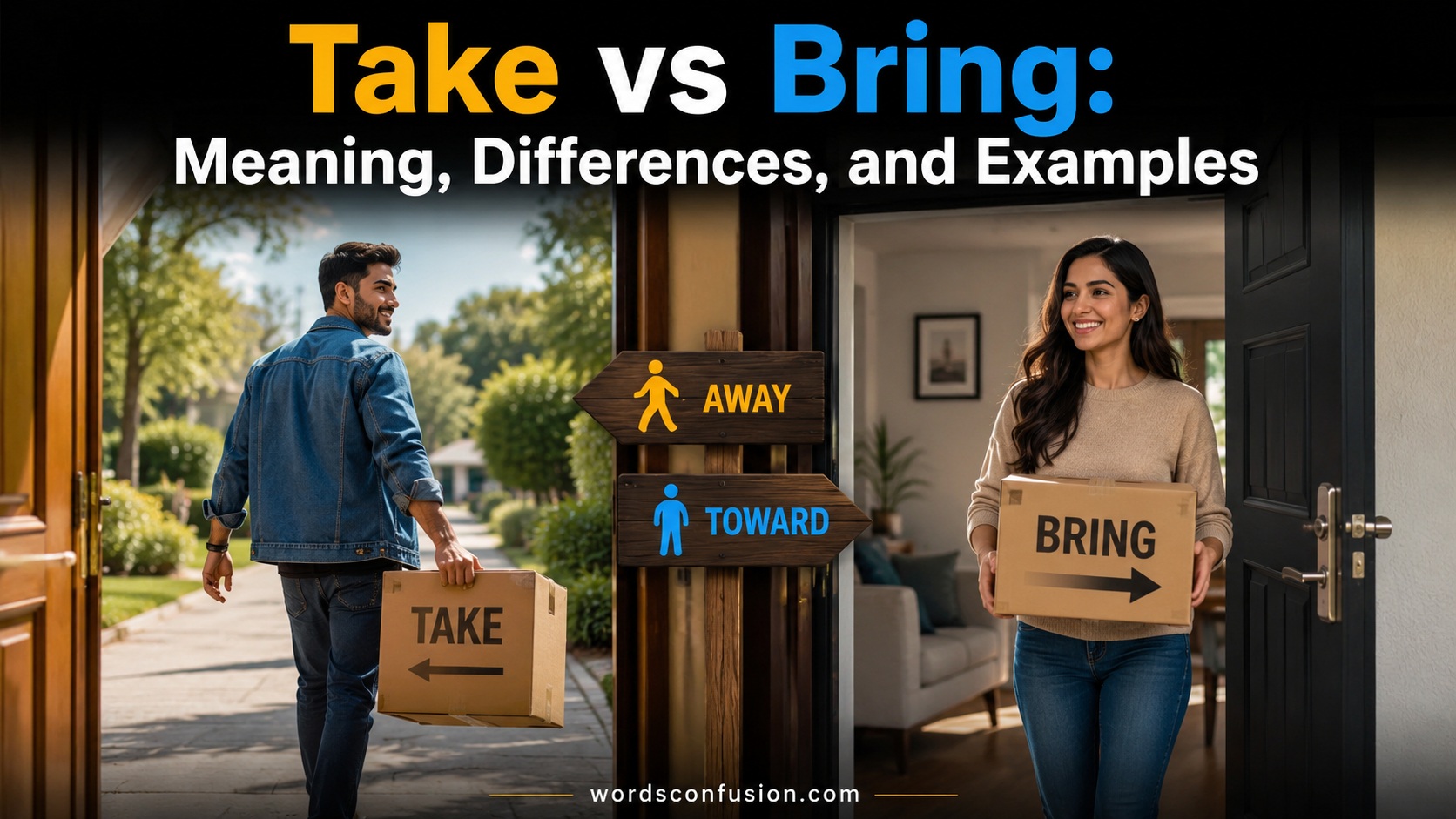
- Take means moving something away from the speaker or the current location.
- Bring means moving something toward the speaker or the destination that is being discussed.
Examples:
- Take these books to the library.
- Bring your laptop to tomorrow’s meeting.
- I’ll take my kids to school.
- Can you bring me a glass of water?
Easy memory trick:
- Take = Away
- Bring = Toward
Take vs Bring: What’s the Main Difference?
Both verbs describe movement. However, they describe movement from different perspectives.
Imagine standing in your living room.
If you’re carrying your keys from your house to your car, you’re taking your keys because they’re moving away from where you are.
Now imagine you’re waiting in the living room and ask someone in another room to carry your keys to you. They’re bringing your keys because they’re moving toward you.
The speaker’s viewpoint changes everything.
| Word | Direction | Simple Meaning |
| Take | Away from the speaker | Move something somewhere else |
| Bring | Toward the speaker or destination | Move something here |
The Simple Rule to Remember
Ask yourself one question:
Is the object moving away from me or toward me?
If it’s moving away, use take.
If it’s moving toward you or toward the place you’re talking about, use bring.
A One-Sentence Memory Trick
Take goes away. Bring comes your way.
That short phrase helps many learners remember the difference instantly.
What Does “Take” Mean?
Take means to carry or move someone or something away from the current place to another location.
You often use it when talking about:
- Transportation
- Delivering something elsewhere
- Moving objects
- Going somewhere
Examples:
- I’ll take these papers upstairs.
- She takes her son to school every morning.
- Please take your shoes outside.
- He took the package to the post office.
Notice that every example involves movement away from the current position.
Common Sentence Patterns
- Take + object + to + place
- Take + someone + somewhere
- Take + object + away
Examples:
- Take the food to the kitchen.
- Take your umbrella with you.
- Take the children home.
What Does “Bring” Mean?
Bring means to carry or move someone or something toward a person, place, or destination.
Examples:
- Please bring your notebook to class.
- Can you bring me a bottle of water?
- She brought dessert to dinner.
- Don’t forget to bring your passport.
The destination is where the speaker is or where the conversation is focused.
Common Sentence Patterns
- Bring + object + to + person
- Bring + object + here
- Bring + someone + along
Examples:
- Bring your laptop to work.
- Bring me the report.
- Bring your family to the party.
Take vs Bring Comparison Table
| Feature | Take | Bring |
| Basic Meaning | Move something away | Move something toward |
| Direction | Away from speaker | Toward speaker or destination |
| Focus | Leaving | Arriving |
| Common Question | Where is it going? | Where is it coming? |
| Example | Take these books home. | Bring those books here. |
How to Use “Take” Correctly
The verb take appears in thousands of everyday conversations.
You usually use it when:
- Leaving home
- Going to work
- Delivering packages
- Driving someone somewhere
- Carrying items elsewhere
Examples:
- I’ll take my lunch to work.
- She took the children to the zoo.
- Please take this letter to the manager.
- They took extra clothes on vacation.
Everyday Examples
| Sentence | Correct? |
| Take your umbrella to school. | ✔ |
| I’ll take the cake to Grandma’s house. | ✔ |
| He took the medicine to the hospital. | ✔ |
How to Use “Bring” Correctly
Use bring whenever something moves toward the speaker or toward the meeting place.
Examples include:
- Invitations
- Meetings
- Parties
- Family gatherings
- Office discussions
Examples:
- Bring your ID to the interview.
- Bring snacks to the movie night.
- Bring your homework tomorrow.
- Can you bring your camera?
Everyday Examples
| Sentence | Correct? |
| Bring your passport to the airport. | ✔ |
| Bring your friends to dinner. | ✔ |
| Bring your documents to my office. | ✔ |
The Direction Rule Explained
The easiest way to master take vs bring is to think about direction.
Moving Away From the Speaker
Use take.
Examples:
- Take these clothes upstairs.
- Take the books back.
- Take the groceries home.
Moving Toward the Speaker
Use bring.
Examples:
- Bring the keys here.
- Bring your report to me.
- Bring the cake inside.
When the Speaker Thinks About the Destination
Sometimes the speaker isn’t physically at the destination.
For example:
“I’ll bring dessert to the party.”
The speaker isn’t at the party yet. However, the conversation focuses on the party, so bring sounds natural.
This explains why native speakers sometimes choose bring even before arriving.
Take vs Bring in Different Tenses
| Tense | Take | Bring |
| Present | take | bring |
| Past | took | brought |
| Present Participle | taking | bringing |
| Past Participle | taken | brought |
| Future | will take | will bring |
Examples
Present:
- I take my lunch every day.
- I bring coffee every morning.
Past:
- She took my bag.
- She brought flowers.
Present Perfect:
- They have taken the documents.
- They have brought everything.
Future:
- I’ll take the car tomorrow.
- I’ll bring the laptop.
Read More: Sit vs Set: What’s the Difference?
Common Situations Where People Get Confused
Certain situations create confusion because both words seem possible.
At Home
Correct:
- Take the trash outside.
- Bring the laundry inside.
At School
Correct:
- Bring your homework tomorrow.
- Take your books home.
At Work
Correct:
- Bring the report to the meeting.
- Take the package to reception.
While Traveling
Correct:
- Take your passport with you.
- Bring souvenirs back for your friends.
During Phone Calls
Suppose your friend says:
“I’m at your house.”
You reply:
“I’ll come over and bring your charger.”
You’re moving toward your friend.
Invitations and Events
Correct:
- Bring a dessert.
- Bring your family.
- Bring your own drinks.
Side-by-Side Sentence Comparisons
| Situation | Correct Sentence | Why It Is Correct |
| Leaving home | Take your laptop to work. | Moving away from home |
| At work | Bring the report to my office. | Moving toward office |
| Restaurant | Bring the menu here. | Toward speaker |
| School | Take these books home. | Away from school |
| Party | Bring snacks to the party. | Toward event |
Take vs Bring in Questions
Questions often reveal the difference clearly.
Examples:
- Can you bring me some water?
- Should I take my laptop?
- Can you bring your brother?
- Should I take an umbrella?
Notice how the destination determines the correct verb.
Take vs Bring in Commands
Commands use these verbs constantly.
Polite Requests
- Please bring your receipt.
- Please take a seat.
- Bring your ticket.
- Take this form upstairs.
Formal Instructions
- Employees must bring identification.
- Visitors should take the elevator.
Informal Conversation
- Bring some pizza.
- Take your phone.
- Bring your jacket.
- Take the dog outside.
Common Expressions Using “Take”
Many English expressions use take.
| Expression | Meaning |
| Take a break | Rest |
| Take a look | Look quickly |
| Take notes | Write information |
| Take action | Begin doing something |
| Take responsibility | Accept responsibility |
| Take care | Stay safe |
Idioms With “Take”
- Take it easy
- Take your time
- Take charge
- Take control
- Take advantage of
Common Expressions Using “Bring”
English also includes many expressions with bring.
| Expression | Meaning |
| Bring good news | Deliver positive information |
| Bring attention | Make people notice |
| Bring hope | Give hope |
| Bring peace | Create peace |
| Bring happiness | Cause happiness |
Idioms With “Bring”
- Bring to light
- Bring up a topic
- Bring someone around
- Bring back memories
- Bring down the house
FAQs:
Is it “take this with you” or “bring this with you”?
Both can be correct. It depends on the direction. If the item moves away from the current place, use take. If it moves toward the speaker or destination, use bring.
Can “take” and “bring” mean the same thing?
Sometimes they describe the same action from different perspectives. The choice depends on the speaker’s viewpoint.
Why do native speakers sometimes use both?
Native speakers often focus on different reference points. One speaker may think about the starting point while another thinks about the destination.
Is it correct to say “bring to school” or “take to school”?
Both are correct in different situations.
- “Take the children to school.”
- “Bring your homework to school.”
What is the difference between “take home” and “bring home”?
Take home focuses on leaving a place.
Bring home focuses on arriving home.
Is “bring” always toward the speaker?
Not always. It can also refer to movement toward the place or event that the conversation centers on, such as a meeting, party, or classroom.
Conclusion:
Understanding take vs bring becomes much easier once you focus on direction instead of simply thinking about movement. Take moves something away from the speaker or current location. Bring moves something toward the speaker or toward the destination that matters in the conversation.
Whenever you’re unsure, pause and ask one simple question: Is the object moving away or coming toward someone? The answer will usually tell you which verb to choose.
With regular practice, real-life examples, and the memory trick “Take goes away. Bring comes your way,” you’ll use both words naturally and confidently in conversations, emails, school assignments, and professional writing.

Andrew Wilson is an experienced language researcher and content writer specializing in WordsConfusion topics. He helps readers understand commonly confused English words, spelling differences, grammar rules, word meanings, and proper usage through clear explanations, practical examples, and easy-to-follow language guides. His goal is to make English learning simple, accurate, and accessible for students, writers, professionals, and everyday learners.