
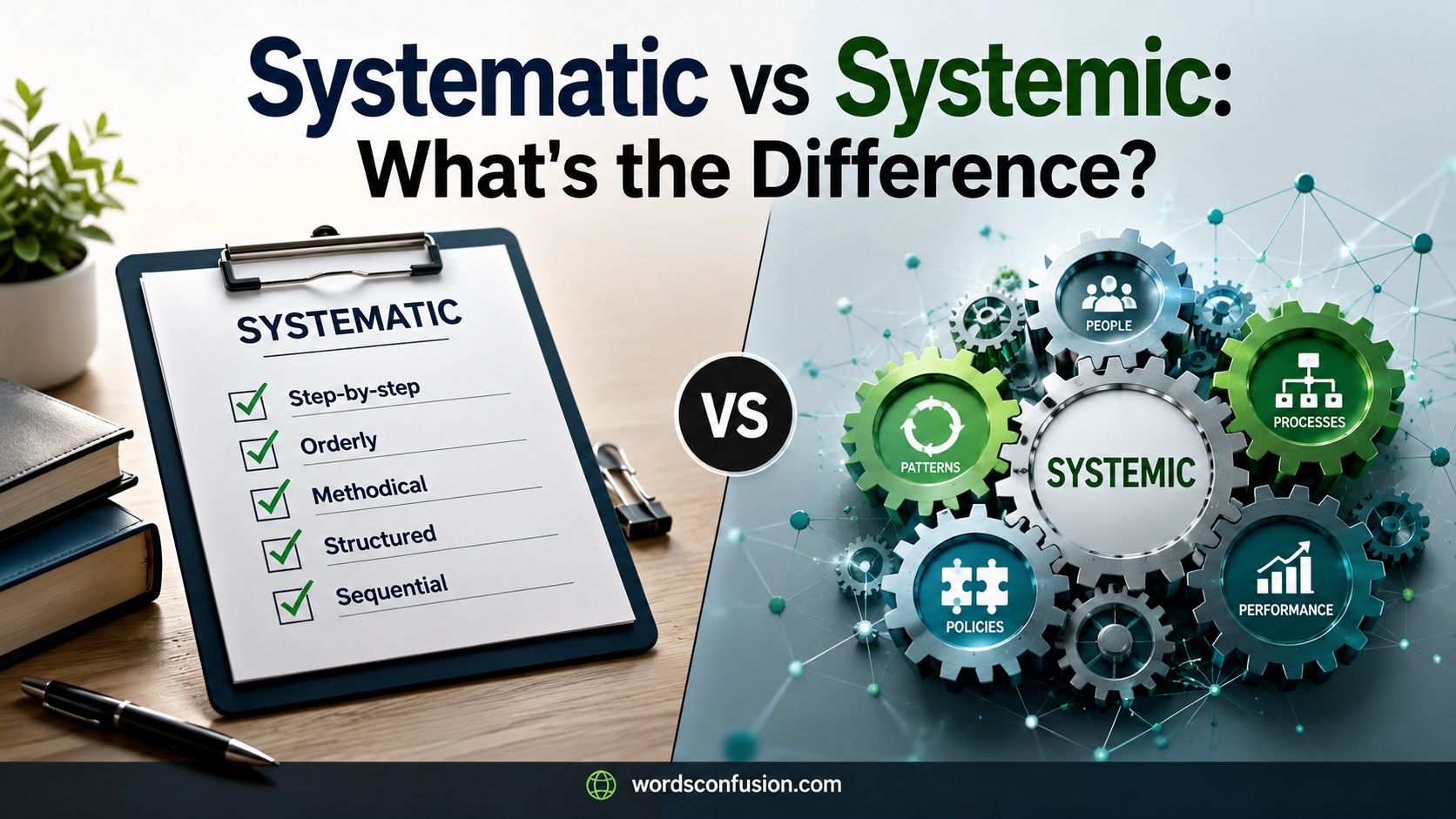
Many English words look almost identical yet carry completely different meanings. Systematic and systemic are perfect examples. At first glance, they differ by only two letters. However, those small differences create a major shift in meaning. If you use the wrong one, your sentence can communicate something entirely different from what you intended.
For example, saying a company has a systematic problem suggests the issue results from an organized or methodical process. Saying it has a systemic problem means the issue exists throughout the organization’s structure and affects the entire system. Those aren’t interchangeable ideas.
This confusion appears everywhere. Students encounter these words in textbooks, professionals use them in reports, journalists include them in news articles, and researchers rely on them in academic writing. Even native English speakers mix them up because both words come from the same root, system, and often appear in similar contexts.
The good news is that the distinction isn’t difficult once you understand the purpose of each word. One describes how something is done, while the other describes where a problem or condition exists.
This guide explains the meanings of systematic vs systemic in plain English. You’ll learn their definitions, origins, common uses, practical examples, memory tricks, and the situations where each word fits naturally. By the end, you’ll know exactly which one to choose with confidence.
Quick Answer
The difference between systematic and systemic is simple.
- Systematic means organized, methodical, or carried out according to a planned process.
- Systemic means affecting or relating to an entire system rather than one isolated part.
A simple memory trick makes the distinction easy:
- Systematic = Step-by-step
- Systemic = System-wide
Here are two examples:
- The scientist followed a systematic approach to analyze the data.
- The investigation uncovered systemic corruption throughout the organization.
| Word | Meaning | Easy Memory Trick | Example |
| Systematic | Organized and methodical | Step-by-step | A systematic review of research |
| Systemic | Affecting the whole system | System-wide | Systemic inequality affects many institutions |
If you’re talking about a process or method, choose systematic.
If you’re talking about a condition that spreads throughout an entire system, choose systemic.
What Does “Systematic” Mean?
Definition of Systematic
Systematic describes something done according to a clear plan or organized method. It emphasizes order, consistency, and careful execution rather than random action.
When someone works systematically, they don’t jump from one task to another. Instead, they follow logical steps until they reach a goal.
Most dictionaries define systematic as:
Performed according to a fixed plan, organized method, or structured system.
Think of a builder constructing a house. The builder doesn’t install the roof before laying the foundation. Every task follows a logical order. That’s a systematic process.
The Origin of “Systematic”
The word systematic comes from the Greek word systēma, meaning “organized whole” or “organized body.” It later entered Latin before becoming part of English during the seventeenth century.
Originally, the word described things arranged into an organized framework. Over time, its meaning expanded to include any activity completed through careful planning and logical progression.
Today, you’ll see systematic used across many fields, including:
- Scientific research
- Education
- Business management
- Engineering
- Healthcare
- Manufacturing
- Project management
Although these industries differ greatly, they all value structured methods over guesswork.
Characteristics of Something Systematic
A systematic approach usually shares several important qualities.
- It follows a logical sequence.
- Every step has a purpose.
- The process remains organized.
- Results can often be repeated.
- Planning happens before action.
- Decisions rely on evidence rather than chance.
- Progress can be measured.
Imagine cleaning an entire house.
A random approach might involve vacuuming one room, washing dishes, then suddenly cleaning windows before returning to vacuum another room.
A systematic approach would look different.
You might start upstairs, clean each bedroom, move to the bathrooms, continue downstairs, finish the kitchen, and end with the living room. Every task follows an organized sequence.
That’s exactly what systematic means.
Common Situations Where “Systematic” Appears
You’ll often encounter this word in situations involving organization and planning.
Research
Scientists collect data systematically to reduce bias and improve accuracy.
Education
Teachers use systematic instruction to help students master difficult concepts step by step.
Business
Companies create systematic procedures for hiring employees, managing inventory, and serving customers.
Healthcare
Hospitals develop systematic treatment protocols to ensure patients receive consistent care.
Technology
Software developers test applications systematically before releasing updates.
Examples of “Systematic” in Sentences
Here are examples that show the word used correctly.
- The detective conducted a systematic investigation of every room.
- Our marketing team developed a systematic plan for launching the product.
- She organized her notes using a systematic filing system.
- Engineers completed a systematic safety inspection before opening the bridge.
- The professor explained the topic through a systematic series of lectures.
- A systematic review combines findings from multiple research studies.
- The company introduced a systematic training program for new employees.
- Archaeologists documented every artifact using a systematic process.
- The editor performed a systematic review of the manuscript.
- Learning grammar becomes easier with a systematic study plan.
Notice something important.
Every sentence focuses on organization, planning, or method. None describe a condition affecting an entire organization or society.
Why a Systematic Approach Matters
People often associate systematic work with higher quality because it reduces mistakes.
Consider the difference between these two mechanics.
The first mechanic checks random parts whenever a customer complains.
The second follows a checklist every time.
- Inspect the engine.
- Test the battery.
- Check fluid levels.
- Examine brakes.
- Scan for diagnostic codes.
- Perform a road test.
The second mechanic works systematically, making it less likely they’ll overlook a problem.
The same principle applies in almost every profession.
| Field | Example of a Systematic Process |
| Medicine | Following treatment guidelines |
| Research | Collecting data using the same method |
| Education | Teaching concepts in logical order |
| Accounting | Reviewing financial records step by step |
| Manufacturing | Inspecting every product before shipping |
| Software Development | Testing each feature before release |
Common Collocations with “Systematic”
Certain word combinations appear frequently in everyday English.
- Systematic approach
- Systematic review
- Systematic analysis
- Systematic investigation
- Systematic process
- Systematic method
- Systematic search
- Systematic observation
- Systematic planning
- Systematic evaluation
Learning these phrases makes your writing sound more natural because native speakers use them regularly.
A Real-World Case Study
Imagine a hospital notices an increase in medication errors.
Instead of guessing the cause, administrators launch a systematic investigation.
They review patient records.
They interview nurses.
They examine prescription software.
They compare shift schedules.
They inspect medication storage.
They analyze every step involved in dispensing medicine.
After gathering evidence, they discover confusing package labels caused most errors.
Because the investigation followed an organized method, the hospital identified the root cause efficiently.
This is an excellent example of a systematic approach in action.
What Does “Systemic” Mean?
Definition of Systemic
Unlike systematic, systemic doesn’t describe a process.
Instead, it describes something that exists throughout an entire system.
A systemic issue isn’t isolated to one person, department, or location. It’s built into the structure itself or spreads across the whole system.
Most dictionaries define systemic as:
Relating to, affecting, or occurring throughout an entire system.
That system could be:
- A human body
- A business
- A government
- An education system
- A financial market
- A healthcare network
- Society itself
Whenever a condition affects the whole rather than one part, systemic is usually the correct word.
The Origin of “Systemic”
The word systemic also comes from the Greek word systēma, but English adopted it much later for a different purpose.
Doctors first used systemic to describe diseases that affected the entire body rather than a single organ.
For example, influenza is considered a systemic illness because it can affect multiple body systems instead of remaining confined to one location.
Over time, writers expanded the word into economics, politics, sociology, education, law, and business.
Today, it often describes deep-rooted problems that require structural change rather than simple fixes.
Characteristics of Something Systemic
A systemic issue usually has these characteristics:
- It affects an entire system.
- It isn’t limited to one isolated event.
- The problem often repeats.
- Individual fixes rarely solve it.
- Structural change is usually necessary.
- Multiple parts of the system contribute to the issue.
- The effects spread widely.
For example, imagine a school where only one classroom has broken computers.
That’s an isolated problem.
Now imagine every classroom lacks updated technology because the district hasn’t invested in equipment for years.
That’s a systemic problem because it affects the entire educational system rather than a single classroom.
What Does “Systemic” Mean?
Common Examples of Systemic Issues
The word systemic appears most often when discussing large-scale conditions or structural challenges. These issues usually can’t be solved by fixing just one part because the underlying problem affects the entire system.
Here are some common examples.
Healthcare
A systemic disease affects the whole body or multiple organs instead of remaining in one place.
Examples include:
- Diabetes
- Lupus
- Sepsis
- Hypertension
Doctors distinguish systemic diseases from localized diseases, which affect only one area of the body.
Business
A company may experience systemic management problems if poor communication, outdated policies, and weak leadership affect every department.
Hiring one new manager won’t solve the issue because the problem exists throughout the organization.
Government
Corruption can become systemic when dishonest practices spread across multiple agencies and become embedded in everyday operations.
Instead of involving a few individuals, the issue becomes part of the institution’s structure.
Education
A school district might face systemic educational challenges if outdated curricula, unequal funding, and limited teacher resources affect every school in the district.
Improving one classroom won’t eliminate the larger problem.
Finance
Banks and economists often discuss systemic risk, which refers to the possibility that one major financial failure could trigger widespread instability across the entire financial system.
The global financial crisis of 2008 demonstrated how interconnected modern financial institutions have become.
Read More: Sympathetic vs Empathetic: What’s the Difference? Meaning, Examples, and Correct Usage
Examples of “Systemic” in Sentences
These examples show how the word works in real-life contexts.
- The report identified systemic weaknesses in the company’s hiring process.
- Lawmakers proposed reforms to address systemic inequality.
- Doctors diagnosed the patient with a systemic autoimmune disease.
- The investigation revealed systemic corruption across several government departments.
- Cybersecurity experts warned about systemic vulnerabilities in critical infrastructure.
- The organization introduced major reforms after discovering systemic communication failures.
- Economists studied systemic financial risks following the banking crisis.
- The nonprofit focuses on solving systemic poverty rather than temporary hardships.
- Researchers examined systemic barriers to healthcare access.
- Leaders acknowledged that the company faced systemic cultural problems.
Notice the pattern.
Every sentence describes something that extends throughout an entire system rather than a single action or process.
Why Systemic Problems Are Difficult to Solve
One reason systemic issues receive so much attention is that they rarely have simple solutions.
Imagine a tree with yellow leaves.
You could paint the leaves green, but the tree would still be unhealthy if its roots lacked water or nutrients.
A systemic problem works the same way.
Treating only the visible symptoms may improve the situation temporarily. However, lasting improvement usually requires changes to the underlying system.
For example:
| Surface Problem | Possible Systemic Cause |
| High employee turnover | Poor workplace culture and ineffective leadership |
| Low student performance | Unequal funding, outdated resources, and inconsistent instruction |
| Frequent software failures | Weak development processes across the organization |
| Hospital delays | Staffing shortages and inefficient scheduling systems |
| Customer complaints | Company-wide quality control failures |
The visible problem is only one symptom. The root cause often lies deeper within the system.
Common Collocations with “Systemic”
Native English speakers frequently use these word combinations.
- Systemic change
- Systemic issue
- Systemic problem
- Systemic risk
- Systemic failure
- Systemic inequality
- Systemic racism
- Systemic corruption
- Systemic disease
- Systemic reform
Learning these expressions helps you recognize the word in newspapers, research papers, business reports, and everyday conversations.
Systematic vs Systemic: Side-by-Side Comparison
Although the words share the same root, they describe entirely different concepts.
| Feature | Systematic | Systemic |
| Core Meaning | Organized and methodical | Affecting an entire system |
| Focus | Process or method | Structure or whole system |
| Describes | How something is done | Where a condition exists |
| Typical Contexts | Research, education, business, planning | Medicine, economics, politics, sociology, business |
| Common Tone | Neutral or positive | Usually neutral or negative, depending on context |
| Memory Trick | Step-by-step | System-wide |
| Example | A systematic investigation | A systemic problem |
This table highlights the most important distinction.
Systematic focuses on method.
Systemic focuses on scope.
The Key Difference Between Systematic and Systemic
The easiest way to understand the difference is to ask yourself one question.
Are you describing a process or describing an entire system?
If you’re talking about a process, choose systematic.
If you’re talking about the entire system, choose systemic.
Consider these examples.
Correct:
- The scientist conducted a systematic review of previous studies.
- The company faced systemic management problems.
Now look at what happens if you switch the words.
Incorrect:
- The scientist conducted a systemic review.
- The company faced systematic corruption.
The first sentence sounds strange because a review is a methodical process, not something that affects an entire system.
The second sentence changes the meaning completely. It suggests the corruption was organized rather than deeply embedded throughout the organization.
Choosing the wrong word can confuse readers and weaken your writing.
When to Use “Systematic”
Use systematic whenever you’re discussing an organized process, structured method, or carefully planned approach.
You’ll commonly see it in academic writing, scientific research, business operations, education, and project management.
Choose systematic when talking about:
- Organized procedures
- Step-by-step methods
- Research techniques
- Data collection
- Business planning
- Learning strategies
- Quality assurance
- Problem-solving methods
- Investigations
- Reviews
Common Phrases with “Systematic”
These combinations appear frequently in professional writing.
- Systematic approach
- Systematic review
- Systematic analysis
- Systematic process
- Systematic observation
- Systematic planning
- Systematic testing
- Systematic evaluation
- Systematic search
- Systematic investigation
Example Scenario
A software company wants to eliminate bugs before launching a new app.
Instead of testing random features, developers create a checklist.
They test user accounts.
Then payment processing.
Then notifications.
Then security.
Then performance.
Every tester follows the same sequence.
That is a systematic testing process because it follows a structured method rather than relying on guesswork.
FAQs:
Is systemic the same as systematic?
No. Although the words look similar, they have different meanings. Systematic describes a methodical or organized process, while systemic describes something that affects an entire system. For example, a systematic review follows a structured research method, whereas a systemic problem exists throughout an organization or society.
How can I easily remember the difference between systematic and systemic?
A simple memory trick is:
- Systematic = Step-by-step
- Systemic = System-wide
If you’re describing how something is done, use systematic. If you’re describing where a problem or condition exists, use systemic.
Can a problem be both systematic and systemic?
Yes. A problem can be both. For example, a company might have systemic communication issues that affect every department. If managers investigate those issues using a systematic process, both words apply. Systemic describes the problem, while systematic describes the method used to solve it.
Is systemic always used for negative situations?
Not always, but it often is. People commonly use systemic to describe problems such as systemic inequality, systemic corruption, or systemic risk. However, the word itself is neutral. In medicine, for example, a systemic treatment simply means a treatment that works throughout the body.
What is the difference between systematic risk and systemic risk?
These are two different financial terms.
- Systematic risk is the market-wide risk that affects nearly all investments, such as inflation, interest rate changes, or recessions. Investors cannot eliminate it through diversification.
- Systemic risk is the risk that the failure of one financial institution or part of the financial system could trigger widespread instability across the entire economy.
Although the names are similar, they describe different types of risk and should not be used interchangeably.
Conclusion:
Understanding the difference between systematic vs systemic becomes much easier once you focus on what each word actually describes.
Use systematic when you’re talking about an organized, methodical, or step-by-step process. Whether you’re describing a research project, a business strategy, or a learning plan, the emphasis is on how something is done.
Use systemic when you’re describing something that affects an entire system. This could include a disease that spreads throughout the body, a structural issue within an organization, or a widespread challenge in society. Here, the emphasis is on where the condition exists and how.

Andrew Wilson is an experienced language researcher and content writer specializing in WordsConfusion topics. He helps readers understand commonly confused English words, spelling differences, grammar rules, word meanings, and proper usage through clear explanations, practical examples, and easy-to-follow language guides. His goal is to make English learning simple, accurate, and accessible for students, writers, professionals, and everyday learners.