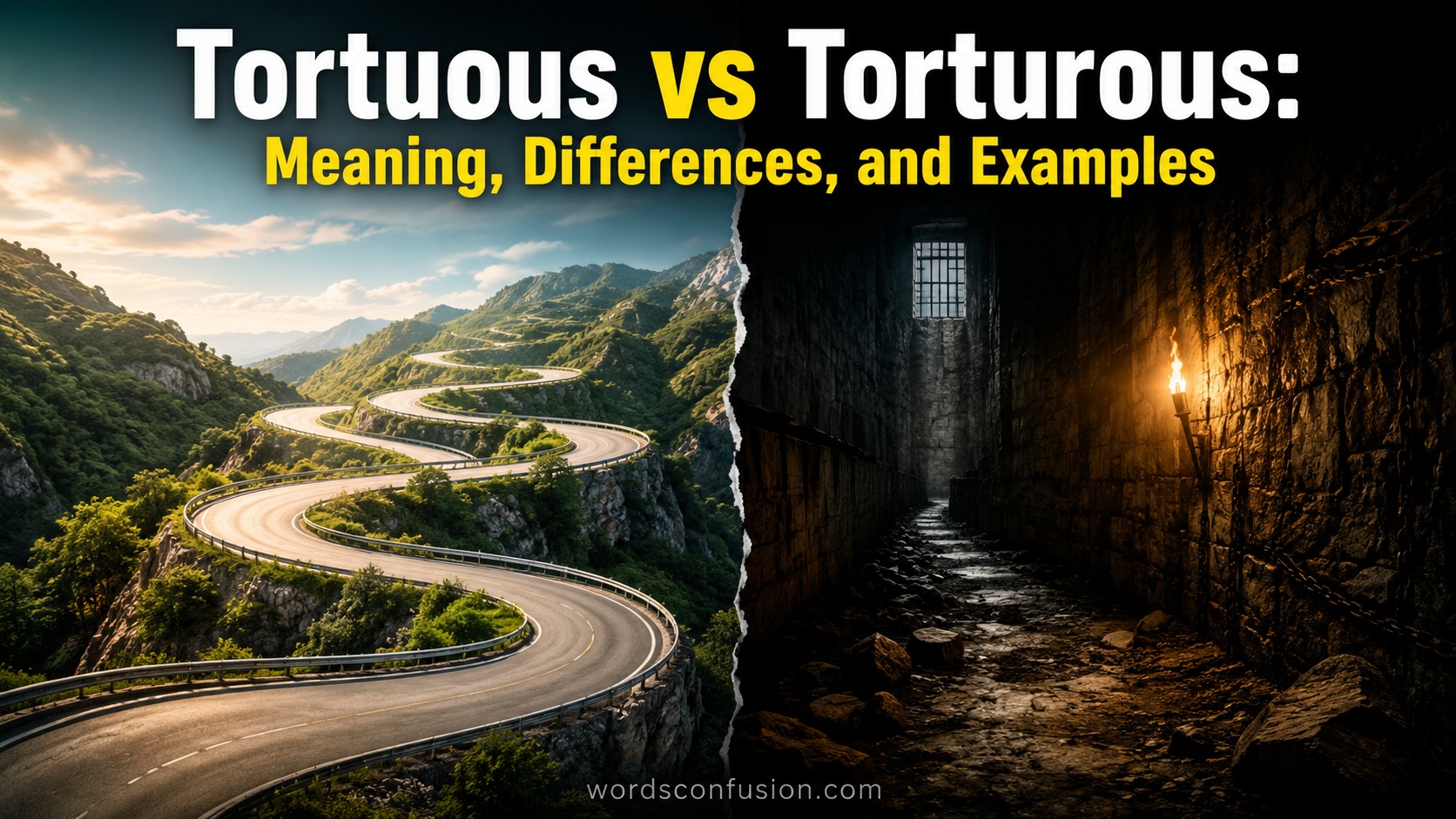
Learning English can feel like walking through a maze, especially when two words look almost identical but carry different meanings. Tortuous and torturous are perfect examples. They share similar spelling, have related origins, and even sound alike when spoken quickly. Because of this, many writers and speakers use them interchangeably even though they shouldn’t.
Understanding the difference between tortuous vs torturous will help you write more clearly and avoid a common vocabulary mistake. While one word describes something twisting, winding, or unnecessarily complicated, the other refers to something that causes great pain, suffering, or distress.
In this guide, you’ll learn what each word means, how to use it correctly, the key differences between them, common mistakes to avoid, memory tricks, examples from everyday English, and much more.
Quick Answer
The difference between tortuous and torturous is simple:
| Word | Meaning | Example |
| Tortuous | Full of twists, turns, or unnecessary complexity | The hikers followed a tortuous mountain trail. |
| Torturous | Causing severe pain, suffering, or mental anguish | Waiting for the medical results was torturous. |
Quick tip: If something is winding or complicated, use tortuous. If something is painful or agonizing, use torturous.
Tortuous vs Torturous at a Glance
| Feature | Tortuous | Torturous |
| Meaning | Twisting, winding, or complicated | Causing pain or suffering |
| Part of Speech | Adjective | Adjective |
| Describes | Roads, paths, reasoning, processes | Pain, experiences, emotions |
| Emotional Tone | Neutral or slightly negative | Strongly negative |
| Common Contexts | Routes, legal documents, explanations | Injuries, waiting, emotional hardship |
| Example | A tortuous route through the forest. | A torturous recovery after surgery. |
What Does “Tortuous” Mean?
Tortuous is an adjective that describes something with many twists, turns, bends, or unnecessary complexity. It often refers to physical paths, but writers also use it to describe ideas, arguments, or processes that are difficult to follow.
The word comes from the Latin tortuosus, which means full of twists. That origin explains why the word often suggests something winding rather than painful.
In modern English, tortuous can describe both physical and abstract things.
When to Use Tortuous
Use tortuous when talking about something that:
- Has many twists or curves
- Is difficult because it is complicated
- Follows an indirect path
- Is confusing to understand
- Takes unnecessary steps
Common Situations
Roads and Paths
A road with many sharp bends is tortuous.
Example
- The mountain road was so tortuous that drivers had to slow down at every corner.
Processes
Some procedures involve too many unnecessary steps.
Example
- The visa application followed a tortuous approval process.
Arguments
An explanation can become difficult to follow.
Example
- His tortuous reasoning confused everyone in the meeting.
Writing
Long, complicated writing often receives this description.
Example
- The legal document contained tortuous language that ordinary readers struggled to understand.
Examples of Tortuous in Sentences
- We drove along a tortuous coastal highway.
- The detective followed a tortuous chain of evidence.
- Her explanation became increasingly tortuous as she tried to justify her decision.
- The negotiations took a tortuous path before reaching an agreement.
- The hikers enjoyed the tortuous trail through the canyon.
What Does “Torturous” Mean?
Torturous is an adjective that means extremely painful, agonizing, or causing intense physical or emotional suffering.
Unlike tortuous, this word relates directly to the idea of pain. The word comes from torture, making its meaning much easier to remember.
A torturous experience doesn’t have to involve physical pain. Emotional stress, anxiety, or waiting can also feel torturous.
When to Use Torturous
Choose torturous when something causes:
- Physical pain
- Emotional suffering
- Mental stress
- Severe discomfort
- Agonizing experiences
Common Situations
Physical Pain
The word often describes injuries or medical conditions.
Example
- The athlete experienced torturous pain after the accident.
Emotional Suffering
Strong emotional distress also fits.
Example
- Losing a lifelong friend was a torturous experience.
Long Waits
Waiting can feel emotionally painful.
Example
- The final hour before the interview felt torturous.
Difficult Challenges
Some situations demand tremendous endurance.
Example
- Completing the race in extreme heat proved torturous.
Examples of Torturous in Sentences
- Recovery after the surgery was torturous.
- The endless delay became torturous for passengers.
- She endured a torturous divorce.
- The examination results took weeks to arrive, making the wait torturous.
- Climbing the final section of the mountain was torturous.
Tortuous vs Torturous: The Main Differences
Although the words differ by only two letters, their meanings are entirely different.
| Aspect | Tortuous | Torturous |
| Main Meaning | Twisting or complicated | Painful or agonizing |
| Connected to Pain | Rarely | Always |
| Connected to Complexity | Yes | No |
| Describes Places | Frequently | Occasionally |
| Describes Feelings | Sometimes | Very often |
| Best Keyword | Winding | Painful |
Think of it this way:
- A tortuous road has many bends.
- A torturous journey causes suffering.
One describes shape or complexity.
The other describes pain or hardship.
Why People Confuse Tortuous and Torturous
Many English learners—and even native speakers—mix up these words because they share several similarities.
Nearly Identical Spelling
Only two letters separate the words.
- Tortuous
- Torturous
That small spelling difference is easy to overlook while writing quickly.
Similar Pronunciation
The words sound remarkably alike in everyday conversation.
Unless someone emphasizes each syllable, listeners may not notice the difference.
Shared Latin Roots
Both words ultimately trace back to the Latin verb torquere, meaning to twist.
Over time, English developed two separate meanings:
- Tortuous kept the idea of twisting.
- Torturous evolved through torture, emphasizing pain and suffering.
Although they share historical roots, their modern meanings no longer overlap.
Similar Appearance in Writing
Because the words look so alike, many people assume they are simply spelling variations. They are not.
Each word has a distinct meaning, and using the wrong one can change the message of your sentence.
For example:
- The tortuous road climbed the mountain. ✓ Correct because the road twists and turns.
- The torturous road climbed the mountain. ✗ Usually incorrect unless the emphasis is that traveling on it caused intense suffering.
Understanding this distinction will make your writing clearer, more precise, and more professional.
How to Remember the Difference Between Tortuous and Torturous
Many people remember the meanings once they learn a simple association. Instead of memorizing dictionary definitions, connect each word to an easy mental image.
Memory Trick
Think about the extra letters in each word.
- Tortuous contains “UO”, which can remind you of a curving route.
- Torturous contains the word “torture,” so it relates to pain and suffering.
Another easy way to remember them is this:
- Twists = Tortuous
- Torture = Torturous
Visual Comparison
| If You’re Talking About… | Use This Word |
| A winding road | Tortuous |
| A confusing explanation | Tortuous |
| A painful injury | Torturous |
| A difficult recovery | Torturous |
| A complicated legal process | Tortuous |
| An agonizing wait | Torturous |
Practice Examples
Correct:
- The hikers followed a tortuous trail through the forest.
- The patient endured a torturous recovery after surgery.
Incorrect:
- The hikers followed a torturous trail.
- The patient endured a tortuous recovery.
The first sentence focuses on the shape of the trail, while the second focuses on the pain of recovery.
Tortuous vs Torturous Examples in Everyday English
Seeing these words in real situations makes the difference much easier to understand.
In Everyday Conversation
Tortuous
- Our GPS took us along a tortuous back road.
- The discussion followed a tortuous path before reaching a decision.
- His explanation was so tortuous that nobody understood it.
Torturous
- Waiting for the test results was torturous.
- The last ten minutes of the workout felt torturous.
- Recovering from the injury was absolutely torturous.
In Business Writing
Tortuous
- The approval process became increasingly tortuous.
- The contract contains tortuous legal language.
Torturous
- Employees described the extended negotiations as torturous.
- The software failure created a torturous week for the support team.
In Academic Writing
Researchers often use tortuous when discussing complicated reasoning or procedures.
Examples:
- The philosopher developed a tortuous argument.
- Scientists criticized the paper’s tortuous methodology.
In News Reports
Journalists frequently choose these words carefully.
Examples:
- Firefighters navigated a tortuous mountain road.
- Survivors recalled the torturous conditions they experienced.
In Creative Writing
Authors often use these adjectives to create vivid descriptions.
Tortuous
The river carved a tortuous path through the valley.
Torturous
Every second of silence became more torturous than the last.
Read More: Take vs Bring: Meaning, Differences, and Examples
Common Collocations
Certain nouns naturally pair with each word. Learning these combinations will make your English sound more natural.
Common Collocations with Tortuous
| Collocation | Example |
| Tortuous route | We took a tortuous route through the mountains. |
| Tortuous path | The river follows a tortuous path. |
| Tortuous journey | The expedition involved a tortuous journey. |
| Tortuous reasoning | His tortuous reasoning confused everyone. |
| Tortuous process | The application required a tortuous process. |
| Tortuous negotiations | The companies survived months of tortuous negotiations. |
| Tortuous explanation | She offered a tortuous explanation. |
Common Collocations with Torturous
| Collocation | Example |
| Torturous pain | He suffered torturous pain after the injury. |
| Torturous experience | Losing the match was a torturous experience. |
| Torturous wait | The torturous wait finally ended. |
| Torturous recovery | She faced a torturous recovery. |
| Torturous workout | Yesterday’s workout was torturous. |
| Torturous decision | Choosing between the two options felt torturous. |
| Torturous hours | The survivors endured torturous hours without help. |
Common Mistakes and How to Avoid Them
Many mistakes happen because writers choose the word based on spelling rather than meaning.
| Incorrect Sentence | Correct Sentence | Why? |
| The torturous road had many sharp turns. | The tortuous road had many sharp turns. | Roads twist. They don’t normally cause pain. |
| His torturous explanation confused everyone. | His tortuous explanation confused everyone. | The explanation is complicated, not painful. |
| Recovery was tortuous after surgery. | Recovery was torturous after surgery. | Recovery causes suffering. |
| We followed a torturous hiking trail. | We followed a tortuous hiking trail. | The trail winds through the hills. |
| The tortuous wait lasted three weeks. | The torturous wait lasted three weeks. | Waiting causes emotional pain. |
Tips to Avoid Confusion
- Ask yourself whether you’re describing shape or pain.
- If something winds or twists, choose tortuous.
- If something hurts or causes suffering, choose torturous.
- Read your sentence aloud. The correct word usually sounds more natural once you understand its meaning.
- Don’t rely on spelling alone. Focus on the context.
Tortuous vs Torturous in American and British English
One question many learners ask is whether these words have different meanings in American and British English.
The answer is no.
Both varieties of English use tortuous and torturous with the same meanings.
| Feature | American English | British English |
| Tortuous | Same meaning | Same meaning |
| Torturous | Same meaning | Same meaning |
| Spelling Difference | None | None |
| Pronunciation | Slight accent differences | Slight accent differences |
Although pronunciation varies slightly between regions, the definitions remain identical.
In both American and British English:
- Tortuous means winding or complicated.
- Torturous means painful or agonizing.
Because the meanings are consistent worldwide, you don’t need to learn separate rules for different English varieties.
FAQs:
Is tortuous the same as torturous?
No. Although the words look and sound similar, they have different meanings. Tortuous describes something that is winding, twisting, or unnecessarily complicated, while torturous describes something that causes great pain, suffering, or emotional distress.
Can a road be described as torturous?
Usually, no. A road with many bends and turns is tortuous. However, if traveling on that road causes extreme discomfort or hardship, you could describe the journey as torturous rather than the road itself.
Example:
- The tortuous mountain road challenged every driver.
- The eight-hour drive on that road was torturous because of heavy traffic and bad weather.
Which word should I use for a complicated process?
Use tortuous. It is the correct adjective for describing a process, explanation, argument, or procedure that is difficult to follow because it is overly complex or indirect.
Example:
- The company introduced a tortuous hiring process with too many approval steps.
Can torturous describe emotional pain?
Yes. Torturous often describes emotional suffering as well as physical pain.
Examples:
- Waiting for the exam results was torturous.
- Saying goodbye to her family was a torturous experience.
What’s the easiest way to remember the difference between tortuous and torturous?
A simple memory trick is:
- Tortuous = Twisting or complicated
- Torturous = Torture, pain, or suffering
If you’re talking about twists and turns, choose tortuous. If you’re talking about pain or agony, choose torturous.
Conclusion:
The difference between tortuous vs torturous becomes easy once you focus on the meaning instead of the spelling. Tortuous refers to something that is winding, twisting, or unnecessarily complicated, while torturous describes something that causes intense physical or emotional pain.
Although the two words share similar origins and appear almost identical, they are not interchangeable. A tortuous road twists through the mountains, whereas a torturous recovery involves pain and hardship. Choosing the correct word makes your writing more precise, professional, and easier to understand.
Whenever you’re unsure, ask yourself one simple question: Am I describing complexity or suffering? If the answer is complexity, use tortuous. If the answer is suffering, use torturous. With this simple rule and the examples in this guide, you’ll be able to use both words confidently in everyday conversations, academic writing, and professional communication.

Andrew Wilson is an experienced language researcher and content writer specializing in WordsConfusion topics. He helps readers understand commonly confused English words, spelling differences, grammar rules, word meanings, and proper usage through clear explanations, practical examples, and easy-to-follow language guides. His goal is to make English learning simple, accurate, and accessible for students, writers, professionals, and everyday learners.